
Cancer Immunotherapy Market Size and Forecast 2025–2033
How Immune-Based Therapies Are Redefining the Future of Global Cancer Treatment

Introduction: A New Era in Cancer Treatment
The global fight against cancer is entering a transformative phase, powered by rapid advances in immunotherapy. Once considered a niche or experimental approach, cancer immunotherapy has now become one of the most promising pillars of modern oncology. Unlike conventional treatments such as chemotherapy and radiation, which often attack both healthy and cancerous cells, immunotherapy works by empowering the body’s own immune system to recognize, target, and destroy cancer cells more precisely.
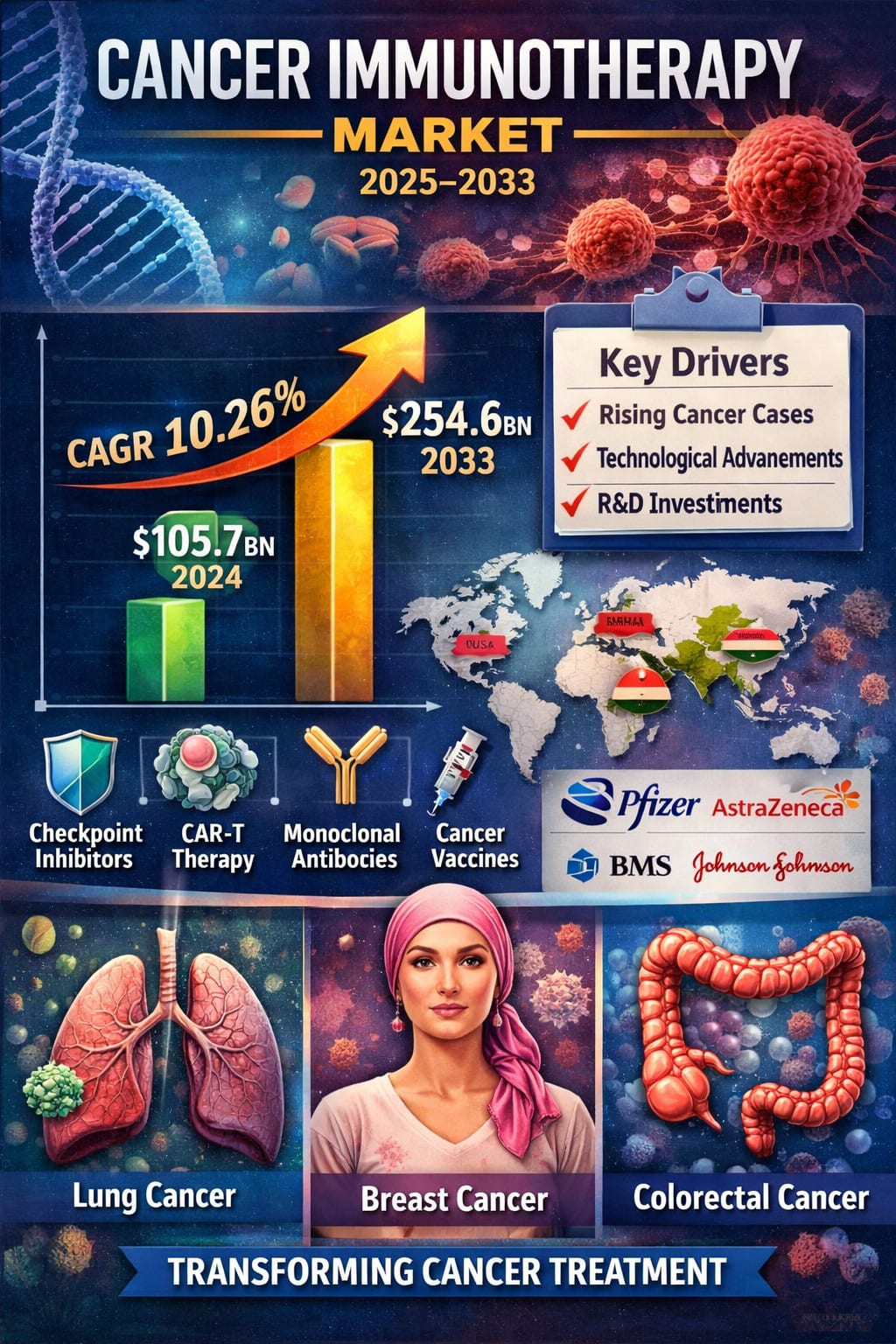
According to Renub Research, the Global Cancer Immunotherapy Market was valued at USD 105.7 billion in 2024 and is projected to reach USD 254.6 billion by 2033, expanding at a CAGR of 10.26% from 2025 to 2033. This remarkable growth reflects not only rising cancer incidence worldwide, but also increasing confidence among clinicians and patients in immune-based therapies that offer better survival outcomes and improved quality of life.
The market’s expansion is being driven by several factors: growing awareness of immunotherapy benefits, intensive research into targeted treatments, increasing healthcare investments, and continuous innovation across biotechnology and pharmaceutical industries. Together, these forces are reshaping the global oncology landscape.
Global Cancer Immunotherapy Market Overview
Cancer immunotherapy refers to a group of treatments that stimulate or restore the immune system’s ability to fight cancer. Instead of directly killing cancer cells like traditional therapies, immunotherapy enhances the body’s natural defenses. Some of the most widely used approaches include immune checkpoint inhibitors, CAR T-cell therapy, monoclonal antibodies, and cancer vaccines.
These therapies are now used across a broad range of cancers, including melanoma, lung cancer, breast cancer, colorectal cancer, bladder cancer, kidney cancer, and several blood cancers. Their ability to provide long-lasting responses, even in advanced or treatment-resistant cases, has significantly boosted their clinical adoption.
What makes immunotherapy especially compelling is its potential for durable remission. In many patients, the immune system “remembers” cancer cells, reducing the chances of relapse. This long-term benefit, combined with a more targeted mechanism of action, has positioned immunotherapy as a cornerstone of modern cancer care.
Pharmaceutical giants, biotechnology startups, and academic research centers worldwide are investing heavily in this field. As access improves and awareness grows, immunotherapy is no longer seen as an alternative—it is increasingly becoming a standard component of cancer treatment protocols.
Key Growth Drivers in the Cancer Immunotherapy Market
1. Rising Global Cancer Incidence
The growing global burden of cancer is one of the strongest drivers of demand for innovative treatments. Cancer remains one of the leading causes of death worldwide, and the number of cases continues to rise due to aging populations, lifestyle changes, and environmental factors.
Globally, an estimated 20 million new cancer cases and 9.7 million deaths occurred in 2022, with around 53.5 million people living within five years of a cancer diagnosis. Roughly 1 in 5 people will develop cancer during their lifetime. This immense disease burden is pushing governments, healthcare providers, and researchers to seek more effective and sustainable treatment options—making immunotherapy a critical area of focus.
2. Technological Advancements and Innovation
Rapid progress in biotechnology and immuno-oncology has dramatically improved treatment outcomes. Breakthroughs such as CAR T-cell therapy, immune checkpoint inhibitors, and next-generation monoclonal antibodies have changed the way many cancers are treated.
The integration of artificial intelligence into drug discovery and biomarker research is also accelerating the development of more precise therapies. These innovations not only improve survival rates but also help reduce relapse and tailor treatments to individual patients.
A notable milestone came in November 2024, when India became the third country after China and the U.S. to gain access to the next-generation PD-1 inhibitor Toripalimab, which demonstrated a 48% reduction in the risk of disease progression or death in nasopharyngeal carcinoma when combined with chemotherapy. Such developments highlight how innovation continues to expand the clinical and commercial potential of immunotherapy.
3. Increasing Research and Development Funding
Rising public and private investment in cancer research is another major growth engine. Governments, pharmaceutical companies, and biotech firms are pouring billions into preclinical studies, clinical trials, and regulatory approvals.
In April 2024, the Irish government allocated over €50 million for cancer treatment and €37.6 million for cancer research under its National Cancer Strategy. At the corporate level, companies such as Bayer AG, AstraZeneca, and ImmunoGen continue to strengthen the immunotherapy pipeline through partnerships and acquisitions. This expanding investment ecosystem is ensuring a steady flow of new products into the market.
Challenges Facing the Cancer Immunotherapy Market
High Cost of Treatment
Despite its clinical success, the high cost of immunotherapy remains a significant barrier, especially in developing countries. Advanced treatments like CAR T-cell therapy can cost hundreds of thousands of dollars per patient, limiting accessibility and putting pressure on healthcare budgets and insurance systems.
The high cost of R&D, complex manufacturing processes, and regulatory requirements all contribute to elevated prices. Inconsistent reimbursement policies across regions further complicate adoption, even when therapies demonstrate strong clinical value.
Variable Patient Response and Side Effects
Not all patients respond equally to immunotherapy. While some experience dramatic and lasting benefits, others see limited results or develop immune-related side effects such as inflammation, autoimmune reactions, or organ toxicity.
This variability makes it difficult to standardize treatment and underscores the need for better biomarkers and companion diagnostics. Personalized treatment strategies are becoming increasingly important to ensure that the right patients receive the right therapies at the right time.
Market Segmentation Insights
Cancer Immunomodulators Market
Cancer immunomodulators play a crucial role in enhancing the immune system’s ability to fight tumors. These include cytokines, interleukins, and interferons, which are widely used in melanoma and hematological cancers. Ongoing research aims to develop next-generation immunomodulators with higher efficacy and fewer side effects, supporting steady growth in this segment.
Cancer Monoclonal Antibodies Market
Monoclonal antibodies remain one of the most widely used forms of cancer immunotherapy. Drugs such as trastuzumab for breast cancer and rituximab for lymphoma have set clinical benchmarks. The growing availability of biosimilars is also improving affordability and access, especially in cost-sensitive markets, further expanding this segment’s reach.
Application-Based Market Trends
Lung Cancer Immunotherapy Market
Lung cancer is the leading cause of cancer-related deaths worldwide, and immunotherapy has become a frontline treatment, particularly for non-small cell lung cancer (NSCLC). Immune checkpoint inhibitors like pembrolizumab have significantly improved survival rates, making this one of the fastest-growing application segments.
Breast Cancer Immunotherapy Market
In breast cancer, especially triple-negative breast cancer (TNBC), immunotherapy is showing strong promise. Agents such as atezolizumab are being used in combination with chemotherapy, and ongoing clinical trials are expected to further expand treatment options in this high-need area.
Colorectal Cancer Immunotherapy Market
Immunotherapy has shown notable success in patients with MSI-H or dMMR colorectal cancer, using drugs like nivolumab and pembrolizumab. While challenges remain for broader patient populations, ongoing research is focused on overcoming resistance mechanisms and improving tumor immune response.
End-User Perspective: Cancer Research Centers
Cancer research centers are at the heart of immunotherapy innovation. Institutions such as MD Anderson Cancer Center, Dana-Farber Cancer Institute, and Institut Gustave Roussy are leading global efforts in clinical trials and translational research. Their collaborations with biotech and pharmaceutical companies are accelerating the journey from laboratory discovery to real-world treatment.
Regional Market Highlights
United States
The U.S. dominates the global cancer immunotherapy market due to its advanced healthcare infrastructure, strong R&D ecosystem, and supportive regulatory environment. In December 2024, the FDA approved AstraZeneca’s Imfinzi (durvalumab) for small cell lung cancer, reinforcing the country’s leadership in immuno-oncology adoption.
Germany
Germany’s market is driven by a strong pharmaceutical industry, extensive clinical research, and supportive reimbursement policies. In January 2025, Greenwich LifeSciences announced the opening of clinical sites in Germany for its Phase III breast cancer immunotherapy trial, highlighting the country’s role in global research.
India
India’s immunotherapy market is growing steadily due to rising cancer incidence and improving healthcare access. With over 14 lakh new cancer cases projected in 2023 and increasing government initiatives, India is emerging as an important market, especially with the growth of biosimilars and local manufacturing.
Saudi Arabia
Saudi Arabia is investing heavily in healthcare under its Vision 2030 program, with oncology as a priority. Expanding access to advanced treatments and partnerships with global pharma companies are supporting the adoption of immunotherapy in the region.
Market Segmentation Snapshot
By Product:
Monoclonal Antibodies
Immunomodulators
Cancer Vaccines
By Application:
Lung Cancer
Breast Cancer
Colorectal Cancer
Melanoma
Prostate Cancer
Head & Neck Cancer
Others
By End User:
Hospitals
Cancer Research Centers
Clinics
By Region:
North America, Europe, Asia Pacific, Latin America, Middle East & Africa, Rest of World
Key Players in the Global Market
Amgen Inc.
AstraZeneca
Bayer AG
Bristol-Myers Squibb Company
Pfizer Inc.
Novartis AG
Johnson & Johnson
Eli Lilly Company
Seattle Genetics Inc.
These companies are competing across innovation, clinical performance, global reach, and pipeline expansion, shaping the future of cancer treatment worldwide.
Final Thoughts
The global cancer immunotherapy market is no longer just a high-growth niche—it is rapidly becoming a central force in oncology. With the market projected to more than double from USD 105.7 billion in 2024 to USD 254.6 billion by 2033, the coming decade will likely see immunotherapy move even deeper into standard cancer care.
While challenges such as high costs and variable patient responses remain, continuous innovation, rising investment, and expanding global access are steadily overcoming these barriers. For patients, clinicians, and healthcare systems alike, immunotherapy represents not just a new treatment option, but a fundamental shift in how cancer is understood and fought.
About the Creator
Tom Shane
Tom Shane is a content writer specializing in SEO-driven blogs, product descriptions, and thought leadership. He crafts engaging, research-backed content that connects with audiences and drives results.
Vanguard FTSE Canadian High Dividend Yield Index ETF: Your Guide to Steady Income and Smart Investing
Investing can be simple if you choose the right tools. The Vanguard FTSE Canadian High Dividend Yield Index ETF is designed to provide steady income while helping your portfolio grow over time. Focusing on Canadian companies with consistent dividend payments, this ETF is a smart choice for investors who want reliable returns without constantly monitoring the market. They will break down how this ETF works and why it could fit perfectly into your investment strategy.
By John.doe7983 days ago in Trader


Comments
There are no comments for this story
Be the first to respond and start the conversation.