
China Hits 5% Growth Target in 2025 as Exports Power Economy Despite Trade Tensions
China meets its GDP target thanks to strong exports and a record trade surplus, despite weak consumer demand and property issues revealing deeper economic issues.
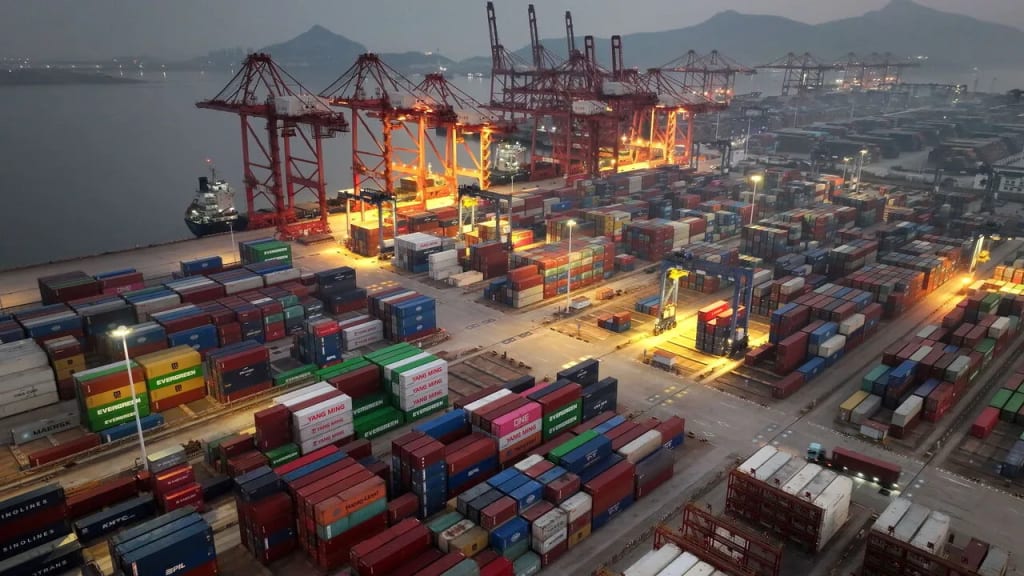
China’s national economy achieved its official 2025 growth target of about 5%, surprising some observers who expected renewed U.S. tariffs and internal structural weaknesses to slow the world’s second-largest economy significantly. GDP increased by 5.0% last year, in line with Beijing's stated goal and indicating resilience in the face of numerous obstacles, according to government data.
Yet a deeper look beneath the headline figures reveals a dual-track economy: a booming export machine on one hand, and persistent weakness in domestic demand on the other. Domestic consumption and investment slowed, raising concerns about the long-term viability of China's growth pattern, despite the fact that exports helped cushion external pressures such as the sharp rise in tariffs imposed by the US administration.
China's economic performance in 2025 was significantly influenced by the export sector. Despite the sharp drop in shipments to the United States as a result of increased tariffs, Chinese manufacturers reaped the benefits of strong demand from overseas markets. Export destinations expanded to compensate for the impact of U.S. barriers: shipments to Europe, Southeast Asia, Latin America, and Africa increased, bringing China's annual trade surplus to a record close to $1.2 trillion.
Some analysts claim that China's commercial reach was expanded as a result of Washington's aggressive trade strategy, which encouraged exporters to shift their focus toward alternative global markets. Economists at Bloomberg pointed out that the United States' efforts to "strongarm allies" into restricting Chinese goods may have inadvertently accelerated China's strategy of export diversification and strengthened trade ties with emerging economies.
Throughout 2025, industrial production remained resilient, with manufacturing and high-tech sectors maintaining growth despite a decline in domestic demand. High-tech exports, including electronics and machinery, showed particular strength, underscoring China’s effort to shift its industrial base up the value chain.
China's economy faces significant internal headwinds despite the export boom. Retail sales increased at modest rates of approximately 3.7%, while household consumption, which is a significant contributor to economic output, remained muted. In 2025, fixed-asset investment, a key indicator of corporate and government commitment to future growth, decreased by approximately 3.8%, indicating that businesses and local governments remain cautious. The real estate sector, traditionally a major engine of growth, continued its protracted slump: investment in residential property development dropped sharply, extending the downturn that began several years ago.
China's economy's broader structural issues are brought to light by the combination of sluggish consumption and falling investment. With domestic demand lagging, the reliance on exports for growth has increased, exposing the economy to global trade cycles and protectionist pressures. In addition, efforts to revive internal economic momentum are further complicated by demographic trends like a low birth rate and an aging population.
Although annual GDP hit its target, growth slowed toward the end of 2025. After growing at higher rates earlier in the year, growth slowed to 4.5 percent in the fourth quarter. This level represented the weakest quarterly growth in three years, indicating that the national economy may be losing momentum. Retail sales growth slowed in the final months of the year, making consumer confidence appear particularly fragile. Economists contend that unless policymakers implement more forceful measures to stimulate internal demand, this trend of softening will likely continue into 2026.
For the upcoming year, growth is expected to be around 4%, which is lower than historical averages but still within Beijing's comfort zone. Trade tensions with the United States continued to influence China’s economic calculations in 2025. Due to the severe tariffs that were reimposed as part of new protectionist policies, exports to the United States decreased by approximately 20%.
Through aggressive diversification of export markets and a truce in parts of the tariff war that eased the burden on key supply chains, China was able to mitigate the effects of these pressures. The adaptability of China's export-oriented sectors and China's evolving role in global commerce are emphasized by this resilience. But it also raises questions about whether continued reliance on foreign demand can offset inherent weaknesses in domestic consumption and investment over the long term.
The authorities in China have acknowledged these difficulties and reaffirmed their determination to strike a balance between growth and structural reform. Officials have stressed the need to "boost household consumption," strengthen social safety nets, and boost support for high-quality industries like green technologies and advanced manufacturing.
These efforts are part of a larger strategy to move China away from its past reliance on investment-driven expansion and toward a model that is more centered on consumption and innovation. Government stimulus programs — including appliance subsidies, consumer incentives, and support for small businesses — aim to provide a modest boost to internal demand, though analysts caution that more substantial policy measures may be needed to spark meaningful changes in consumer behavior.
Both an economic triumph and a cautionary tale can be drawn from China's achievement of its growth target for 2025. Even though domestic weaknesses and external pressures have slowed growth, fundamental imbalances persist beneath the surface.
The challenge will be to cultivate a "broader, more resilient growth model" that can maintain prosperity even if global trade conditions worsen or export demand declines as policymakers prepare for the next phase of economic planning. China's economic future is determined by its ability to strike a balance between export strength and domestic fragility. The manner in which it achieves this balance will influence global economic trends for many years to come.
About the Creator
Keep reading
More stories from Raviha Imran and writers in Trader and other communities.
SpaceMobile or Verizon? A High-Risk Decision Between Stability and Change
Due to the explosion of mobile data usage, the deployment of 5G, and emerging satellite broadband technologies, connectivity remains one of the stock market's most dynamic areas. Verizon Communications Inc. is one of many businesses vying for position. (VZ) and AST SpaceMobile Inc. (ASTS) has attracted a lot of interest from investors, but for very different reasons.
By Raviha Imran5 days ago in Trader
Australia Construction Market: Infrastructure Expansion, Urban Growth & Industrial Momentum
Australia Construction Market Overview The Australia construction market remains a key driver of economic activity, employment and long-term growth, reflecting robust investment in public infrastructure, residential building, commercial developments and industrial facilities. The Australia construction market size was valued at USD 420.5 Billion in 2025. Looking forward, the market is expected to reach USD 603.0 Billion by 2034, exhibiting a CAGR of 4.09% from 2026-2034. The market is driven by the growing government infrastructure spending, economic expansion, which is leading to the construction of commercial, residential, and mixed complexes, and advanced technologies and sustainability trends. This sustained expansion stems from government infrastructure programmes, urbanisation trends, rising housing demand, and private sector investment in commercial and industrial projects. As Australia positions itself for future growth, the construction sector continues to mirror economic resilience, evolving policy focus and the shift toward sustainable development.
By Amyra Singh6 days ago in Trader
How, Too
Many people wonder how, too. You are not alone, and I am an expert. I will teach you how, too! First, you need to remit a small application fee and fill out an application describing the nature of your financial situation and how often payments will be made, as this will have great bearing on how well I teach you how, too.
By Harper Lewis4 days ago in Fiction




Comments
There are no comments for this story
Be the first to respond and start the conversation.