
Australia Construction Market: Infrastructure Expansion, Urban Growth & Industrial Momentum
How rising public spending, housing demand and sustainability priorities are shaping Australia’s construction industry

Australia Construction Market Overview
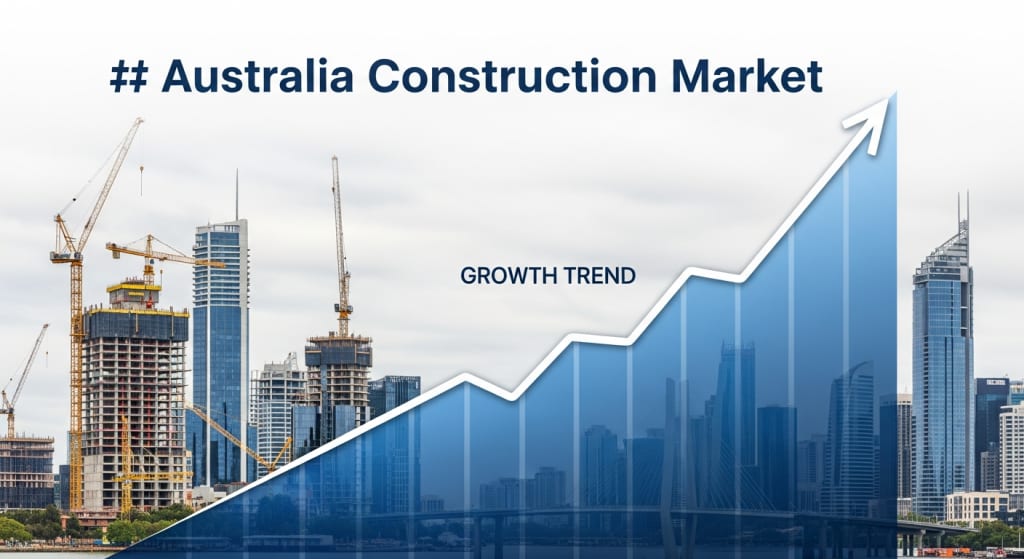
The Australia construction market remains a key driver of economic activity, employment and long-term growth, reflecting robust investment in public infrastructure, residential building, commercial developments and industrial facilities. The Australia construction market size was valued at USD 420.5 Billion in 2025. Looking forward, the market is expected to reach USD 603.0 Billion by 2034, exhibiting a CAGR of 4.09% from 2026-2034. The market is driven by the growing government infrastructure spending, economic expansion, which is leading to the construction of commercial, residential, and mixed complexes, and advanced technologies and sustainability trends. This sustained expansion stems from government infrastructure programmes, urbanisation trends, rising housing demand, and private sector investment in commercial and industrial projects. As Australia positions itself for future growth, the construction sector continues to mirror economic resilience, evolving policy focus and the shift toward sustainable development.
The construction market encompasses a wide range of activities — from building homes and commercial complexes to delivering transport networks, energy facilities, water infrastructure and environmental projects. Stakeholders across government, private developers, investors and communities closely monitor construction trends as they indicate broader economic health and long-term structural transformation.
What’s Driving Market Growth
Government Infrastructure Investment
Large-scale public infrastructure spending remains a cornerstone of the construction market. Federal and state governments are allocating significant capital toward transport corridors, road networks, bridges, rail systems, airports, hospitals, schools and utilities. These projects not only improve connectivity and public services but also stimulate economic activity through job creation, local supply chain engagement and increased material demand.
Residential Construction & Housing Demand
Population growth, urbanisation and household formation drive strong demand for residential construction. Major cities such as Sydney, Melbourne, Brisbane and Perth are witnessing continuous building activity across detached houses, multi-unit apartments, townhouses and mixed-use developments. Efforts to address housing affordability — including incentives for first-home buyers and streamlined planning approvals — further support residential project pipelines.
Commercial & Industrial Development
Demand for commercial and industrial spaces remains resilient as businesses expand operations, logistics networks modernise, and urban centres evolve. Office buildings, retail complexes, data centres, warehouses and manufacturing facilities are key contributors to construction output. The rise of e-commerce, supply chain restructuring and logistics efficiency imperatives are sustaining activity in industrial property construction.
Sustainable & Green Construction Practices
Environmental considerations and net-zero commitments are shaping construction strategies. Green building certifications, energy-efficient designs, renewable integration and sustainable material use are becoming mainstream. Developers and contractors increasingly adopt low-emission technologies, resilient designs and waste reduction practices aligned with environmental, social and governance (ESG) goals.
Request a Sample Report with the Latest 2026 Data & Forecasts
What the Opportunities Are
Affordable Housing & Urban Renewal Initiatives
With housing supply and affordability challenges persisting, there is strong opportunity for innovative housing solutions, public-private partnerships (PPPs) for affordable projects, modular housing technologies, and urban renewal programmes that revitalise existing city precincts while providing much-needed homes.
Sustainable Construction & Green Building Solutions
Investing in energy-efficient designs, renewable integration, low-carbon materials and sustainability certification frameworks can attract environmentally conscious buyers, reduce operational costs and support ESG mandates. Green construction not only aligns with climate goals but also appeals to institutional investors and global capital seeking sustainable assets.
Digital Construction & Industry 4.0 Technologies
Adopting digital tools such as building information modelling (BIM), 3D printing, drones, robotics and AI-enhanced project management can improve cost control, accelerate timelines and enhance quality. Digitalisation streamlines coordination, reduces rework, and supports data-driven decisions — driving efficiency across project lifecycles.
Infrastructure & Transport Network Upgrades
Continuing investment in transport infrastructure — including mass transit, road modernisation and smart mobility systems — presents long-term opportunities for contractors, material suppliers, civil engineers and technology providers involved in integrated infrastructure solutions.
Retrofitting & Adaptive Reuse Projects
Renovation of ageing infrastructure, heritage buildings and underutilised properties through adaptive reuse strategies can unlock value while meeting sustainability and functional needs. Retrofitting contributes to urban densification goals and provides opportunities for specialised construction capabilities.
Recent News and Developments in Australia Construction Market
Jul 2025: Federal and state governments jointly announced expanded funding for urban transport infrastructure, including rail upgrades, major bridge works and smart traffic systems — reinforcing long-term construction pipelines and regional connectivity improvements.
Sep 2025: Major developers reported increased pre-sales in residential apartment projects in key urban markets, indicating sustained buyer confidence and demand for multi-unit housing despite broader economic fluctuations.
Nov 2025: Industry analysts highlighted that green building certifications and energy-efficient construction practices recorded strong year-on-year growth, with developers and institutional investors prioritising sustainability metrics in project planning and financing decisions.
Why should You Know About Australia Construction Market?
You should know about this market because construction serves as a barometer of economic strength, infrastructure readiness and long-term investment confidence — reflecting demand across housing, industry, public services and modern facilities. The sector influences employment, material supply chains, urban landscapes and productivity while shaping how communities live, work and move.
For investors, the construction market presents exposure to diversified growth drivers including residential growth, infrastructure spending, commercial expansion, and sustainability-aligned assets. Construction technology, green building solutions and digital transformation create avenues for differentiation and value creation.
For developers, policymakers and industry stakeholders, understanding segmentation, demand drivers and innovation pathways supports strategic planning, risk management and capital allocation. In essence, the Australia construction market illustrates how economic structure, policy direction and consumer preferences converge — making it a foundational sector with wide-ranging impacts on national development and investment performance.
About the Creator
Amyra Singh
Market research analyst who loves spotting patterns, digging into data, and turning insights into strategies that help brands grow and stay ahead of the curve.
Keep reading
More stories from Amyra Singh and writers in Trader and other communities.
Australia Residential Real Estate Market: Housing Demand, Urban Growth & Market Dynamics
Australia Residential Real Estate Market Overview The Australia residential real estate market remains one of the most closely watched segments of the nation’s economy, given its critical role in household wealth, urban development, investment flows and housing supply. Residential real estate — encompassing houses, apartments, townhouses and multi-unit dwellings — reflects broader demographic changes, migration patterns, policy dynamics and consumer preferences. The Australia residential real estate market size was valued at USD 6.40 Trillion in 2025 and is projected to reach USD 7.99 Trillion by 2034, growing at a compound annual growth rate of 2.49% from 2026-2034. This growth illustrates sustained long-term demand, evolving lifestyle preferences and structural shifts that continue to influence housing markets across major cities and regional areas.
By Amyra Singh5 days ago in Trader
United States Interactive Whiteboard Market Size and Forecast 2025–2033
Introduction The United States is undergoing a significant transformation in how information is shared, taught, and collaboratively developed. From digital classrooms and university lecture halls to corporate boardrooms and remote work environments, interactive technologies are redefining traditional communication tools. Among these, interactive whiteboards (IWBs) have emerged as one of the most powerful and versatile platforms for enhancing engagement, productivity, and real-time collaboration.
By Marthan Sir3 days ago in Trader
Australia Faucet Market Flows Toward Strong Growth on Construction, Water Efficiency & Smart Tech Adoption
The Australia faucet market is experiencing a dynamic growth phase as consumer demand, regulatory momentum, and construction activities converge to drive broader adoption of modern plumbing fixtures. According to IMARC Group, the market was valued at USD 661.13 Million in 2025 and is expected to reach USD 1,142.71 Million by 2034, exhibiting a compound annual growth rate (CAGR) of 6.27% over 2026–2034.
By Rashi Sharma3 days ago in Trader


Comments
There are no comments for this story
Be the first to respond and start the conversation.