
SpaceMobile or Verizon? A High-Risk Decision Between Stability and Change
AST SpaceMobile's satellite ambitions vs. Verizon: Why income-focused investors may choose Verizon

Due to the explosion of mobile data usage, the deployment of 5G, and emerging satellite broadband technologies, connectivity remains one of the stock market's most dynamic areas. Verizon Communications Inc. is one of many businesses vying for position. (VZ) and AST SpaceMobile Inc. (ASTS) has attracted a lot of interest from investors, but for very different reasons.
While one is a disruptive newcomer pursuing satellite-based connectivity for underserved regions, the other is a telecom heavyweight with steady cash flows and dividends. For investors weighing connectivity opportunities in 2026, it is essential to comprehend each stock's strengths, risks, and investment narratives. For a number of years, income-oriented portfolios have relied heavily on Verizon, one of the largest U.S. telecommunications carriers. Cash flow from the company's extensive wireless footprint and legacy copper and fiber networks enables dividend payments and ongoing investments in network upgrades.
Verizon has invested a lot of money over the past few years to improve its "5G coverage" and "service quality," putting it in a better position to satisfy both consumer and business demand for faster, more dependable connectivity. Investors are drawn to Verizon because of its "predictable revenue base" and "attractive dividend yield." Companies like Verizon have frequently acted as defensive plays when growth stocks face volatility or economic slowdown. They benefit from recurring subscription revenue — from monthly phone plans, fixed broadband, and business services — that tends to be less cyclically sensitive than other tech segments.
Moreover, Verizon’s leadership in mid-band 5G deployment — especially following spectrum acquisitions and network densification efforts — has improved its competitive positioning against rivals like AT&T and T-Mobile. Verizon's expanded footprint enables it to provide superior performance that resonates with both consumers and enterprise customers, and mid-band spectrum offers an ideal balance of coverage and speed. Verizon is a compelling investment for long-term investors due to its combination of dividends, scale, and cash flow, which makes it less volatile than pure growth stocks and offers steady returns.
However, analysts acknowledge other drawbacks, such as high capital expenditures for infrastructure upkeep and expansion, pressure on ARPU in highly competitive markets, and structural stagnation of telecom growth rates in developed markets. At the other end of the risk–reward spectrum sits AST SpaceMobile, a company banking on a bold vision: expanding broadband connectivity from space using satellites that can link directly to existing mobile phones without requiring specialized hardware.
Theoretically, AST SpaceMobile has the potential to provide service to millions of people in underserved, rural, and remote areas—markets that traditional terrestrial networks find unprofitable to serve. The company's idea is based on a group of low Earth orbit (LEO) satellites designed to serve as flying cell towers and bridge the gap between satellite broadband and terrestrial networks, which typically require dishes. The technology has the potential to position ASTS as a growth disruptor in the global wireless market, which is worth $600 billion.
However, execution risk continues to be extremely high. The satellite broadband stock has been hit hard in recent trading, according to the Yahoo Finance piece on ASTS. The stock has lagged other markets and investors have doubted its commercialization timeline. While ASTS has secured partnerships with carriers such as Vodafone, skeptics point to the long, capital-intensive path ahead — including regulatory approvals, satellite launches, ground integration, and customer adoption.
As is typical of speculative growth stocks, AST SpaceMobile is valued based on future potential rather than current revenue or profitability. ASTS presents an opportunity for investors with a high tolerance for risk and a belief in the role that space-based connectivity will play in the future. However, it also carries the risk of significant downside if execution fails or if competing technologies (such as terrestrial 5G or other LEO broadband players) dominate the market first.
The stability of Verizon's earnings, dividends, and mature business model with clear cash flow are what draw customers in. Investors looking for income and lower volatility, particularly in uncertain economic conditions, will benefit more from this stock. AST SpaceMobile, by contrast, represents high-risk, high-reward growth exposure to a frontier technology. The ambitious objectives of integrating satellites with widespread consumer adoption and carrier ecosystems are crucial to its success. ASTS attracts retail and institutional investors who are able to tolerate volatility and invest over a long period of time.
From a valuation perspective, telecom giants like Verizon frequently trade at multiples that are related to earnings and cash flow. On the other hand, speculative growth plays like ASTS are valued more on their promise for the future than on the facts of the present. Because of this divergence, Verizon's earnings stability and dividend sustainability, as well as ASTS's launch milestones, partnership announcements, and technological validation, may be the catalysts for short-term price movements. The decision between Verizon and AST SpaceMobile comes down to "risk tolerance," "investment horizon," and "strategic preference." There is no one right answer.
Verizon might be a good choice for investors who want stability and a steady income, especially since telecommunications are still essential to everyday connectivity. If they are willing to navigate price swings and execution uncertainty, those with a long-term perspective on space-based technology and disruptive growth may find ASTS's vision appealing. In a world where connectivity is increasingly mission-critical, both companies play roles in shaping the future: Verizon through incremental innovation and network expansion, and AST SpaceMobile by challenging traditional paradigms of how and where wireless service can be delivered.
Some investors may even choose to hold both for balanced portfolios, capturing Verizon's income and stability while allocating a smaller, speculative position to AST SpaceMobile's disruptive potential. The connectivity landscape in 2026 promises both steady yields and frontier growth, which is a combination that modern tech portfolios should take into consideration.
About the Creator
Keep reading
More stories from Raviha Imran and writers in Trader and other communities.
NASA Conducts First-Ever Medical Evacuation From ISS, Bringing Crew-11 Astronauts Back to Earth Early
NASA and SpaceX successfully carried out the first medical evacuation from the International Space Station (ISS), bringing four astronauts safely back to Earth earlier than planned following a medical issue aboard the orbital lab. This was a historic moment for human spaceflight. The Crew-11 mission, which had been operating on the ISS for more than five months, abruptly came to an end when one of the astronauts developed a medical condition that couldn't be fully diagnosed or treated in space. This forced NASA to bring the entire crew back to Earth for comprehensive care.
By Raviha Imran2 months ago in Trader
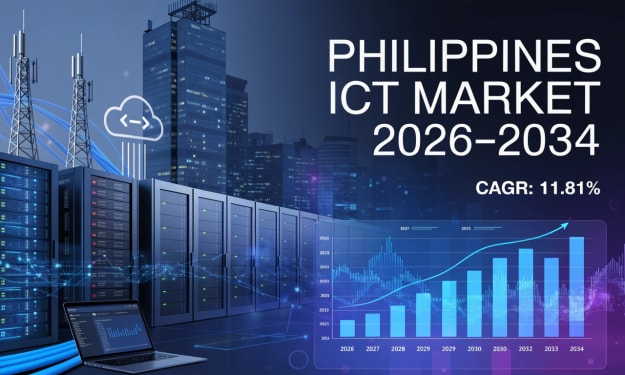
Philippines ICT Market 2026: Digital Infrastructure Expansion, Cloud Adoption and Connectivity Transformation
Philippines ICT Market Overview The Philippines information and communication technology (ICT) market is experiencing strong expansion as digital transformation accelerates across government, enterprise and consumer ecosystems. ICT encompasses telecommunications, IT services, cloud computing, data infrastructure and digital platforms that collectively power the country’s digital economy. With rising internet penetration, growing outsourcing capabilities and increasing demand for advanced connectivity solutions, ICT has become a central pillar of economic modernisation and innovation in the Philippines.
By Manisha Dixit6 days ago in Trader



Comments
There are no comments for this story
Be the first to respond and start the conversation.