
Verdict at Uvalde: Jury Clears Former School Officer in Landmark Trial
First criminal case tied to the Robb Elementary tragedy ends in acquittal, reopening painful questions about accountability and public trust

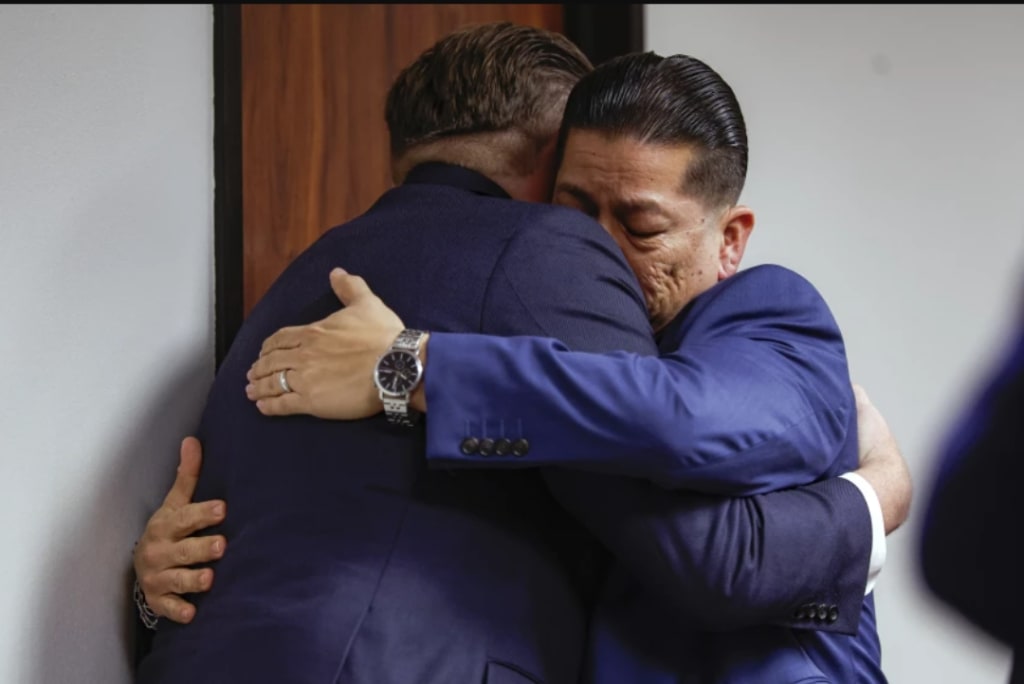
The first criminal trial connected to the Robb Elementary School shooting in Uvalde, Texas has ended with a verdict that is already reverberating far beyond the courtroom. A jury has acquitted a former Uvalde school police officer who faced charges related to his response during the 2022 mass shooting that killed 19 children and two teachers.
The decision marks a pivotal — and deeply emotional — moment for a community still grappling with trauma, grief, and unanswered questions about how law enforcement responded to one of the deadliest school shootings in U.S. history.
A Trial Watched by the Nation
The case drew national attention because it was the first criminal prosecution of a law enforcement officer tied to the Uvalde shooting. Prosecutors argued that the officer’s actions — or lack of action — endangered children during the critical moments of the attack. The defense, however, maintained that the officer followed training protocols, lacked command authority, and was unfairly singled out for systemic failures that went far beyond one individual.
After hearing days of testimony, reviewing body-camera footage, and weighing expert opinions, jurors ultimately found insufficient evidence to support criminal liability, delivering a not-guilty verdict on all charges.
What the Jury’s Decision Means
The acquittal does not mean the officer’s actions were flawless, nor does it erase the documented failures of law enforcement during the shooting. Instead, the verdict reflects the high legal threshold required for criminal conviction, particularly when evaluating split-second decisions made during chaotic emergencies.
Legal experts say the case highlighted a difficult reality:
Criminal law requires proof beyond a reasonable doubt
Poor judgment or flawed training does not automatically equal a crime
Responsibility can be spread across institutions, not just individuals
For jurors, the question was not whether mistakes were made — but whether those mistakes rose to the level of criminal conduct under Texas law.
Families React with Pain and Frustration
For many families of the victims, the verdict was devastating. Parents and relatives expressed anger, disappointment, and heartbreak, saying the acquittal felt like another failure in a long chain of institutional breakdowns.
Some families hoped the trial would bring a sense of accountability, even if limited. Instead, the outcome has reinforced fears that no one will ever be held criminally responsible for the delayed response that allowed the gunman to remain inside the classroom for more than an hour.
Community advocates stress that while the legal case has concluded, the emotional and psychological wounds remain open.
Defense: A Scapegoat for Systemic Failure?
The defense argued throughout the trial that the officer was being used as a symbolic scapegoat for a much broader collapse in command, communication, and leadership among multiple agencies at the scene.
Testimony revealed confusion over who was in charge, inconsistent radio communication, and unclear active-shooter protocols — issues that investigators have repeatedly identified since the shooting.
From this perspective, the acquittal reinforces the idea that systemic reform, not individual prosecution, is the more appropriate response to the tragedy.
Broader Impact on Law Enforcement Accountability
The verdict raises complex questions about how — or whether — criminal courts are the right venue to address failures in emergency response. Civil lawsuits, policy reforms, and federal investigations may still offer avenues for accountability, but the criminal path has now proven challenging.
Experts warn that future prosecutions of officers for inaction during mass shootings will likely face similar obstacles unless laws are rewritten to clearly define legal duties to act in such scenarios.
At the same time, critics argue that without criminal consequences, meaningful change may be slow or symbolic at best.
Uvalde Community Still Searching for Closure
For Uvalde, the trial’s end does not signal closure. The town continues to live with the consequences of the shooting — from ongoing investigations to debates over school safety, police training, and public transparency.
Memorials remain active, families continue to advocate, and community leaders say the focus must now shift to preventing future tragedies, rather than relitigating the past alone.
The acquittal may close one legal chapter, but it opens new conversations about responsibility, preparedness, and trust between communities and law enforcement.
What Comes Next
While this criminal case has ended, other legal and policy efforts tied to the Robb Elementary shooting are still unfolding. Civil lawsuits, internal disciplinary reviews, and legislative proposals aimed at improving active-shooter response protocols remain in progress.
The verdict also sends a message to lawmakers: if accountability is the goal, laws and training standards may need to change, not just enforcement of existing rules.
Conclusion
The jury’s decision to acquit the former Uvalde school officer underscores the limits of criminal law in addressing complex institutional failures. For families, the outcome feels like justice delayed — or denied. For legal observers, it reflects the difficulty of assigning criminal blame in moments defined by confusion and breakdown.
What remains undeniable is the tragedy itself and the responsibility to ensure it never happens again. As Uvalde continues its long road toward healing, the community — and the nation — is left to confront a painful question: If not here, then where does accountability begin?
About the Creator
Asad Ali
I'm Asad Ali, a passionate blogger with 3 years of experience creating engaging and informative content across various niches. I specialize in crafting SEO-friendly articles that drive traffic and deliver value to readers.
Trump Says UK Handing Over Chagos Islands Sovereignty Is an Act of “Great Stupidity”
The debate over the future of the Chagos Islands has reignited global political discussion after former U.S. President Donald Trump sharply criticized the United Kingdom’s decision to hand over sovereignty of the archipelago. Calling the move an act of “great stupidity,” Trump’s remarks have once again placed the strategically important islands at the center of international geopolitics, colonial legacy debates, and security concerns in the Indian Ocean. A Brief History of the Chagos Islands The Chagos Archipelago, located in the central Indian Ocean, has long been a point of contention. Administered by Britain since the 19th century, the islands were separated from Mauritius in 1965, just before Mauritius gained independence. This separation laid the groundwork for decades of legal and political disputes. The most prominent island, Diego Garcia, hosts a major U.S.-UK military base that plays a critical role in regional security operations. Over the years, international pressure has mounted on the UK to resolve the sovereignty issue. In 2019, the International Court of Justice issued an advisory opinion stating that Britain’s continued administration of the islands was unlawful and that the territory should be returned to Mauritius. Although the ruling was non-binding, it significantly shifted global opinion against London’s position. Trump’s Strong Reaction Donald Trump’s condemnation of the UK’s decision reflects his long-standing emphasis on hard power, military strategy, and national interest. From Trump’s perspective, relinquishing control of the Chagos Islands risks undermining Western security interests, particularly those of the United States. Diego Garcia has been vital for military logistics, intelligence gathering, and operations in the Middle East and Asia. Trump’s statement suggests that he views the handover as a concession that weakens strategic dominance rather than a step toward correcting historical injustice. His use of blunt language aligns with his broader political style—direct, confrontational, and dismissive of international institutions that prioritize legal or moral arguments over strategic considerations. Britain’s Rationale for the Decision The UK government, however, sees the issue through a different lens. Handing over sovereignty is framed as an effort to comply with international law, repair diplomatic relations, and finally address a colonial-era dispute that has lingered for decades. British officials have emphasized that any transfer would include guarantees ensuring continued military access to Diego Garcia, preserving its role as a defense hub. This approach reflects a shift in British foreign policy toward rule-based international cooperation and post-colonial reconciliation. For London, the decision is not about abandoning security interests but modernizing diplomacy in a changing global order. Strategic and Global Implications The controversy highlights the tension between geopolitics and international law. Supporters of the handover argue that respecting court rulings strengthens global norms and enhances the UK’s moral credibility. Critics, including Trump, warn that such moves may embolden rival powers by signaling weakness or indecision. The Indian Ocean is increasingly important as global trade routes expand and strategic competition intensifies. Any change in control over key locations like the Chagos Islands inevitably draws scrutiny from major powers. While Mauritius has pledged to maintain security cooperation with the UK and the U.S., skeptics remain unconvinced that long-term strategic interests can be fully safeguarded. The Human Dimension Often overlooked in the geopolitical debate is the fate of the Chagossian people, who were forcibly displaced from the islands in the 1960s and 1970s to make way for the military base. For many, the sovereignty transfer represents a long-awaited acknowledgment of historical injustice. Trump’s remarks, focused solely on strategic calculations, contrast sharply with this humanitarian perspective. The situation underscores a broader global reckoning with colonial legacies, where nations are increasingly challenged to balance strategic priorities with ethical responsibility. A Debate Far from Over Trump’s criticism ensures that the Chagos Islands will remain a contentious issue, particularly in transatlantic political discourse. His comments resonate with those who prioritize military strength and geopolitical realism, while others see the UK’s move as a necessary step toward justice and international legitimacy. As the handover process unfolds, the world will be watching closely to see whether security assurances hold and whether this decision becomes a model for resolving other colonial-era disputes—or a cautionary tale, as Trump suggests. One thing is certain: the Chagos Islands are no longer a quiet corner of the map. They have become a symbol of the complex choices modern nations face when history, law, and power collide.
By Fiaz Ahmed Brohi3 days ago in The Swamp
Trump Announces Tariffs on European Countries Opposing Greenland Takeover
In a move that has reignited global debate and unsettled international markets, former U.S. President Donald Trump has announced the possibility of imposing new tariffs on European countries that oppose what he describes as America’s “strategic interest” in Greenland. The statement, delivered during a recent political rally and later reinforced through campaign surrogates, has once again placed Greenland, European unity, and transatlantic trade relations at the center of global attention.
By Aqib Hussain5 days ago in The Swamp
How, Too
Many people wonder how, too. You are not alone, and I am an expert. I will teach you how, too! First, you need to remit a small application fee and fill out an application describing the nature of your financial situation and how often payments will be made, as this will have great bearing on how well I teach you how, too.
By Harper Lewis6 days ago in Fiction

Comments
There are no comments for this story
Be the first to respond and start the conversation.