
Utah planning Trump-inspired concentration camp for homeless people
$46 million faclity would shelter more than1,000 people


The state of Utah plans to build a $46 million homeless detention camp where unhoused people could be detained against their will and forced to work.
In an interview with Sam Deder’s The Majority Report, Jesse Rabinowitz of the National Homeless Law Center said the plan “should send chills up everyone’s spine.” He went on to say Utah’s plan for the camp was “inspired by the Trump administration’s attacks on homeless people” and that it will be “the largest government run detention camp for homeless people.”
Indeed, during his campaign Trump frequently spoke of creating such camps on the outskirts of cities to warehouse people experiencing homelessness. But how could this legally occur?
Rabinowitz said The Cicero Institute, a think tank funded by billionaires, already has worked to pass laws in states criminalizing homelessness. Utah has a law on the books that says you can’t live outside, Rabinowitz explained. “Your choice is to go to jail or a detention camp, and those aren’t real choices.” He added that “billionaires should be the last people in this country shaping homelessness policy” and said the camp takes money away from solutions that do solve homelessness, such as housing. “At no time in history has rounding people up and forcing people to live in camps been a good thing.” He likened it to forced placements in mental institutions around the turn of the 20th century and debtor’s prison. “We have to stem the flow of people into homelessness and that requires fundamentally reshaping our profit-driven housing system,” Rabinowitz said.

State of Utah offers hopeful picture for site
On its website, the state of Utah describes the camp in much gentler terms than Rabinowitz. The state calls it “reimagining hope” and “a groundbreaking new undertaking—a transformative campus—to help those experiencing homelessness rebuild their lives.”
According to a statement on the website, the camp will be on almost 16 acres on the outskirts of town. The facility will contain 1,300 beds. “Despite tremendous effort, resources, and goodwill across the state, homelessness in Utah has continued to worsen—for both those experiencing it and for our communities,” said Randy Shumway, chair of the Utah Homeless Services Board, in the statement. “The proposed Utah campus will take a human-first approach that provides healing and stability while embedding accountability at every stage. By pairing compassionate support and medical care with clear expectations and opportunities for growth, the campus will help individuals reclaim their inherent dignity, achieve self-reliance, and live drug-free, crime-free, and contributing lives.”According to the statement, a feasibility study has been completed and environmental studies are ongoing. “The next steps are to secure funding partnerships, continue to engage with community stakeholders, service providers, and state leaders to bring the campus to actualization,” the statement explains. It is anticipated that the initial operations of the campus will begin in 2027.
"Our state has long needed more shelter beds and services, and this campus represents a critical step forward in supporting the most vulnerable people in our communities,” said Salt Lake City Mayor Erin Mendenhall. “By providing consistent shelter and wraparound services in one location, this facility could also help Salt Lake City first responders by reducing the number of emergency calls, freeing up law enforcement to focus on public safety, and better connecting people to the help they need.”
A homeless shelter or ‘accountability center?’
On its website, the state of Utah describes the camp in much gentler terms than Rabinowitz. The state calls it “reimagining hope” and “a groundbreaking new undertaking—a transformative campus—to help those experiencing homelessness rebuild their lives.”

According to a statement on the website, the camp will be on almost 16 acres on the outskirts of town. The facility will contain 1,300 beds. “Despite tremendous effort, resources, and goodwill across the state, homelessness in Utah has continued to worsen—for both those experiencing it and for our communities,” said Randy Shumway, chair of the Utah Homeless Services Board, in the statement. “The proposed Utah campus will take a human-first approach that provides healing and stability while embedding accountability at every stage. By pairing compassionate support and medical care with clear expectations and opportunities for growth, the campus will help individuals reclaim their inherent dignity, achieve self-reliance, and live drug-free, crime-free, and contributing lives.”

According to the website of Freedom United, which works to end modern slavery, over 300 beds at the center would be for involuntary commitment. Others would be “an alternative to jail,” as Shumway called it, and an “accountability center” where people could be sanctioned there for about 90 days to detox and receive care. According to an article on the Common Dreams website, a non-profit publication, the center will use beds not slated for civil commitment for “work-conditioned housing,” said Eric Tars of the National Homelessness Law Center. He said that this is “the thing that scares me the most,” because it “means forced labor.”
According to Common Dreams, Tars noted that other anti-homeless bills recently proposed in Republican states have a “forced labor element” to them. In Louisiana, a bill punishing outdoor camping introduced earlier this year proposes requiring those convicted to serve up to two years of “hard labor.” Another bill introduced in West Virginia would have required those arrested for camping to take part in “facility upkeep” and other forms of vocational training.
Rabinowitz: 'Deeply unsettling and unethical'
Rabinowitz said forcing people into institutions is “deeply unsettling and unethical.”
In an ABC4 report, the Salt Lake City station quoted Joseph Grenny, founder of the Other Side Village, as saying the camp should include “involuntary detention” of unsheltered individuals. “I don’t think we need 1,300 beds, I think we probably need a much smaller number,” he said. “What we probably need is a set where people can be involuntarily detained, when necessary.”
He added: “We need to hold people accountable, [even] if that means involuntary detention for a period of time. There needs to be a location where [they are] held accountable long enough that [their] head clears.”
About the Creator
David Heitz
I am a journalist with 38 years' experience. I write for Potent, Vocal's cannabis blog, and Psyche, where I share stories of living with schizoaffective disorder bipolar one. I have lived in a penthouse and also experienced homelessness.
Keep reading
More stories from David Heitz and writers in The Swamp and other communities.
'Tall Whites': Legend of alien species makes resurgence in Trump era
The author used artificial intelligence in the crafting of this article. One of the earliest U.S. reports of alien encounters came in the 1960s. A soldier stationed as a weather watcher at Nellis military base in Nevada described seeing pale yet slender, graceful beings.
By David Heitz4 months ago in The Swamp
Donald Trump, Live From Davos
When Donald Trump appeared live from Davos, the annual gathering of global elites at the World Economic Forum once again became a stage for controversy, spectacle, and sharp political signaling. Davos has long been a symbol of globalization — a place where presidents, billionaires, CEOs, and activists debate the future of the world economy. Trump’s presence, whether physical or virtual, disrupts that atmosphere in a way few leaders can, forcing uncomfortable conversations about power, nationalism, and the fragility of international consensus.
By Salaar Jamaliabout 6 hours ago in The Swamp
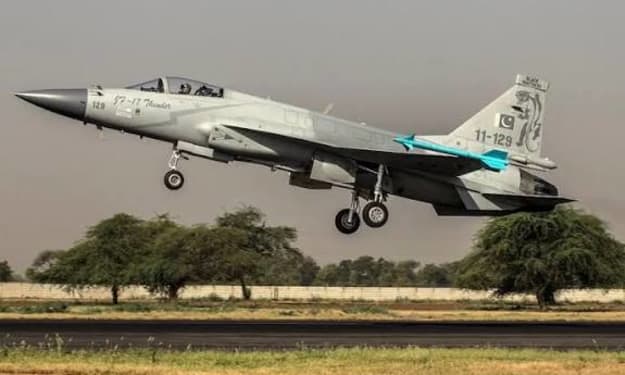
Ex-Air Commodore Explains Why Pakistan’s JF-17 Excels in Today’s Fighter Jet Market
In an era where modern air combat is defined as much by affordability and adaptability as by raw power, Pakistan’s JF-17 Thunder has emerged as one of the most competitive multirole fighter jets in the global market. According to a former Pakistan Air Force (PAF) Air Commodore, the aircraft’s growing appeal lies not in trying to outmatch fifth-generation stealth fighters, but in offering a smart, balanced solution for countries seeking reliable air power without unsustainable costs. Designed for Real-World Needs The JF-17 was conceived with a clear purpose: to meet the operational requirements of air forces that cannot afford expensive Western fighters or are constrained by political and logistical barriers. The ex-Air Commodore explains that many nations do not need ultra-high-end platforms; instead, they require jets that are versatile, easy to maintain, and capable of performing multiple missions effectively. From air defense and ground attack to maritime strike and reconnaissance, the JF-17 is built as a true multirole aircraft. Its design philosophy prioritizes flexibility, allowing air forces to tailor the jet according to their specific security environments. Cost-Effectiveness Without Compromise One of the JF-17’s strongest advantages is its cost-effectiveness. Compared to Western fighters such as the F-16 or Eurofighter Typhoon, the JF-17 costs significantly less to acquire, operate, and maintain. The former Air Commodore highlights that affordability does not mean sacrificing combat capability. Lower lifecycle costs make the JF-17 especially attractive to developing countries that need to modernize their air fleets without placing excessive strain on national budgets. Maintenance requirements are simpler, spare parts are more accessible, and training pipelines are shorter—factors that collectively enhance operational readiness. Modern Avionics and Combat Systems Contrary to outdated perceptions, the JF-17 is far from technologically basic. The latest Block III variant incorporates advanced avionics, including an Active Electronically Scanned Array (AESA) radar, modern electronic warfare systems, and an improved cockpit with a wide-area display and helmet-mounted sight. The ex-Air Commodore notes that these upgrades significantly enhance situational awareness and survivability in contested airspace. AESA radar, in particular, places the JF-17 in a competitive category, enabling better target detection, tracking, and engagement compared to older mechanically scanned systems. Weapons Integration and Operational Flexibility Another key reason for the JF-17’s success is its broad weapons compatibility. The aircraft can carry a wide range of air-to-air, air-to-ground, and anti-ship missiles, including beyond-visual-range (BVR) weapons. This allows operators to adapt the jet for diverse mission profiles without relying on a single supplier. The former Air Commodore emphasizes that this flexibility reduces political dependency. Unlike some Western platforms that come with strict usage and upgrade restrictions, the JF-17 offers greater autonomy in weapons integration, a crucial factor for many countries navigating complex geopolitical realities. Proven in Service, Not Just on Paper Operational credibility is essential in today’s fighter jet market, and the JF-17 has demonstrated its reliability through active service with the Pakistan Air Force. It has participated in numerous exercises and real-world operations, showcasing its effectiveness in both defensive and offensive roles. According to the retired Air Commodore, combat-proven platforms inspire confidence among potential buyers. The JF-17’s consistent performance under demanding conditions reinforces its reputation as a dependable aircraft rather than a purely experimental design. Export Success and Strategic Appeal The JF-17’s export record further underscores its market strength. Countries such as Myanmar and Nigeria have inducted the aircraft, while others have expressed interest. For many air forces, the jet represents a strategic entry point into modern air combat capability without long-term financial or political constraints. The ex-Air Commodore points out that Pakistan’s willingness to offer technology transfer, training, and long-term support makes the JF-17 package even more appealing. This partnership-based approach contrasts with traditional arms deals that often leave buyers dependent and constrained. A Fighter Built for Today’s Realities In a fighter jet market dominated by expensive fifth-generation platforms, the JF-17 occupies a vital middle ground. It does not aim to replace stealth fighters, but it excels as a practical, modern, and affordable solution for nations focused on sovereignty, readiness, and sustainability. As the former Air Commodore concludes, the JF-17’s success lies in understanding what most air forces truly need: a reliable aircraft that delivers modern combat capability without overwhelming costs or political limitations. In today’s complex security environment, that balance makes Pakistan’s JF-17 Thunder not just competitive, but highly relevant.
By Fiaz Ahmed Brohi5 days ago in The Swamp
Thoughts on Vocal and the way the world is
"Death cannot stop true love, only delay it." – Wesley in The Princess Bride. I decided to come back to Vocal on a very cold and dark night at the end of December. I had been, and still am, convalescing from a horrible staph infection that had gone misdiagnosed for months. This, paired with the increasing challenges of being healthy, making the best choices for my co-parented child, being a wife, and being a director at a new job, was a lot to manage.
By Jazzy 4 days ago in Confessions



Comments
There are no comments for this story
Be the first to respond and start the conversation.