
US Touts ‘New Gaza’ Filled With Luxury Real Estate: A Vision of Reconstruction or Controversy in the Making?
Subtitle: The U.S. envisions a “New Gaza” with luxury real estate and modern infrastructure, sparking debate over economic opportunity, humanitarian priorities, and political realities.

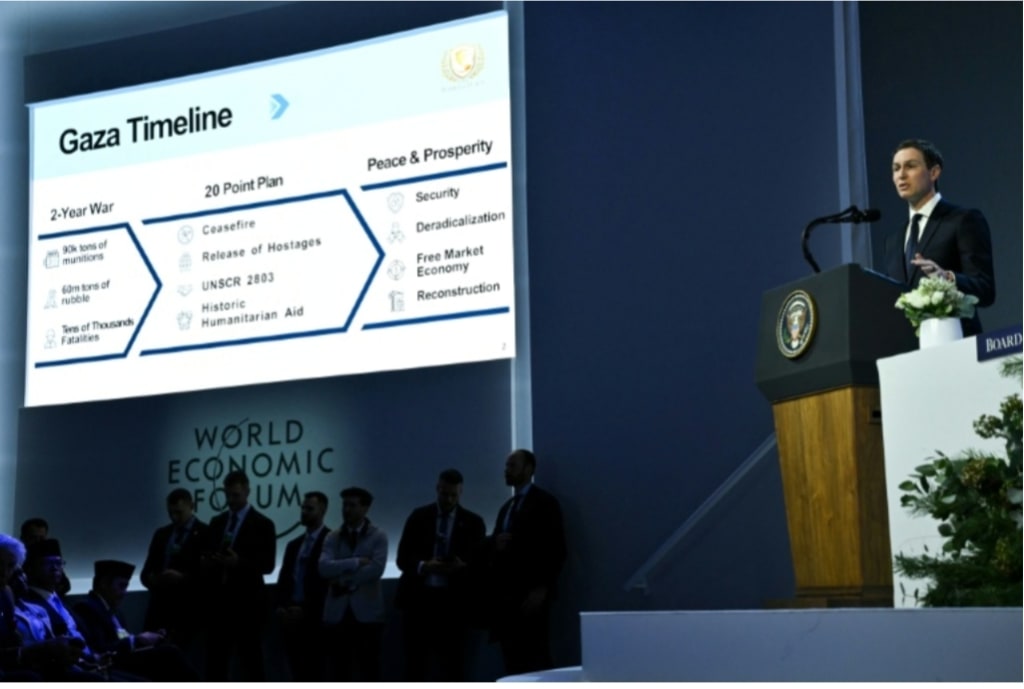
The Gaza Strip — long synonymous with conflict, humanitarian crises, and geopolitical complexity — is suddenly at the center of a bold U.S.‑led vision that might seem almost surreal to many: a future “New Gaza” filled with luxury real estate, high‑rise towers, seaside promenades, and economic opportunity. This plan, unveiled by U.S. officials at the World Economic Forum in Davos, has captivated global attention not just for its scope but for the immense social, political, and ethical questions it raises.
What Is the “New Gaza” Plan?
At its core, the “New Gaza” concept is a reconstruction and redevelopment blueprint designed to transform the heavily damaged Palestinian territory into a modern urban and economic hub. Presented by Jared Kushner, an envoy for the U.S. ceasefire efforts and real‑estate investor‑turned‑diplomat, the plan imagines luxurious residential skyscrapers along the Mediterranean, industrial zones, modern infrastructure, and bustling data and commercial centers.
U.S. officials described Gaza’s geographic location — its coastal landscape and access to the sea — as “prime real estate.” Speaking at the Davos event, former U.S. President Donald Trump highlighted the potential of the territory, saying plans would be “very successful” and something to watch unfold in the coming years.
Financially, advocates say the project could attract $25 billion or more in investment, earmarked for infrastructure, housing, job creation, and public services. Proponents have touted goals such as 100% employment and an annual GDP increase that could make Gaza “a destination” for industry and commerce.
Components of the Proposed Redevelopment
According to detailed planning descriptions:
Luxury coastal development: Hundreds of high‑rise towers and apartments overlooking the Mediterranean would create both housing and premium tourist space.
Transportation and logistics: A new port, airport, freight rail line, and upgraded road networks are envisioned to integrate Gaza with regional trade and travel corridors.
Economic zones: Interior areas would be developed for industry, data centers, and tech startups, aiming to diversify the local economy.
Human capital investments: Funds are planned for vocational training, education, and job‑skills development to empower local workers.
Together, these elements paint a picture of a vibrant, modern city — a dramatic departure from the images of destruction that came to define Gaza over years of conflict.
Political and Humanitarian Context
But the “New Gaza” plan does not exist in a vacuum. It is deeply entwined with broader political developments, including the 2025 Gaza peace plan endorsed by the United Nations Security Council and efforts to stabilize the region after years of intense conflict.
The proposal follows a ceasefire and negotiations between Israel and Hamas, aiming to end hostilities that began with a deadly 2023 attack and resulting Israeli military operations. Beyond economic goals, the reconstruction strategy is tied to demilitarization and security guarantees, with U.S. officials saying that disarming militant groups is key to attracting investment and ensuring long‑term peace.
Criticism and Controversy
Despite its ambitious vision, the “New Gaza” plan has stirred significant global debate and criticism. Critics argue that presenting Gaza primarily as “luxury real estate” overlooks the lived reality of its residents — communities that have endured loss, displacement, and chronic shortages of basic necessities like clean water, electricity, and medical care.
Some analysts also raise concerns about who would benefit from such a project. Would the new developments serve Gazans first, or would they primarily attract foreign capital and outsiders, leaving local populations marginalized in their own homeland? The risk of gentrification or limited access to new housing and services is a key worry among critics.
There are broader geopolitical implications as well. Some international voices have characterized aspects of the rebuilding proposals as reflective of neo‑imperialist control or external dominance over Gaza’s future if local governance and autonomy are not respected.
Local Voices and Future Prospects
Voices inside Gaza and within Palestinian civil society emphasize that reconstruction must prioritize humanitarian needs, dignity, and the right to self‑determination. They argue that without addressing political justice and ensuring meaningful input from Gaza’s residents, grand development schemes risk appearing detached from reality. Many point out that homes, schools, hospitals, and infrastructure still need immediate attention — before luxury towers.
At the same time, some investors and planners see the potential for economic revival that could benefit many if development is pursued in partnership with local stakeholders and under transparent governance.
Balancing Hope and Skepticism
The “New Gaza” narrative — dazzling towers rising from the ashes — captures imaginations precisely because it is so different from years of suffering and stagnation. It is a story of potential transformation but also one fraught with ethical, political, and practical challenges.
Whether this vision becomes a reality will depend on key factors such as international cooperation, funding commitments, security conditions, and the extent to which Gaza’s own people are central to shaping their future. As debates unfold in capitals from Washington to Cairo to Geneva, the world will be watching not just a construction plan, but a complex experiment in post‑conflict reconstruction, healing, and justice.
In that sense, the “New Gaza” project embodies both hope and controversy — a testament to the power and perils of reimagining a land scarred by war into a beacon of modernity.
-
Ifoul
About the Creator
Keep reading
More stories from Salaar Jamali and writers in The Swamp and other communities.
Silver Price Today: Silver Holds Near Record Highs as Traders Brace for U.S. PCE Data
Silver has once again captured global markets’ attention — trading near all‑time highs as traders and investors prepare for the release of the U.S. Personal Consumption Expenditures (PCE) Price Index, a key inflation indicator that could influence monetary policy and market direction in 2026. The precious metal’s remarkable performance highlights its evolving role not only as a traditional safe‑haven asset, but also as a commodity with growing industrial relevance and speculative momentum.
By Salaar Jamaliabout 17 hours ago in The Swamp
France and the Rafale Lose a €3.2 Billion Contract After a Last-Minute U-Turn
In a surprising turn of events, France and its flagship fighter jet, the Dassault Rafale, have reportedly lost a massive €3.2 billion defense contract following a last-minute reversal by the buyer. The decision has sent ripples through Europe’s defense industry, raising questions about geopolitics, competition in the global arms market, and the fragile nature of high-value military deals. A Deal That Once Looked Secure For months, the contract had been viewed as a diplomatic and industrial success for France. The Rafale, a multirole fighter aircraft developed by Dassault Aviation, has built a strong reputation in recent years, securing export deals with countries in Asia, the Middle East, and Europe. Known for its combat performance, advanced avionics, and operational flexibility, the aircraft has often been marketed as a reliable alternative to American and Russian fighters. The €3.2 billion agreement was expected to include not just the jets themselves, but also training, maintenance packages, weapons integration, and long-term logistical support—elements that make such contracts economically and strategically significant for both buyer and seller. The Sudden Reversal What makes this development particularly striking is the timing. According to reports, negotiations were largely complete when the buyer abruptly changed course. Such last-minute U-turns are rare in defense procurement, where deals usually take years to finalize and involve extensive political oversight. While official explanations remain limited, analysts suggest several possible reasons: shifting geopolitical alignments, pressure from allies, budgetary reassessments, or the emergence of a more politically convenient alternative. In some cases, defense purchases are less about technical superiority and more about diplomatic signaling. Competitive Pressures in the Fighter Jet Market The global fighter jet market has become increasingly crowded and politicized. The Rafale competes with U.S.-made aircraft like the F-35, Sweden’s Gripen, and emerging platforms from other defense manufacturers. The F-35, in particular, benefits from strong political backing from Washington and offers interoperability advantages for NATO and allied nations. For some countries, choosing a fighter jet is also a choice of long-term strategic alignment. Selecting American equipment often deepens military ties with the United States, while opting for European systems can signal a desire for greater strategic autonomy. The sudden loss of this contract highlights how fragile that balance can be. Economic and Industrial Impact on France A €3.2 billion contract is not just a headline number—it represents thousands of jobs, years of industrial activity, and sustained investment in research and development. While Dassault Aviation has a healthy order book, losing a deal of this scale is still a setback, particularly at a time when European defense industries are seeking to strengthen their global competitiveness. France has positioned the Rafale as a cornerstone of its defense exports, and each successful sale reinforces its credibility in future negotiations. Conversely, a high-profile loss can embolden competitors and complicate upcoming bids. Political Fallout and Strategic Questions The decision may also carry diplomatic consequences. Defense contracts often serve as pillars of broader strategic relationships, including intelligence sharing, joint exercises, and industrial cooperation. A sudden reversal can strain bilateral ties, especially if France perceives the move as politically motivated rather than purely technical. At a broader level, the incident reignites debate within Europe about defense sovereignty. As EU nations discuss reducing reliance on non-European military equipment, the loss of a major Rafale contract underscores the challenges of translating that ambition into reality. Lessons for the Future This episode serves as a reminder that even well-established defense platforms are not immune to sudden shifts. For manufacturers like Dassault, diversification of markets and deeper industrial partnerships may be key to reducing vulnerability. For governments, it highlights the importance of aligning defense exports with long-term diplomatic strategies. The Rafale remains a capable and battle-proven aircraft, and its export story is far from over. However, the loss of a €3.2 billion deal at the eleventh hour illustrates how modern defense procurement is shaped as much by politics and perception as by performance. A Wake-Up Call for Europe’s Defense Industry Ultimately, the episode is less about one lost contract and more about the evolving dynamics of global defense. As competition intensifies and geopolitical calculations grow more complex, European manufacturers may need to adapt faster, negotiate smarter, and prepare for abrupt changes—even when victory seems assured.
By Fiaz Ahmed 6 days ago in The Swamp
Smart phones, Humans and Aliens.
WARNING. I will be tapping into one of your favorite creative tensions: The absurdity of humans worshipping their glowing rectangles as if they were tiny oracles. There’s something deliciously poetic about that contradiction, and it lends itself beautifully to an instructive proviso.
By Novel Allen6 days ago in Poets




Comments
There are no comments for this story
Be the first to respond and start the conversation.