
US Says Chinese Military Drills Around Taiwan Cause Unnecessary Tensions
The US and Taiwan's Growing Military Relations: Why China’s Drills Are Escalating Tensions in the Taiwan Strait”


In the latest escalation of military tensions in the Asia-Pacific region, the United States has condemned China’s recent military drills near Taiwan, calling them provocative and unnecessarily escalating regional tensions. The drills, which involve live-fire exercises and simulated strikes against Taiwan, have raised alarms not only within Taiwan itself but also across the global community, particularly in Washington.
Context Behind the Drills
The Chinese military drills were initiated as a response to Taiwan’s increased engagement with the United States and other international allies. Beijing views Taiwan as a breakaway province and has long expressed its intent to reunite Taiwan with mainland China, by force if necessary. The island, however, operates as a de facto independent nation with its own government and economy, a status that China strongly opposes.
Taiwan's growing international relations, particularly with the US, have led to heightened concerns in Beijing. The recent drills are seen as part of a broader strategy to intimidate Taiwan and to showcase China’s military capabilities. They come at a time when the US has continued to bolster its defense commitment to Taiwan, including arms sales and diplomatic support.
US Reaction: A Call for Stability
The US government has consistently expressed its commitment to supporting Taiwan's sovereignty and security. The US is bound by the Taiwan Relations Act, which obligates it to assist Taiwan in maintaining its defense capabilities, although it does not formally recognize Taiwan as a separate nation.
The US State Department condemned China’s military maneuvers, describing them as an "unnecessary escalation" that undermines peace and stability in the region. A senior US official pointed out that such military exercises are designed to increase fear and anxiety among the Taiwanese population, sending a clear message of military coercion.
The Pentagon issued a statement stating, “China’s actions near Taiwan only exacerbate the tensions and instability in the region. These provocations are counterproductive and only strengthen Taiwan's resolve to preserve its democracy and independence.”
A Response to Increased US-Taiwan Relations
Beijing has long viewed Taiwan as part of its sovereign territory, and the growing military relationship between the US and Taiwan has become one of the most contentious issues in the Taiwan Strait. Over the last few years, Taiwan’s strategic importance has only grown in the eyes of the US, especially in the context of rising Chinese influence in the Indo-Pacific region.
The military drills can be seen as a direct response to the increased US involvement in Taiwan's security. In the past year alone, Taiwan has secured advanced weaponry from the US, including missiles, fighter jets, and radar systems. Furthermore, senior US politicians and military officials have made frequent visits to Taipei, signaling robust diplomatic and military support.
In response, China has ramped up its military presence around Taiwan, conducting several rounds of live-fire drills and air incursions. These actions, according to the US, are meant to provoke instability and intimidate Taiwan into submission. The US has emphasized the importance of dialogue and peaceful resolution to avoid further conflict.
Taiwan’s Position: Sovereignty and Security
Taiwan has been a consistent and vocal advocate for its sovereignty and independence, stressing that its people should have the right to determine their own future. Taiwanese officials have reiterated that they seek peace and stability in the region but will not yield to external pressures or military intimidation.
Taiwan's President Tsai Ing-wen has called on China to “cease military threats and focus on dialogue.” At the same time, she affirmed that Taiwan would strengthen its military capabilities to defend itself in the face of rising threats.
Taiwan’s Ministry of Defense issued a statement confirming that it is closely monitoring China’s military activities and maintaining a high level of readiness. “We will continue to safeguard Taiwan’s sovereignty and territorial integrity while avoiding unnecessary provocations,” the Ministry said.
International Reactions: A Broader Concern
The increasing military presence in the Taiwan Strait has triggered concerns beyond the US and Taiwan. Countries in the Indo-Pacific region, including Japan, South Korea, and Australia, have expressed growing concerns over the stability of the Taiwan Strait and the potential for conflict in the area. These nations are increasingly wary of China’s growing military assertiveness and the potential ramifications of a conflict over Taiwan.
Furthermore, the European Union (EU) has also voiced its concerns about the rising tensions. In a recent statement, EU officials called for calm and urged China to avoid military escalation. They emphasized the importance of diplomatic dialogue and respect for international law.
The Bigger Picture: US-China Rivalry
The ongoing military standoff in the Taiwan Strait is part of a larger geopolitical competition between the US and China, which is intensifying as both nations vie for dominance in the Indo-Pacific region. The US has long maintained that it has a strategic interest in the region and that Taiwan’s security is integral to regional stability.
The situation reflects the broader US-China rivalry, with Taiwan being a focal point in this strategic competition. While both countries have at times engaged in diplomatic dialogue, their differing positions on Taiwan continue to pose a significant risk to regional security.
The Path Forward
As tensions continue to mount, experts agree that the risk of miscalculation is high. Military exercises, such as China’s recent drills around Taiwan, can inadvertently lead to conflict, especially in an area as sensitive as the Taiwan Strait. The US and its allies will likely continue to bolster their military presence in the region, while China will likely press forward with its efforts to assert control over Taiwan.
For now, the focus remains on reducing tensions and ensuring that diplomacy and dialogue remain at the forefront of efforts to resolve the situation. However, with both sides entrenched in their positions, finding a path to lasting peace remains a significant challenge.
About the Creator
Fiaz Ahmed Brohi
I am a passionate writer with a love for exploring and creating content on trending topics. Always curious, always sharing stories that engage and inspire.
Keep reading
More stories from Fiaz Ahmed Brohi and writers in The Swamp and other communities.
U.S. Army Squadron in Korea Deactivated Amid Concerns About Potential Troop Cuts
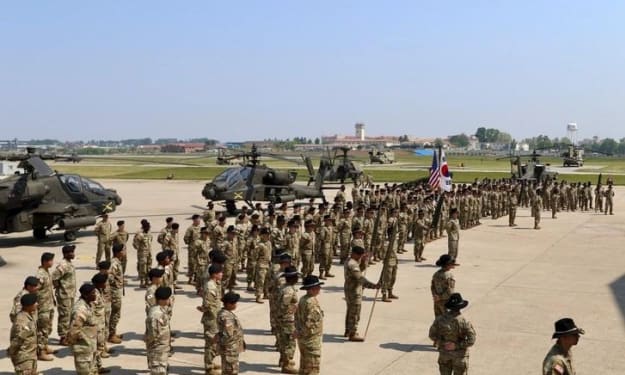
The recent deactivation of a U.S. Army squadron stationed in South Korea has sparked concerns about the future of U.S. military presence in the region, as well as the strategic implications of such a move. While the U.S. government has presented this action as part of routine military restructuring, many experts and analysts are interpreting it as an indication of potential reductions in U.S. military personnel stationed in South Korea. This development comes at a time of growing uncertainty in the region, with rising tensions between the U.S. and North Korea, as well as the evolving geopolitical dynamics surrounding China. Background: The Deactivation of the Squadron In late December 2025, the U.S. Army’s 2nd Armored Brigade Combat Team (ABCT), part of the 1st Armored Division, was deactivated after nearly two decades of service in South Korea. This marks a significant shift in the U.S. military’s posture in the region, especially as the Korean Peninsula remains a high-stakes area in terms of security concerns. The 2nd ABCT was a key component of the U.S. military’s presence in South Korea, responsible for ensuring readiness to counter any potential aggression from North Korea. The unit had a critical role in deterring North Korean provocations, as well as providing rapid response capabilities in the event of a military conflict on the peninsula. South Korea has been home to a significant U.S. military presence since the Korean War, with tens of thousands of U.S. troops stationed in the country as part of the U.S.-South Korea alliance. This military presence has played a crucial role in maintaining stability in the region, as well as serving as a deterrent against potential North Korean aggression. The Strategic Implications The decision to deactivate the squadron comes amid growing concerns over the evolving geopolitical landscape in Asia. The U.S. has been gradually shifting its military focus towards countering China’s growing influence in the Indo-Pacific region, particularly in the South China Sea. As part of this shift, the U.S. military has been reassessing its military deployments and strategic posture in various regions, including the Korean Peninsula. The U.S. has made efforts to modernize its military presence in South Korea, focusing on enhancing the capabilities of remaining troops and ensuring that the forces stationed there are able to quickly respond to any emerging threats. However, many analysts see the deactivation of the squadron as part of a broader strategy to reduce the U.S. military footprint in the region, as troop reductions have been discussed in previous defense budget proposals. One possible reason for the reduction in the U.S. military presence in South Korea is the changing nature of North Korea’s military capabilities. While the North Korean regime has continued to test nuclear and missile technology, its military capabilities are not as advanced as those of the U.S. and South Korean forces. This has led some experts to question whether a large U.S. military presence is still necessary on the peninsula. Additionally, the evolving relationship between the U.S. and South Korea has likely contributed to the decision to reduce the squadron. Under President Yoon Suk-yeol, South Korea has emphasized a stronger role in its own defense, seeking to take on a more active role in countering North Korea’s threats. The growing capabilities of the South Korean military and its greater emphasis on self-defense may have led to the reassessment of the U.S. military’s role in the region. Concerns Over Potential Troop Cuts While the deactivation of the 2nd ABCT squadron is being described as a “routine” military adjustment, many experts are concerned about the potential broader implications. The reduction of U.S. forces in South Korea could signal the beginning of a more substantial shift in U.S. military presence on the peninsula. Critics have expressed concerns that such reductions could embolden North Korea, as the U.S. military has long been seen as a key deterrent against Pyongyang’s aggressive actions. The presence of U.S. forces in South Korea has helped maintain peace on the peninsula for decades, and a reduction in that presence could be interpreted by North Korea as a sign of diminishing U.S. commitment to the alliance. Additionally, there is concern that reduced troop levels in South Korea could undermine U.S. credibility in the region. U.S. allies in the Indo-Pacific, particularly Japan and South Korea, may worry that the U.S. is pulling back from its traditional role as the security guarantor in the region, making it harder to counter the growing influence of China and North Korea. The U.S. Response and Future Plans The U.S. government has emphasized that the decision to deactivate the squadron is part of an ongoing effort to modernize and optimize military capabilities in the region. The U.S. Department of Defense has stated that the reduction of the squadron will be balanced by increased reliance on advanced technologies, including missile defense systems, cyber capabilities, and air superiority. Moreover, the U.S. has reaffirmed its commitment to defending South Korea in the event of an armed conflict, with the American government pledging to maintain a “robust and flexible” military presence in the region. The deactivation of the 2nd ABCT squadron does not mean the U.S. is abandoning its security obligations to South Korea, but rather reflecting a strategic shift toward more efficient and flexible defense capabilities. Conclusion As the deactivation of the 2nd ABCT squadron in South Korea sets the stage for further potential adjustments to the U.S. military presence on the Korean Peninsula, concerns over the future of U.S.-South Korea relations and regional security are likely to grow. While the U.S. continues to invest in modernizing its defense capabilities, the question remains whether the reduced troop presence will undermine its deterrence strategy or if South Korea’s increased military capabilities can pick up the slack. In the coming years, it will be crucial for both the U.S. and South Korea to maintain a strong partnership and ensure that the region remains stable in the face of growing challenges from North Korea and other geopolitical threats. The U.S. military's ongoing role in East Asia, particularly on the Korean Peninsula, will continue to evolve, with the deactivation of the 2nd ABCT squadron serving as a potential precursor to a larger reorientation of U.S. forces in the region.
By Fiaz Ahmed Brohi17 days ago in The Swamp
Five Graphics That Show Greenland’s Importance to Trump
When you think of Greenland, you probably imagine a frozen wasteland with more ice than people. But during Donald Trump’s presidency—and even in public discussions since—it has become a hot topic in geopolitics. From military strategy to rare minerals and climate change, Greenland’s importance goes far beyond its icy landscape. Let’s explore five graphics that help explain why Greenland matters to Trump.
By Aqib Hussainabout 16 hours ago in The Swamp


Comments
There are no comments for this story
Be the first to respond and start the conversation.