
The 2016 Election From the Perspective of a Female, Disabled Special Educator
Donald Trump's Relationship With the Disabled Community

The 2016 Presidential Election was, without question, a pivotal moment in our country’s history. Never before have we seen a more controversial or contentious race, and never before have we been so divided along party lines. Even now, over a year after the election of Donald Trump, I think most of the country does not fully realize or appreciate how devastating this election was for the disabled community.
The irony of the 2016 election is that we saw the first candidate to run for president who really made an effort to bring issues faced by the disabled community to the forefront, juxtaposed against a candidate who openly mocked a disabled reporter; and we elected the latter.
I feel as though I have a unique perspective on the 2016 election because I actually belong to several groups that were directly adversely effected by Donald Trump’s campaign. Not only am I a disabled person (I was born with Spina Bifida and am a wheelchair user as a result) but I am also a soon-to-be Special Education teacher, and a woman. I feel strongly about the significance of recognizing these groups, not just individually, but as an important, albeit relatively uncommon, intersection.
I have been involved in disability activism for basically as long as I have been breathing. It’s just something that comes with the territory when you have a visible disability. I have to practice subtle forms of activism every day in the form of educating those around me about how to treat and interact with me. This type of activism can take different forms and is sometimes very subtle, whereas other times, it is more overt. I had internalized this concept from a very young age, but it wasn’t until I got to college and began studying Sociology that I realized that disability as a social issue has always been considered a “niche” issue. Growing up in a small, suburban, upper-middle class community, I had been unable to see the problem with this way of thinking. I was always the only kid in a wheelchair at school, and even in Special Education, none of the other kids ever looked like me. I assumed that I was an anomaly of sorts, so the rest of the world treating my needs as an anomaly wasn’t a surprise to me. As soon as I had the opportunity, I seized the chance to study and write about the sociology of disability in different contexts. I finally began to internalize the concept that disability is a great unifier in society, but it is one that is so often overlooked because many people have been taught to fear it. The disabled community is not only the largest marginalized group in the world, but it is also the only one that everyone has the potential to become a part of at some point in their lives. Disability intersects every other identity group. It does not discriminate along the lines of race, gender, socioeconomic status, or sexual orientation. From its very beginnings, the disability rights movement has been, by definition, intersectional. It has always been inclusive of other identity groups, so isn’t it about time these groups start including us too?
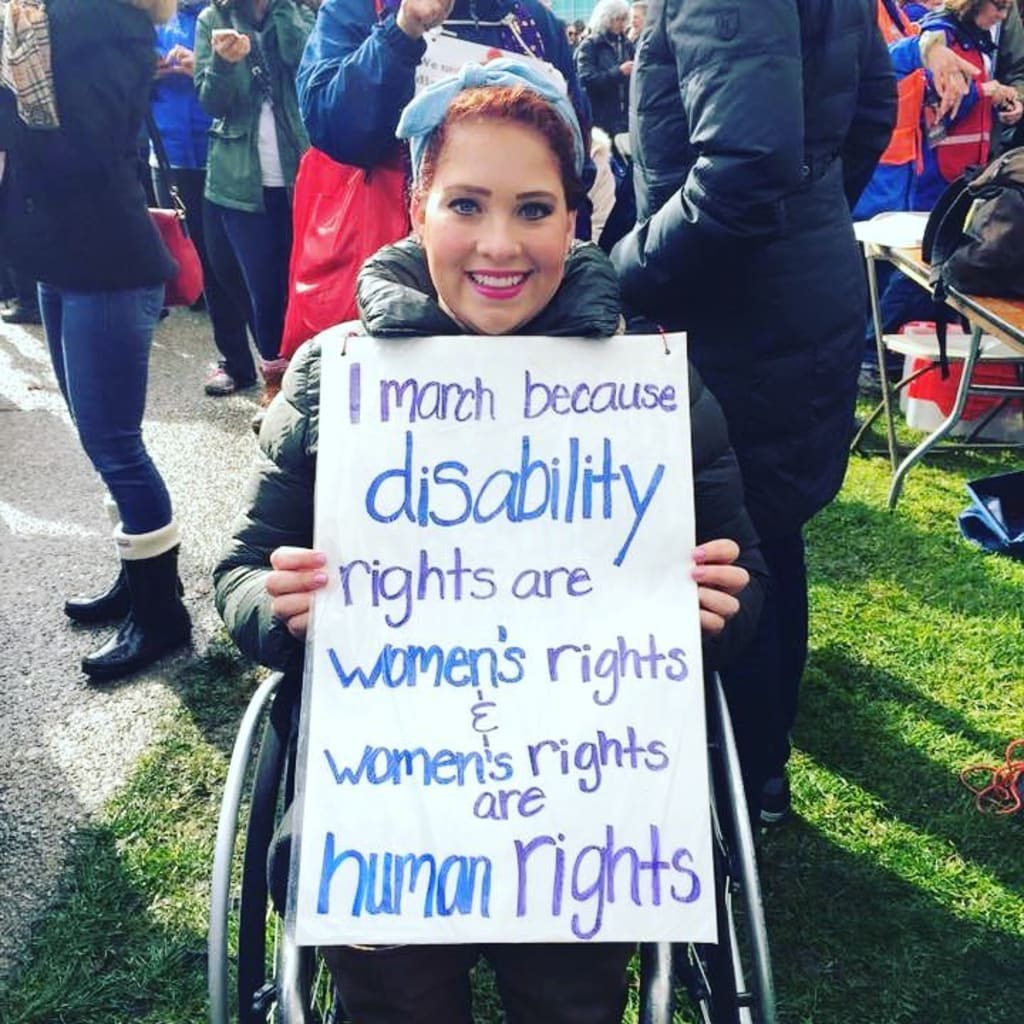
I had an interesting experience participating in the first Women’s March on Washington in January 2017. I participated in one of my local marches. Immediately when I arrived at the location of the march, I was struck by the number of people who had shown up. I went to a march that was held close to where I live, in part because I knew it would likely be a smaller turnout than venturing out to one of the larger cities close by. Being a wheelchair user, I tend to get lost in large crowds, and because I sit below most peoples’ eye level, this is often a recipe for getting tripped over or occasionally elbowed in the face by accident. Despite my initial excitement about the turnout, I soon began to feel like I stuck out like a sore thumb. I was the only visibly disabled person that I could see in this vast sea of people. It also happened to be raining, and although I had had the foresight to cover the sign I was carrying in plastic, the rest of me was largely left to the elements, so I found a spot under the first aid tent and set up camp for the pre-march festivities.
A representative from the office of my local Congressman came over and asked if he could take my picture for their website. They were featuring marchers and their stories in a piece called “Why We March.” I jumped at the opportunity to tell him that I was there because I felt that disabled people, and disabled women in particular, are often excluded or overlooked in activism and I wanted to give them a voice and make them a part of the conversation. Over the course of the two hours or so that I was there before the march began, I had several kind strangers come up and talk to me. I welcomed their friendliness, but the thing that really struck me was the number of able-bodied people who wanted to talk to me about the incident in which Donald Trump appeared to mock the disabled Washington Post reporter. They all wanted to know what my take on it was, but several of them also told me that that was the moment for them when they really became disgusted with Donald Trump, even if they had disagreed with other aspects of his campaign prior to that incident. Were they telling me this because they felt some kind of obligation to acknowledge that incident in my presence, or was this moment really the “deal-breaker” for them even though it did not directly relate to them? My initial reaction was something akin to being offended. I felt like these people were, in a sense, appropriating something that did not really affect them. The other thing that struck me about people specifically pinpointing this incident to me was that they were, in a way, ignoring the intersectionality of my identity. That incident was really the only one during the campaign that directly referenced disabled people, but there had been countless times when Donald Trump, and others working on his campaign had disrespected, degraded, and marginalized women, and also teachers, as well as our education system. The more I talked to people, the more I began to let go of my initial feelings of being offended. I realized that it was important for people to recognize the significance of the fact that we as a country had elected someone to our highest public office who not only has a distinct lack of knowledge about the disabled community, but clearly also lacks respect for that community. Issues faced by the disabled community are not issues that are exclusive to disabled people, because the disabled community is fluid. Many people experience temporary disabilities, and although they may not come with the same level of political strife, I feel as a person with a permanent disability, they are an important consideration, as is the fact that anyone at any time can become disabled.
Being disabled is a piece of my identity that I have struggled to quantify for most of my life, but I can confidently say that I am proud of my disabled identity. I feel this aspect of my identity in the depths of my soul, in the same place I feel my identity as a woman, and as a teacher. There is no denying that disability is a unifier of society, and this is a fact that would do Donald Trump some good to come to terms with. After all, even he cannot escape that fact that he may one day find himself amidst our ranks, and he will likely receive the same level of respect that he has shown us.
About the Creator
Sarah Marks
I was born with Spina Bifida, and as a result I am a wheelchair user. I am also a Special Education Teacher. I write about all things intersectional.
Keep reading
More stories from writers in The Swamp and other communities.
Trump Suspends Immigrant Visas for 75 Countries: Who’s Affected?
In a sweeping move, President Donald Trump’s administration has announced a pause on immigrant visa processing for citizens of 75 countries. The new policy, effective January 21, 2026, applies to family-based and employment-based green cards. It’s one of the broadest immigration actions in recent U.S. history and has raised questions worldwide about who exactly will be affected.
By Aqib Hussain3 days ago in The Swamp
Silver Screen Magic with Mae West
American actress and singer Mae West became a popular film actress during the Great Depression. She started entertaining in vaudeville, then performed on Broadway, and finally went to Hollywood. She signed up with Paramount Pictures and made her debut in the 1932 film “Night After Night.” She also starred in musicals, comedies, and crime dramas. The American Film Institute named her one of the best classic Hollywood actresses.
By Rasma Raisters5 days ago in Geeks



Comments
There are no comments for this story
Be the first to respond and start the conversation.