humanity
Humanity topics include pieces on the real lives of politicians, legislators, activists, women in politics and the everyday voter.
Tsunami Evacuations Ordered in South America, but Worst Risk Passes for U.S. After Huge Quake
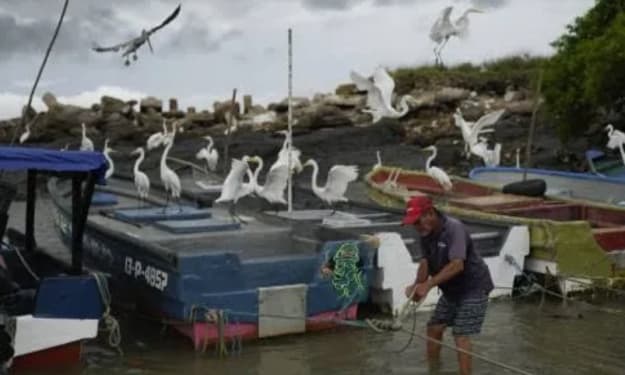
Early on Wednesday, a powerful earthquake with a magnitude of 8.8 struck off the Kamchatka Peninsula in Russia, triggering widespread tsunami warnings and mass evacuations across the Pacific Rim. Officials later determined that the greatest tsunami threat to the United States had passed, despite the frantic efforts of countries in South America to evacuate individuals. At a depth of 19 kilometers, the quake, one of the strongest in recent memory, occurred approximately 75 miles offshore from Petropavlovsk-Kamchatsky. The quake's shallowness made it particularly capable of moving large volumes of water. From Japan to Chile to Hawaii, tsunami warnings were quickly issued across the Pacific Basin. Response times to emergencies were quick in South America. Chile began evacuating vulnerable coastal areas after raising its tsunami alert level to the highest level. Authorities emphasized the danger of after-waves, reminding citizens that the first wave is rarely the most dangerous. Chilean officials coordinated with local governments to evacuate thousands from low-lying areas.
By GLOBAL NEWS6 months ago in The Swamp
Workplace Religious Expression
Lunch time! Makayla smiles, knowing she has been sitting at her desk all morning, buried in paperwork. She hides her crystals back into her desk drawer, then stands and walks to the small break room. The cravings of her prepared pita and hummus overwhelm her. As she opens the doors, she freezes. The sight of her colleagues standing in a tight circle, heads bowed and hands linked in prayer, strikes her. Her chest tightens. An awkward feeling washes over her. She hears John, her supervisor’s voice.
By Iris Harris6 months ago in The Swamp
The Endless Echo: What Corbyn and Sultana's New Party Reveals About the British Political Psyche
For many observers of British politics, just when the dust seemed to settle on one dramatic chapter, another quickly opens. The recent announcement of an alternative formation, a new left-wing political party led by Jeremy Corbyn and Zarah Sultana, feels less like a sudden rupture and more like the latest act in a long-running, complex drama. With its interim moniker "yourparty.uk" and a promise of grassroots determination for its final name and direction, this nascent movement, officially launched on 24 July 2025, has already garnered significant attention, prompting both fervent hope among its half-a-million initial sign-ups and strategic headaches for Labour. But beneath the surface of immediate headlines and internal party machinations, what deeper narratives and societal forces does this phenomenon truly illuminate?
By Abigail Goldwater6 months ago in The Swamp
The Silence of the Brave
When Georgia State Senator Nancy Schaefer released her groundbreaking report, “The Corrupt Business of Child Protective Services,” she likely knew she was stepping into dangerous territory. But what she may not have known is how far-reaching—and deadly—that corruption could be. Just months after publicly declaring CPS a “criminal enterprise” incentivized to kidnap children, Schaefer was found dead in what authorities swiftly ruled a murder-suicide. Case closed—or so they said.
By Michael Phillips6 months ago in The Swamp
Ceasefire Isn’t Enough: What the World Must Do to Truly End the War in Gaza
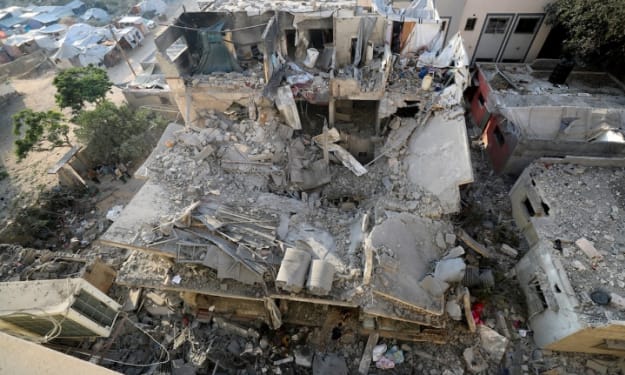
For months now, Gaza has been a living nightmare. The headlines may come and go, but for the people who wake up every day under drones, rubble, and hunger—this isn't a news cycle. It's their reality.
By Azmat Roman ✨6 months ago in The Swamp
Where the Rubble Speaks: A Child’s Cries in Gaza’s Silence
Where the Rubble Speaks: A Child’s Cries in Gaza’s Silence There are no safe places left in Gaza. That sentence, once unthinkable, has now become a mantra for journalists, doctors, aid workers, and the civilians still struggling to survive under relentless airstrikes, displacement, and suffocating siege. Gaza, already one of the most densely populated and impoverished areas in the world, has become an open-air graveyard. And still, the bombs fall.
By Azmat Roman ✨6 months ago in The Swamp
US-Japan trade deal gives Trump control over $550 billion in investments. It could be ‘vapor ware’ — and a model for other countries
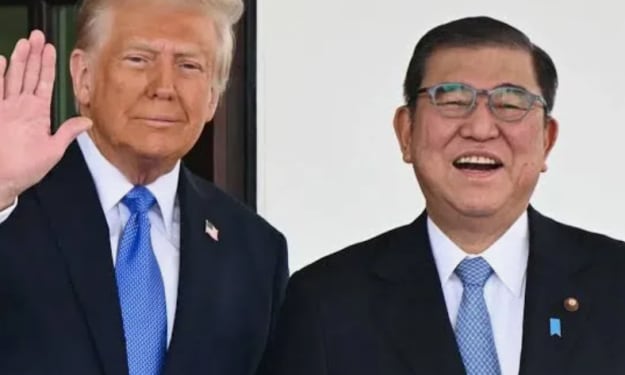
**The US-Japan trade agreement grants Trump control over investments worth $550 billion. It Might Be "Vapor Ware" and Serve as an Example for Other Countries** Former President Donald Trump claimed in a high-profile announcement that a new US-Japan trade deal gave the United States leverage over 550 billion dollars in Japanese investment. The deal has been met with both enthusiasm and skepticism, with Trump hailing it as a landmark achievement for American manufacturing and job creation. Some have dubbed it potential "vapor ware" due to critics' claims that the numbers may be exaggerated, the agreements are non-binding, and the economic impact is speculative. Nonetheless, the way the deal is structured and presented may be used as a model for US trade negotiations in the future, especially if the administration is focused on optics and unilateral gain. At the heart of the agreement is a framework wherein Japan pledged to direct investment toward American industries — especially manufacturing, infrastructure, and emerging technologies. During his presidency, Trump put bilateral trade agreements ahead of multilateral ones and hailed the agreement as an example of nationalist economics. It is in line with his "America First" platform, which places an emphasis on bringing manufacturing jobs back to the United States and reducing reliance on supply chains from other countries. However, experts caution that the headline figure of \$550 billion is misleading. Before the agreement was signed, a significant portion of the pledged investment was already in the works. Financial analysts point out that Japanese companies like Toyota, SoftBank, and Mitsubishi have been present in the United States for a considerable amount of time. Trump can take credit for the trade deal because it simply brings together anticipated and existing investments under a new political banner. Furthermore, the agreement lacks specific enforcement mechanisms. It does not include tariff adjustments, guarantees of market access, or procedures for resolving disputes like traditional trade pacts do. Instead, it resembles a memorandum of understanding, which is advantageous from a political standpoint but has no legal force. Because of this, some economists have referred to it as "vapor ware," which refers to a policy that makes headlines but does not result in significant change. The deal's strategy reflects a larger trend in the way trade agreements are being used as political capital, despite the ambiguity. By framing the deal as a huge economic win — regardless of its actual substance — Trump leveraged it for domestic approval and international prestige. His administration argued that the mere announcement of the deal created a “confidence effect,” encouraging private-sector investment and lifting stock markets.
By GLOBAL NEWS6 months ago in The Swamp
The Children of Gaza: Voices That the World Must Never Forget
In the heart of Gaza, where laughter once echoed through narrow streets and dreams flickered in the eyes of the young, there now lies a silence too deep to bear. This article is not just a collection of words—it is a eulogy for the children who once played in the sands of Gaza, who dreamt of school, birthdays, and a future. They are not alive anymore. They are not statistics. They were sons, daughters, brothers, sisters—innocent lives lost in a war not of their choosing.
By Hasbanullah6 months ago in The Swamp
Whispers from the Viral Swamp: What Today’s Wildest Headlines Reveal About Us
Swamps are strange places. They’re quiet but alive. Still on the surface, but teeming underneath. Full of shadows, echoes, and surprises. In many ways, the internet has become its own kind of swamp—a thick digital fog where truth, spectacle, and silence all swirl together.
By Muhammad Adil6 months ago in The Swamp
The Worst-Kept Secret of the Israeli-Palestinian Conflict
One of the more poorly kept secrets of the Israeli-Palestinian conflict is that many of those involved would prefer to take all the land and have the other side disappear. A 2011 poll found that two-thirds of Palestinians believed that their real goal should not be a two-state solution, but rather using that arrangement as a prelude to establishing “one Palestinian state.” A 2016 survey found that nearly half of Israeli Jews agreed that “Arabs should be expelled or transferred from Israel.” A poll in 2000, conducted during negotiations toward a two-state solution, found that only 47 percent of Israelis and 10 percent of Palestinians supported a school curriculum that would educate students to “give up aspirations for parts of the ‘homeland’ which are in the other state.”
By Kristen Orkoshneli6 months ago in The Swamp