
Pakistan Claims Chinese-Made J-10C Fighter Jets Used Against India’s Air Force
"Escalating tensions over Kashmir prompt Pakistan to claim aerial victories with advanced Chinese fighter jets, while India denies any aircraft losses."

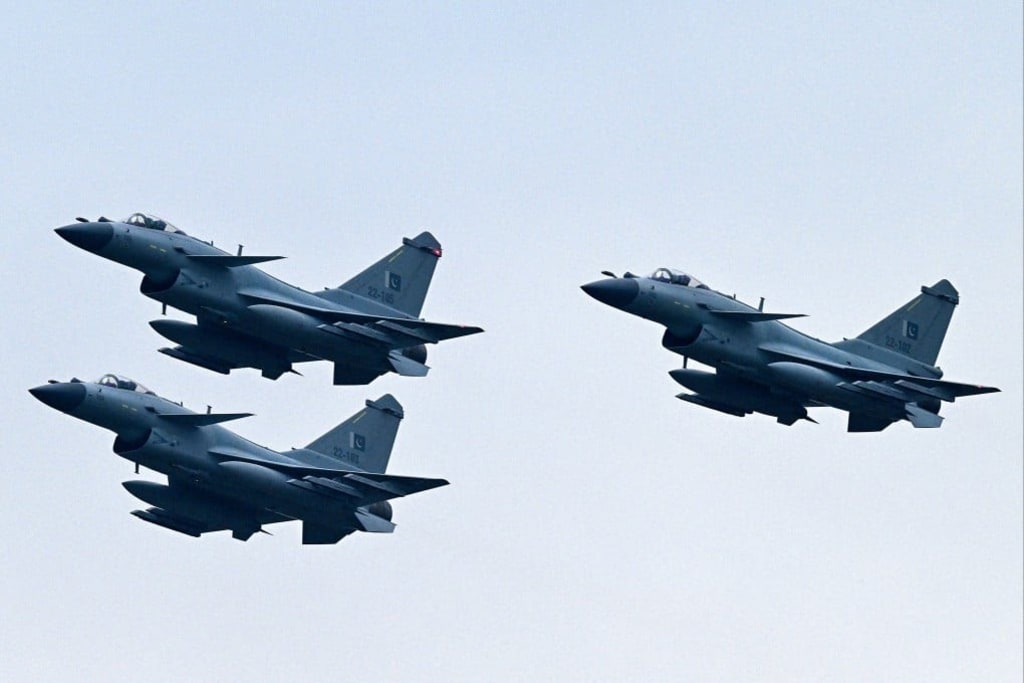
Pakistan Claims Chinese-Made J-10C Fighter Jets Used Against India’s Air Force
In a significant escalation between two nuclear-armed rivals, Pakistan has claimed that its air force used Chinese-made J-10C fighter jets to shoot down five Indian aircraft during a recent military confrontation. The assertion comes amid rising tensions between India and Pakistan over the disputed Kashmir region, with both nations exchanging accusations and conducting air strikes.
Background of the Conflict
Tensions flared after a deadly militant attack in Indian-administered Kashmir led to the deaths of 26 Indian civilians, many of whom were tourists. India blamed Pakistan-based militant groups such as Jaish-e-Mohammed and Lashkar-e-Taiba for the attack, prompting it to conduct what it called "precision strikes" on terrorist camps across the Line of Control (LoC) in Pakistan-administered Kashmir.
In response, Pakistan accused India of violating its airspace and declared the strikes an "act of war." Islamabad warned that it would respond "at a time and place of its choosing."
Pakistan’s Military Response
Pakistan’s Deputy Prime Minister and Foreign Minister Ishaq Dar made a high-profile statement that shocked observers around the world. He announced that the Pakistan Air Force (PAF) had deployed its Chinese-built J-10C fighter jets to engage Indian aircraft during the conflict. According to Dar, the PAF successfully shot down five Indian fighter jets: three French-made Rafales, one Russian MiG-29, and one Su-30MKI.
“The J-10Cs were equipped with PL-15E long-range air-to-air missiles and proved decisive in our air defense,” said Dar during a televised press conference. “Our response was calculated. We only targeted Indian aircraft that violated our airspace and dropped payloads.”
If verified, this would mark the first time the J-10C has scored kills in real combat, making the event a significant milestone for both Pakistan’s air force and Chinese aviation technology.
India’s Denial
India has categorically denied Pakistan’s claims. The Indian Ministry of External Affairs and the Indian Air Force jointly called the reports “false propaganda” and accused Pakistan of spreading misinformation.
India’s embassy in China also rejected related news coverage by China’s state media, particularly a report by the Global Times that reiterated Pakistan’s version of events. “This is pure disinformation and an attempt to manipulate public opinion,” said an Indian government spokesperson.
New Delhi has maintained that its air strikes were limited, targeted operations aimed solely at neutralizing terrorist threats, and that no Indian aircraft were lost in the process.
Strategic Importance of J-10C
The J-10C is a 4.5-generation multi-role fighter developed by China’s Chengdu Aircraft Corporation. It is considered a rival to the American F-16 and French Rafale jets. Equipped with advanced avionics, radar systems, and long-range missiles, the aircraft significantly enhances Pakistan's aerial combat capabilities.
Pakistan officially inducted the J-10C into its air force in 2022, and its inclusion was widely viewed as a move to counterbalance India’s acquisition of the Rafale jets from France. The use of the J-10C in a live combat situation — especially against high-performance Indian jets — would signal a strategic shift in regional air superiority dynamics.
International Reactions
The escalating tension has alarmed the international community. The United Nations, United States, China, Russia, and the European Union have all called for restraint.
U.S. Secretary of State Marco Rubio stated, “We urge both nations to step back from the brink. Any further military action could risk catastrophic consequences.” China, a close ally of Pakistan and supplier of the J-10C jets, has called for peace but has not publicly commented on the reported use of its aircraft in the incident.
The Road Ahead
As of now, the exact number of casualties and damages from both sides remains unclear due to conflicting narratives. Independent verification is also difficult due to restricted access to the conflict zones.
Diplomatic backchannels are reportedly active, with several countries urging both sides to resume dialogue. However, public opinion in both India and Pakistan appears to be hardening, making de-escalation politically difficult.
Conclusion
The claim by Pakistan that its Chinese-made J-10C jets successfully downed five Indian aircraft, if substantiated, would mark a turning point in South Asian military aviation and regional security. However, with India rejecting the claim, the situation remains highly volatile. As international players push for calm, the coming days will be crucial in determining whether this latest flare-up will spiral into a larger conflict or be contained through diplomacy.
About the Creator
Adnan Rasheed
Author & Creator | Writing News , Science Fiction, and Worldwide Update| Digital Product Designer | Sharing life-changing strategies for success.
Keep reading
More stories from Adnan Rasheed and writers in The Swamp and other communities.
India Strikes Deep Inside Pakistan; Islamabad Claims to Down 5 Indian Jets in Major Escalation
India Strikes Deep Inside Pakistan; Islamabad Claims to Down 5 Indian Jets in Major Escalation In a dramatic escalation of hostilities between two nuclear-armed neighbors, India launched what it described as a “preemptive strike” deep inside Pakistani territory early Tuesday morning. The Indian Air Force (IAF) targeted what officials said were terrorist training camps in the Khyber Pakhtunkhwa province of Pakistan. In response, Pakistan claimed to have shot down five Indian fighter jets, raising concerns of a full-scale military conflict between the two rivals.
By Adnan Rasheed9 months ago in The Swamp
Australian Arts Festival Apologizes for Disinviting Palestinian Writer Who Lauded Oct. 7
Hey readers, buckle up — Australia’s arts scene has just been through one of its most dramatic shake-ups in years. If you’ve been following the news, you might have heard about the Adelaide Festival and its controversial decision to disinvite Palestinian Australian writer Randa Abdel‑Fattah. Let’s unpack what happened, why it mattered, and what it tells us about art, politics, and free speech today.
By Aqib Hussain2 days ago in The Swamp




Comments
There are no comments for this story
Be the first to respond and start the conversation.