
Pakistan and India on the Brink: A Modern-Day Conflict
Military Showdown: India vs. Pakistan in 2025

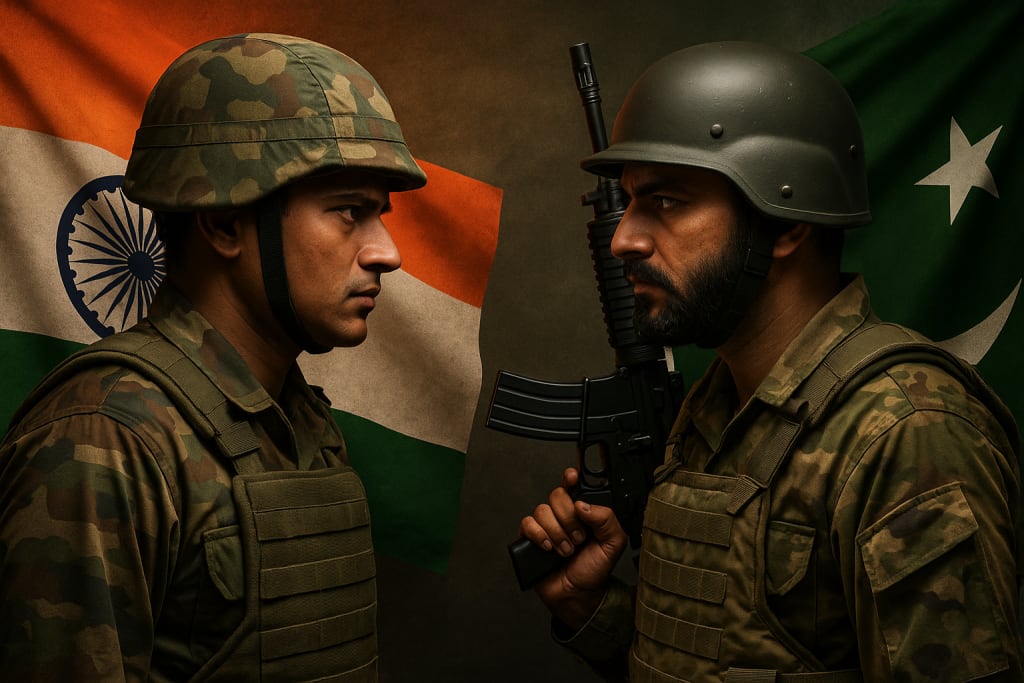
Military Showdown: India vs. Pakistan in 2025
The year 2025 has brought the South Asian subcontinent to the brink of a full-scale war between India and Pakistan. A longstanding history of territorial disputes, political tensions, and military confrontations has once again flared into open hostilities. The current military showdown, which began with a skirmish along the Line of Control (LoC), has rapidly escalated into a modern-day conflict involving both conventional and unconventional warfare tactics. This article delves into the key elements of this military showdown, examining the capabilities, strategies, and potential consequences of this catastrophic clash between two nuclear-armed neighbors.
The Escalation to War: A Tense Beginning
The immediate trigger for the war was an intense confrontation on the LoC in Kashmir, a region that has remained a contentious battleground since the partition of British India in 1947. In late April 2025, a violent exchange between Indian and Pakistani forces along the LoC claimed the lives of several soldiers from both sides. Pakistan blamed India for an unprovoked attack on its military positions, while India accused Pakistan of sponsoring militant groups who were infiltrating its territory. This clash, though small in scale initially, soon spiraled out of control as both nations responded with retaliatory airstrikes, artillery bombardments, and a full mobilization of ground troops.
The Military Capabilities: A Fierce Comparison
Both India and Pakistan possess formidable military forces, each with its own strengths, and a comparison of their capabilities highlights the scale of the potential conflict.
India’s Military Power:
India, with one of the largest standing armies in the world, has a significant advantage in terms of manpower. With a population of over 1.4 billion, India maintains a military force of over 1.4 million active-duty personnel and more than 2 million reserve forces. India’s arsenal is dominated by advanced tanks, artillery, and infantry, supported by modern air and naval power. India’s Air Force, which is considered one of the most capable in Asia, boasts a fleet of fighter jets, including the Sukhoi Su-30MKI, Rafale, and indigenous Tejas aircraft. Furthermore, India possesses a significant array of ballistic missiles and precision-guided munitions.
In terms of nuclear capability, India has an estimated 160 to 170 nuclear warheads. India’s nuclear strategy is centered around the doctrine of "No First Use," meaning that it has pledged not to use nuclear weapons unless first attacked by an adversary with nuclear weapons.
Pakistan’s Military Strength:
Pakistan’s military, though smaller than India’s in terms of sheer numbers, is no less formidable. Pakistan’s armed forces consist of approximately 650,000 active-duty personnel and around 550,000 reserves. The Pakistani military has invested heavily in asymmetric warfare tactics, focusing on maintaining a strategic edge through its use of irregular forces and specialized combat units. Pakistan’s military is also known for its adept use of terrain in the mountainous areas of Kashmir and the ability to launch rapid counterattacks.
In terms of air power, Pakistan's Air Force operates a combination of F-16 Fighting Falcons, JF-17 Thunder, and Mirage fighters. Pakistan has also significantly upgraded its missile defense systems and is developing its own indigenous long-range ballistic missiles. The most concerning aspect of Pakistan’s military capabilities is its nuclear arsenal. With an estimated 170 to 180 nuclear warheads, Pakistan maintains a policy of "full-spectrum deterrence," which means it reserves the right to use nuclear weapons across a range of situations, including low-intensity conflict.
The Role of Air Power and Cyber Warfare
One of the most striking features of this modern military showdown has been the use of advanced airstrikes. Both nations have engaged in frequent bombing runs over disputed territories, targeting military bases, supply lines, and even civilian infrastructure. Indian fighter jets have conducted precision strikes on Pakistani border positions, while Pakistan has retaliated with aerial bombardments and has attempted to disrupt India’s air superiority with surface-to-air missile systems.
In addition to traditional warfare, both India and Pakistan have engaged in a new form of battle: cyber warfare. Both countries have launched sophisticated cyberattacks on each other’s military and civilian infrastructure, targeting everything from communications systems to power grids. These cyber operations have created significant confusion and disruption, making it harder for both sides to coordinate military efforts effectively.
The Risk of Escalation: Nuclear Concerns
As the conflict intensifies, the possibility of nuclear escalation becomes a significant concern. Both nations have significant nuclear arsenals, and the threat of nuclear use, however unlikely, cannot be discounted. While both countries have made public statements reaffirming their commitment to nuclear deterrence and non-use policies, the rapidly deteriorating situation on the ground has raised alarm bells internationally.
India’s nuclear doctrine of "No First Use" is designed to reassure its population and the world that it will only use nuclear weapons in retaliation to a nuclear attack. However, Pakistan’s nuclear policy is based on the concept of "full-spectrum deterrence," meaning it may use nuclear weapons in response to conventional attacks if it perceives an existential threat. In a situation where conventional forces are unable to resolve the conflict, either side might consider escalating to nuclear weapons, potentially triggering a catastrophic regional or even global crisis.
Global Reactions and International Mediation
The international community, including major powers like the United States, China, and Russia, has expressed deep concern over the escalation. The United Nations has called for an immediate ceasefire and has offered to mediate peace talks. However, the diplomatic channels between the two countries have remained closed, with both governments accusing each other of sabotaging peace efforts.
China, a key ally of Pakistan, has cautiously called for restraint, while Russia has expressed support for India's right to defend its sovereignty. The United States, which maintains strategic partnerships with both India and Pakistan, has been vocal in urging both nations to return to the negotiating table before the situation spirals out of control.
Conclusion: The Path Forward
As the military confrontation between India and Pakistan continues to evolve, the world watches with bated breath. The stakes are higher than ever. With both nations possessing nuclear weapons and the potential for widespread destruction, the conflict could have far-reaching consequences, not just for South Asia but for global security. While there are ongoing efforts to de-escalate the conflict through diplomatic means, the path to peace remains uncertain. The world can only hope that the leaders of both nations will choose dialogue over destruction and work toward a lasting resolution to the crisis.
About the Creator
World politics
shares simple and clear updates on global news, leaders, and events. We cover politics, conflicts, and international stories that shape the world. Stay informed and learn something new every day.
Keep reading
More stories from World politics and writers in The Swamp and other communities.
Trump’s Actions May Be Illegal — But His Greed Might Be the Only Thing Holding Him Back
In American politics, few figures provoke as much controversy, outrage, and relentless fascination as Donald Trump. Years after entering the political arena, he remains a dominant force not only in elections and headlines, but also in courtrooms and public debate. Legal scholars, journalists, and watchdog groups have repeatedly argued that many of Trump’s actions — both during his presidency and after — crossed clear legal and ethical lines. From election interference claims to allegations of abusing executive power, mishandling classified information, and entangling public office with private business interests, the accusations against Trump are neither isolated nor trivial. They form a pattern that critics say reveals a leader willing to push, bend, or outright ignore the law when it suits him. And yet, paradoxically, Trump has not gone as far as many of his harshest critics once feared. The reason may not be respect for democratic norms or fear of legal accountability — but something far more personal: his own greed. This is not a defense of Trump’s conduct. Rather, it is an attempt to understand a reality that even some of his opponents quietly acknowledge. Trump’s obsession with personal wealth, brand image, and financial survival may sometimes limit how far he is willing to go, even when legality appears optional. A Pattern of Questionable Legality Trump’s political career has been accompanied by an almost constant cloud of legal scrutiny. Investigations have examined campaign finance violations, obstruction of justice, business fraud, election interference, and misuse of power. Unlike many politicians who rely on subtlety or plausible deniability, Trump often operates in full public view, openly testing the boundaries of what he can get away with. His response to legal challenges is also strikingly consistent. He rarely engages with the substance of allegations. Instead, he frames investigations as politically motivated “witch hunts” and portrays prosecutors, judges, and journalists as enemies of the people. This narrative has proven effective with his base, many of whom see legal accountability not as justice, but as persecution. The brazenness of this strategy has led critics to argue that Trump believes himself above the law. And yet, despite his rhetoric, he has repeatedly stopped short of actions that would create immediate, irreversible consequences. The question is why. The Central Role of Money and Brand To understand Trump’s restraint, one must understand how he sees himself. Trump has never primarily viewed himself as a public servant or ideological leader. His core identity is that of a businessman and brand. Trump’s wealth — or at least the perception of it — is central to his political power. His properties, licensing deals, fundraising apparatus, and media presence all depend on the image of success. Politics, for Trump, has never been separate from profit. It is another platform for monetization and self-promotion. Unlike leaders driven by ideology, nationalism, or historical legacy, Trump’s decisions often reflect a simple cost-benefit calculation. Actions that threaten his brand value, fundraising ability, or business empire are approached with caution. Actions that energize supporters without endangering his financial interests are embraced enthusiastically. This explains a recurring pattern: Trump escalates rhetorically, but hesitates operationally. He may use inflammatory language, encourage outrage, or flirt with extreme ideas, but often stops short of moves that would directly and permanently damage his wealth. Greed as a Limiting Force Greed is typically viewed as a corrupting influence, and in many ways, it is. But in Trump’s case, it also functions as a brake. Absolute power, while tempting, carries real risks — sanctions, asset seizures, international isolation, and loss of market confidence. Trump may dismiss institutions publicly, but he understands markets instinctively. He knows investors flee chaos, lenders demand predictability, and brands collapse under prolonged legal uncertainty. Even when he attacks courts or regulators in speeches, his actual behavior often reveals caution: delays, negotiations, settlements, and procedural maneuvering rather than outright defiance. This suggests that Trump’s greatest fear is not prison, but bankruptcy. Having faced financial collapse multiple times in the past, he appears determined never to experience it again. His greed does not eliminate risk-taking, but it shapes where he draws the line. Why This Is Not Reassuring It would be a profound mistake to find comfort in the idea that greed will protect democracy. Self-interest is not a moral safeguard; it is an unreliable and fragile one. Trump’s restraint is situational, not principled. When personal profit and political power align, the danger increases dramatically. Relying on greed rather than law also sets a dangerous precedent. Democracy should not depend on whether a powerful individual calculates that illegal actions are “bad for business.” That logic leaves institutions vulnerable to leaders with fewer assets to lose, greater tolerance for chaos, or ideological motivations stronger than personal wealth. In Trump’s case, the line is not legality — it is profitability. The Legal System Still Matters Despite its flaws and delays, the legal system has not been irrelevant in Trump’s story. Courts have imposed fines, restricted business practices, and upheld investigations despite intense political pressure. These outcomes matter, not just symbolically, but financially. Every legal loss chips away at Trump’s carefully constructed image as a “winner,” an image that underpins his fundraising and influence. Ironically, his obsession with money also makes him vulnerable. Legal accountability threatens the very thing he values most. A Calculated Balance Trump operates within a narrow corridor: push boundaries enough to energize supporters, but not so far that financial consequences become catastrophic. This balancing act explains why aggressive speeches are often followed by procedural stalling, appeals, and strategic retreats. It also explains why Trump attacks institutions rhetorically while continuing to rely on them practically. Banks, courts, and markets are not enemies he can afford to lose entirely. Conclusion Donald Trump’s legacy will likely be defined by how often he tested the limits of the law — and how inconsistently those limits restrained him. Yet one constant remains unmistakable: his devotion to personal profit. That devotion may sometimes hold him in check — not because he respects democracy, but because he values his wealth. Democracy deserves stronger guardians than greed. But for now, it remains an uncomfortable part of the equation in understanding Trump’s behavior and the risks he poses to American political life.
By Muhammad Hassan7 days ago in The Swamp
Miss Persephone's Manual to a Seemingly Ordinary Life
Miss Persephone was found at the dining table, her blue eyes swollen, her tears arriving and retreating like the tides of the ocean. Earlier that day, her family had visited her in the retirement home where she had lived for eight years. It was her eightieth birthday.
By Imola Tóth3 days ago in Fiction



Comments
There are no comments for this story
Be the first to respond and start the conversation.