

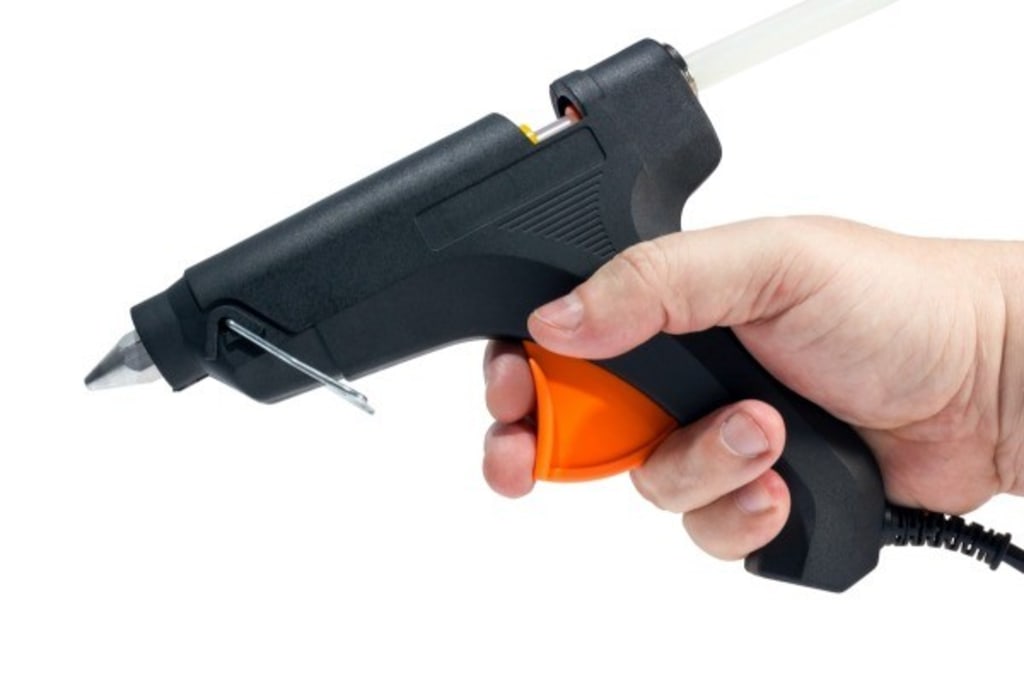
Remind me never to get into crafting outside of my home. Or maybe just don't do anything? I recently came across an article where a Colgate University student was under suspicion of having a firearm when in reality he had a glue gun. Yes ladies and gents, a glue gun. Now to add to the ever growing list of what black people or hell even brown people can't do. So now we can't do arts and craft.
Now I am going to say that terrorism and gun play on college campuses is absolutely insane. The whole world is basically a powder keg of emotional distress. Therapy should be at an all time high considering how much we are inundated with and how much we can't handle. Unfortunately, black and brown people know all to well what we can and cannot do without being accused or losing our damn lives.
This student, going to basically do a project, basically put a campus on lockdown because of a glue gun. I am sure there is someone who will be like "it was dark. No one could tell what is was." Okay. But let's think realistically. Glue guns are not big. They are not even close in size to a .22 or a .32. Secondly, silver tip conical tip. Third, how close were you? Fourth, you almost got someone killed. This is not the climate for mistakes. In fact there is never a climate that black and brown people can make mistakes. We can change our lives around from being what is considered base of society to moguls and the media and society won't let you forget where you came from. Meanwhile, pale nation can and have destroyed other nations and its gets written as we were trying to help or we didn't know better. 👀👀👀
Some days, I really want to just not be woke I really just want to sleep. I do not want to to deal with anything that is considered society but I will never have that luxury.
Black and brown people always have to be ten times better to prove we are worthy and even then can still be overlooked. We have to be considered safe even within our own homes. God forbid you are homeowner and you call to report a robbery and the police shoot you. Knowing that no matter what someone will always see you as inferior just based is on your skin tone.
Seriously world , what the f!?k? All of the strides taken and you still go back to base logic. Yet, the pale nation can walk around and if someone says anything, squeaky wheel cries and defense to protect them. Please. Spare me. Most of the crimes against humanity as a whole were done by the pale nation and they truly still haven't paid for it.
I guess it's up to the universe to send that bill because basically talking, writing and showing is not enough for the pale nation to realize the problem. Black and Brown people are not here to provide you with understanding and time so you can comprehend racism. I may not live certain experiences but it does not make me less empathic or understanding of the situation. But unfair is unfair. Instead, when your own point it out, you kinda it but you still have to interject some level of buzzwords so you can feel like you are adding to the situation. Learn to read and listen critically before you start flapping jaws or getting twitter finger syndrome.
It really is disheartening that I live on this earth for about 40 years and I still have a hard time trusting most white people. History is a bitch ain't it?
About the Creator
Janine Addison
Born and raised in the greatest city in the world NYC. Sees the world through a lens of being here for over forty years. I will wonder why people never want to do better when they can.
Instagram: Theogbklyngirl
Keep reading
More stories from Janine Addison and writers in The Swamp and other communities.
Oppression Is Not a Trend
I am no longer surprised what the world is doing, especially when it comes to race relations. There seems to be this new epidemic of White folks calling the police for whatever black, brown, or any person of color is doing. I guess because they are so comfortably emboldened by the tangerine tyrant that we have as the president of the United States, the police are now their attack dogs. (Not like this is new, but you get it.)
By Janine Addison8 years ago in The Swamp
The Saddest Thing - The Billionaires Who Rule America Aren't Even Enjoying Themselves
This single post says more about our ruling class than a thousand policy papers. The saddest thing about today's system is that the men robbing the rest of us - sabotaging our economic prospects, our pensions, our access to affordable healthcare - are not even happy.
By Scott Christenson🌴23 days ago in The Swamp
Trump Touts Third Term.
Trump must be one of the most boastful men on Earth. In his dreams, he probably sees himself as Superman, not unlike that Spitting Image puppet of Ronald Reagan in the 80s, a Genesis video "Land of Confusion" where Reagan rides a Triceratops putting everything right. In the video, Reagan is dressed as Superman and a cowboy. He wakes up next to his wife Nancy and realises it was all an illusional dream. Strange irony, really, as Trump has a picture of Ronald Reagan in the Oval Office. And we know while Trump doesn't literally think he is Reagan come again (although that wouldn't surprise me!), he is certainly an admirer of Reagan.
By Nicholas Bishop5 days ago in The Swamp



Comments
There are no comments for this story
Be the first to respond and start the conversation.