
Hubble Telescope Spots Strange, Massive Disk 40 Times the Size of Our Solar System
A colossal cosmic discovery reshapes what we know about planet formation


The universe never stops surprising us. Just when scientists think they have a handle on how planetary systems are born, the cosmos throws something entirely unexpected into view. This time, the surprise comes from NASA’s legendary Hubble Space Telescope, which has discovered an enormous and chaotic disk of gas and dust—one that is 40 times larger than our solar system.
This massive structure, known as IRAS 23077+6707, is now the largest protoplanetary disk ever observed. Protoplanetary disks are the birthplaces of planets, where dust and gas slowly clump together to form worlds over millions of years. What makes this discovery extraordinary is not just its size, but its strange, turbulent appearance that challenges long-standing ideas about how planets form.
A Disk of Unbelievable Proportions
To understand the scale of this discovery, let’s put it into perspective.
Our solar system stretches out to the Kuiper Belt, about 3 billion miles from the Sun. The newly discovered disk spans nearly 400 billion miles across, dwarfing everything we know in our own cosmic neighborhood.
Astronomers estimate that this disk contains 10 to 30 times the mass of Jupiter, meaning it holds enough raw material to form multiple massive planets. It is located about 1,000 light-years from Earth, far beyond our reach but clearly visible through Hubble’s powerful instruments.
Because the disk is viewed almost edge-on, it appears as a dark band slicing across a glowing cloud of gas and dust. Researchers affectionately nicknamed it “Dracula’s Chivito” due to its layered, sandwich-like appearance and the cultural roots of the research team.
A Chaotic and Asymmetrical Structure
Unlike most protoplanetary disks, which appear smooth and symmetrical, this one looks messy and unbalanced.
One side of the disk features long, wispy filaments extending outward like cosmic smoke trails. The opposite side appears sharper and more compressed. This strange asymmetry suggests that powerful forces are at work inside the disk—possibly material falling in from surrounding space or interactions with nearby cosmic clouds.
Scientists believe this turbulence could dramatically affect how planets form inside the disk. Instead of calm, orderly clumping of particles, planet formation here may be a violent and unpredictable process.
Kristina Monsch, a leading researcher on the project, noted that this discovery shows just how energetic and disorderly planet-forming regions can be. It forces astronomers to rethink traditional models that assume relatively peaceful conditions around young stars.
What’s at the Center of the Disk?
Another mystery lies at the heart of this massive structure.
The central star (or stars) is hidden behind thick layers of dust. Astronomers are still unsure whether the disk surrounds a single massive star or a binary star system. If two stars are present, their gravitational interaction could be responsible for the disk’s unusual shape and turbulence.
Either scenario would influence how planets might eventually form. A binary system, for example, could lead to wildly different planetary orbits compared to the stable paths seen in our own solar system.
Why This Discovery Matters
For centuries, scientists have believed that planetary systems form from flat, rotating disks of gas and dust. This new observation confirms that idea—but also complicates it.
The size and chaos of IRAS 23077+6707 suggest that planet formation can occur under much more extreme conditions than previously imagined. It shows that not all planetary systems are neat and orderly like ours. Some may be born from turbulent environments shaped by gravity, radiation, and interstellar forces.
Studying this disk could help answer important questions such as:
How do massive disks evolve over time?
Can Earth-like planets form in such violent environments?
What role does turbulence play in shaping planetary systems?
Are there limits to how large a planet-forming disk can grow?
By comparing this giant disk to smaller, more familiar ones, astronomers can refine their theories and better understand the diversity of planetary systems across the galaxy.
A Perfect Target for Future Telescopes
While Hubble captured the initial images, this strange disk will likely become a prime target for future observations using telescopes like the James Webb Space Telescope and large ground-based observatories.
Different wavelengths of light can reveal new details about temperature, chemical composition, and motion inside the disk. These observations may even detect early signs of planet formation—such as gaps or clumps where new worlds are beginning to take shape.
This makes IRAS 23077+6707 a natural laboratory for studying how planets are born on a massive scale.
Hubble’s Enduring Legacy
Even after more than three decades in orbit, the Hubble Space Telescope continues to deliver groundbreaking discoveries. Its sharp optical vision allows scientists to see structures that would otherwise remain hidden, proving that older technology can still rival modern instruments when used creatively.
Discoveries like this remind us why Hubble remains one of humanity’s most important scientific tools. It not only expands our knowledge of the universe but also deepens our sense of wonder.
Final Thoughts
The discovery of a protoplanetary disk 40 times the size of our solar system is more than just a record-breaking observation—it is a glimpse into a chaotic and mysterious chapter of cosmic history. This strange, massive disk shows us that the universe builds planets in ways far more diverse and dramatic than we once believed.
As scientists continue to study IRAS 23077+6707, it may reveal new secrets about how worlds are born and how unique our own solar system truly is. One thing is certain: the universe still has many surprises waiting to be uncovered.
And thanks to Hubble, we are closer than ever to understanding them.
About the Creator
Sajida Sikandar
Hi, I’m Sajida Sikandar, a passionate blogger with 3 years of experience in crafting engaging and insightful content. Join me as I share my thoughts, stories, and ideas on a variety of topics that matter to you.
Keep reading
More stories from Sajida Sikandar and writers in The Swamp and other communities.
Astronomers Pinpoint a Repeating Fast Radio Burst to a Mysterious, Steady Source of Radio Emission
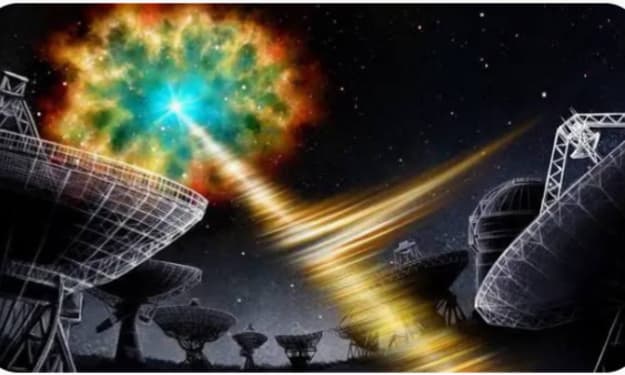
Space is full of surprises, but few have puzzled scientists as much as fast radio bursts (FRBs). These powerful flashes of radio energy last only milliseconds, yet they can outshine entire galaxies during that tiny moment. For years, astronomers have been trying to uncover where these mysterious signals come from—and now, they’ve made a major breakthrough.
By Sajida Sikandar5 days ago in The Swamp
Why Black History Matters in America?
The United States of America is celebrating their 250th anniversary in 2026. I'm proud to be an American and as someone who was born here, I wouldn't imagine myself living anywhere else. This is a country where opportunities are possible. Where anyone can be successful in anything they desire to do. Equality, community, and togetherness are the backbones of what America is and should be about. However, we have an administration who wants to erase and disregard those who have made positive, meaningful impacts in our country, specifically Black figures, such as Martin Luther King, Jr., Rosa Parks, and Maya Angelou. President Trump and his administration have been constantly complaining and fighting against what they call the "Woke agenda". They use this excuse as a distraction from other issues they refuse to address, such as the high cost of living, climate change, and inflation. That equality is dividing America, when in reality, it's bringing us together. Being woke is not tied to a specific political party. No matter where you stand on the political spectrum, you can still care about other people and their plights. Compassion and empathy for others isn't tied to a political party, either. We were taught as children to treat others the way we want to be treated and not judge others because they're different from us. Caring about others isn't a personal attack on your beliefs. It doesn't make you any less of a person. People who are easily offended over African American figures, past or present, or anything related to it, are grasping at straws. Current and future generations need to know who people like Harriet Tubman and Shirley Chisholm were, especially in the classroom. Black History is part of American History. It should be recognized, not hidden or forgotten. Besides, you can't shield children from everything, just because your feelings are easily hurt.
By Mark Wesley Pritchard 14 days ago in The Swamp
Iran ready to discuss compromises to reach nuclear deal, minister tells BBC in Tehran
Iran signalled on Sunday that it is prepared to consider “compromises” in long‑running nuclear negotiations with the United States — but only on the condition that Washington engages seriously on the issue of sanctions relief, a senior Iranian official told the BBC in Tehran. The comments, made by Deputy Foreign Minister Majid Takht‑Ravanchi, come as indirect talks between Tehran and Washington are set to resume this week in Geneva, raising cautious hopes of progress after years of stalemate. “We are ready to discuss this and other issues related to our programme if they are ready to talk about sanctions,” Takht‑Ravanchi said in the BBC interview, stressing that Tehran’s willingness to compromise hinges on reciprocal engagement by the United States. “The ball is in America’s court to prove that they want to do a deal,” he added, underscoring his government’s emphasis on U.S. concessions as part of any negotiated settlement. The Business Standard Context of the Talks The comments follow a first round of indirect negotiations between U.S. and Iranian officials that took place earlier this month in Oman, under the auspices of several regional mediators. With the next round scheduled to begin in Geneva, both sides are under pressure to find common ground after years of complex diplomacy. The Business Standard Iran’s position, as outlined by Takht‑Ravanchi and other officials, combines a readiness to discuss curbs on its nuclear programme with firm insistence that sanctions relief must be part of the equation. Tehran has also reiterated that core elements of its programme, including uranium enrichment, remain non‑negotiable — although it has offered potential adjustments, such as diluting highly enriched material, if sanctions are lifted. The Business Standard That position reflects a longstanding sticking point in negotiations: the United States and its allies want strict limits on Iran’s nuclear activities to ensure the programme remains peaceful, while Tehran seeks economic relief and political leverage in return for any constraints. The negotiators hope to revive aspects of the 2015 Joint Comprehensive Plan of Action (JCPOA), which eased Western sanctions in exchange for nuclear limits, though both sides have diverged sharply over how to reconstruct a mutually acceptable framework. The Sanctions Issue at the Forefront Sanctions remain the central issue for Iranian negotiators. Decades of punitive measures — reimposed on Tehran after the United States withdrew from the JCPOA in 2018 — have crippled Iran’s economy, and officials in Tehran have insisted that any credible deal must meaningfully ease those restrictions. Takht‑Ravanchi’s comments make clear that Iran is not prepared to concede nuclear limitations in isolation from broader economic relief. For Iran, sanctions touch ordinary citizens as well as government revenue streams, and easing them could help stabilize its currency and oil exports. But U.S. policymakers — mindful of domestic political dynamics and strategic concerns — have been cautious about how much relief to offer, especially without verifiable limits on Tehran’s nuclear programme. Iran’s readiness to discuss compromises also indicates a nuanced diplomatic posture. While its leaders repeatedly deny seeking nuclear weapons, Western capitals remain sceptical about Tehran’s intentions, given its enrichment of uranium to 60 percent purity — a level close to weapons‑grade — in recent years. Tehran argues such enrichment is for peaceful purposes, but the capability has been a core concern for U.S. negotiators. The Business Standard Scope and Limitations of Negotiations Takht‑Ravanchi made clear that Iran does not intend to link nuclear discussions to other contentious issues, such as its ballistic missile programme or regional activities — areas Washington and some U.S. allies, particularly Israel, want included in broader negotiations. By limiting the talks strictly to the nuclear file and sanctions, Tehran aims to focus diplomacy on achievable goals while deflecting demands it views as outside the scope of the nuclear agreement. The scheduled Geneva talks will bring together Iranian negotiators and U.S. envoys, including special representatives from Washington, with Oman playing a continuing mediating role. Officials in both capitals have described the process as cautious but constructive, though neither side has guaranteed a breakthrough. Broader Implications The renewed talks come at a time of heightened regional tensions. Iran has faced pressure over its nuclear programme from several angles, including regional adversaries and international sanctions, while domestic political considerations shape Tehran’s negotiating strategy. For U.S. and allied policymakers, the risk of an unconstrained nuclear programme remains a top security concern. If successful, renewed diplomacy could ease one of the most persistent flashpoints in U.S.–Iran relations. But as Takht‑Ravanchi’s remarks suggest, significant gaps remain over sanctions and nuclear limits, and both sides will need to demonstrate political will and flexibility in the coming talks.
By Fiaz Ahmed about 9 hours ago in The Swamp



Comments
There are no comments for this story
Be the first to respond and start the conversation.