
Astronomers Pinpoint a Repeating Fast Radio Burst to a Mysterious, Steady Source of Radio Emission
A groundbreaking discovery brings astronomers closer to solving the mystery of fast radio bursts and their strange, persistent origins.

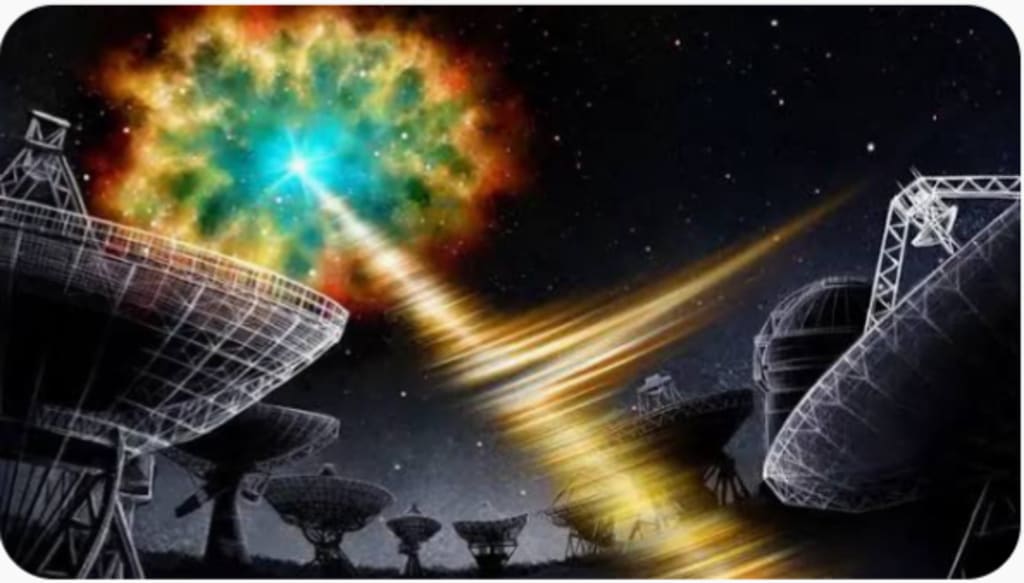
Space is full of surprises, but few have puzzled scientists as much as fast radio bursts (FRBs). These powerful flashes of radio energy last only milliseconds, yet they can outshine entire galaxies during that tiny moment. For years, astronomers have been trying to uncover where these mysterious signals come from—and now, they’ve made a major breakthrough.
Researchers have successfully traced a repeating fast radio burst to a steady and mysterious source of radio emission. This discovery could be the key to understanding what creates these intense cosmic signals and what kind of extreme environment allows them to repeat.
Let’s dive into what this discovery means and why it’s such a big deal.
🌌 What Are Fast Radio Bursts?
Fast radio bursts are brief but incredibly powerful pulses of radio waves that originate from far outside our galaxy. Each burst lasts only a few milliseconds but releases an astonishing amount of energy—sometimes equivalent to what the Sun produces in several days.
Most FRBs appear just once and never return, making them difficult to study. However, a smaller group known as repeating FRBs sends out multiple bursts from the same location. These repeaters offer scientists a unique opportunity to observe and analyze their source over time.
Since their discovery in 2007, FRBs have remained one of astronomy’s greatest mysteries. Are they produced by collapsing stars? Black holes? Exotic neutron stars? Or something we haven’t even imagined yet?
🔭 A Breakthrough in Precision
An international team of astronomers recently focused on a repeating FRB known as FRB 20190417A. Using a technique called Very Long Baseline Interferometry (VLBI)—which links radio telescopes across the globe into one giant virtual telescope—they were able to pinpoint the burst’s location with incredible accuracy.
What they found was astonishing.
The repeating bursts were traced back to the same spot as a persistent, steady radio source. In other words, the short, explosive bursts and the constant radio glow come from the same region in space.
This marks one of the clearest connections ever observed between a repeating FRB and a long-lasting radio signal.
📡 A Mysterious Steady Signal
The persistent radio source doesn’t blink in and out like the bursts—it stays on continuously. Scientists believe this means the FRB is not coming from a single catastrophic explosion but from an object or system that remains active over long periods.
Only a handful of repeating FRBs have ever been linked to such steady radio sources. One famous example is FRB 121102, which was found in a dwarf galaxy and associated with a compact radio emitter.
Now, FRB 20190417A joins this rare category, suggesting there may be a special class of repeating FRBs that live in extreme and energetic environments.
⭐ Could Magnetars Be the Answer?
One of the strongest candidates for producing repeating FRBs is a magnetar—a type of neutron star with an incredibly powerful magnetic field. Magnetars are born from the remnants of massive stars and can unleash violent bursts of energy when their magnetic fields snap or their crusts fracture.
In this scenario, the fast radio bursts come from sudden magnetic eruptions, while the steady radio source could be a surrounding nebula of energized particles created by the magnetar’s activity.
This idea fits well with the observations. The environment around FRB 20190417A appears to be dense and highly magnetized—exactly the kind of place where a magnetar could thrive.
However, magnetars aren’t the only possibility.
🌀 Other Possible Explanations
Astronomers are also considering other theories, including:
A binary system where a neutron star interacts with a companion star
A young supernova remnant feeding energy into surrounding space
A low-level active galactic nucleus
A highly magnetized region inside a star-forming galaxy
Each theory tries to explain why both short bursts and continuous radio emission come from the same location.
The challenge now is collecting more data from similar objects to see if a pattern emerges.
🌍 Why This Discovery Matters
This finding is important for several reasons:
1. It Confirms a Physical Connection
The bursts and steady radio emission are not just close by chance—they originate from the same cosmic source.
2. It Helps Narrow Down Theories
Knowing the exact environment of the FRB makes it easier to test ideas about what could be producing it.
3. It Builds a New Category of FRBs
Astronomers are beginning to recognize a special group of repeating FRBs tied to persistent radio sources, suggesting there may be more than one type of FRB in the universe.
4. It Advances Space Technology
The ability to localize these signals with such precision shows how powerful modern radio astronomy has become.
🧩 One Step Closer to Solving the Puzzle
Despite this breakthrough, the mystery of fast radio bursts is far from solved. Each new discovery adds another piece to a puzzle that scientists are still assembling.
What makes FRBs so fascinating is that they push the limits of known physics. They occur in environments more extreme than anything we can recreate on Earth and may help us better understand magnetic fields, neutron stars, and the structure of distant galaxies.
The link between a repeating FRB and a steady radio source represents a turning point. It suggests that these bursts are not random accidents but part of a complex and ongoing cosmic process.
✨ Final Thoughts
The universe continues to whisper its secrets through signals we are only beginning to understand. By pinpointing a repeating fast radio burst to a mysterious, steady source of radio emission, astronomers have taken a major step toward explaining one of space’s most elusive phenomena.
As new telescopes come online and detection methods improve, we can expect many more revelations. For now, this discovery reminds us that even the briefest flashes of light can tell long stories about the cosmos.
And somewhere, deep in space, a strange object continues to pulse—sending messages across billions of light-years, waiting for us to decode them.
About the Creator
Sajida Sikandar
Hi, I’m Sajida Sikandar, a passionate blogger with 3 years of experience in crafting engaging and insightful content. Join me as I share my thoughts, stories, and ideas on a variety of topics that matter to you.
Keep reading
More stories from Sajida Sikandar and writers in The Swamp and other communities.
Silver Price Forecast: Why the Pullback From $120 Could Fuel the Next Rally
Silver has been making headlines lately. In January 2026, it soared to near $120 per ounce, a staggering move that grabbed the attention of traders and investors worldwide. But after hitting that peak, prices pulled back sharply, leaving many wondering: Is the rally over, or is this just a pause before the next surge?
By Sajida Sikandar3 days ago in The Swamp
The Saddest Thing - The Billionaires Who Rule America Aren't Even Enjoying Themselves
This single post says more about our ruling class than a thousand policy papers. The saddest thing about today's system is that the men robbing the rest of us - sabotaging our economic prospects, our pensions, our access to affordable healthcare - are not even happy.
By Scott Christenson🌴6 days ago in The Swamp


Comments
There are no comments for this story
Be the first to respond and start the conversation.