
How María Corina Machado Dedicated her Peace Prize to Trump?
The Truth Behind the Scene

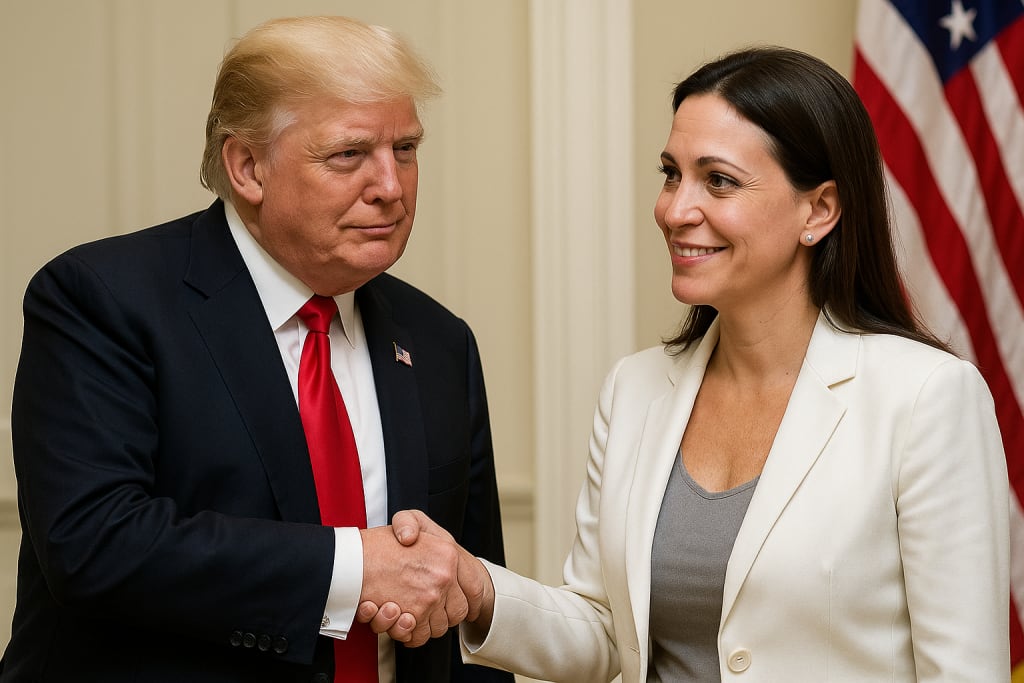
It began with a shockwave across the internet: “Venezuelan opposition leader María Corina Machado dedicates her Nobel Peace Prize to Donald Trump.” Within hours, the claim flooded X (formerly Twitter), Reddit, and YouTube. Memes exploded. Some celebrated her as a brave truth-teller; others mocked her as a political opportunist.
But what really happened? Did the 2025 Nobel Peace Prize laureate; a woman who fought tirelessly against dictatorship; actually dedicate her award to one of the most polarizing figures in U.S. politics? Let’s unravel the story beyond the headlines and uncover what was said, what was meant, and what it tells us about the world’s most complex political alliances.
A Prize That Shook Caracas; and Washington
When María Corina Machado won the 2025 Nobel Peace Prize, few were surprised by the decision itself. For years, she’s been the unwavering face of Venezuela’s pro-democracy movement; a woman who defied Nicolás Maduro’s regime, faced political persecution, and became the symbol of a nation’s hope.
The Nobel Committee praised her for “her tireless work promoting democratic rights and peaceful transition in Venezuela.” It was a recognition not just of one woman’s struggle, but of an entire country’s longing for freedom. But then came the viral moment — the one that made her victory trend far beyond Latin America.
The Viral Statement
In her post-award remarks, Machado said something that immediately set the internet ablaze:
“This recognition of the struggle of all Venezuelans is a boost … and I dedicate this prize to the suffering people of Venezuela and to President Donald Trump for his decisive support of our cause.”
The quote was real. It came directly from Machado’s verified X account. (Politico, Reuters). And with that, a new storm began.
The Explosion of Reactions
Across the political spectrum, reactions came fast and furious: Trump supporters hailed her as a “truth-teller” and “freedom fighter,” sharing clips of her speech with captions like “Finally, someone who gets it.”
Critics accused her of politicizing the Nobel Prize, turning what should be a universal symbol of peace into a partisan statement. Latin American commentators were split — some said her words were a sincere acknowledgment of U.S. support, while others called it a “strategic mistake” that could weaken her domestic credibility. Meanwhile, the Nobel Committee remained neutral, saying that laureates are “free to express gratitude as they wish,” but emphasizing that the award recognizes independent peace efforts, not alliances with political figures.
Why Would She Do It?
To understand why Machado invoked Donald Trump’s name at all, you have to look at Venezuela’s recent history. During Trump’s presidency, the U.S. applied maximum pressure on Maduro’s government — imposing sanctions, supporting opposition leaders like Juan Guaidó, and labeling Maduro’s rule as “illegitimate.”
Many in the Venezuelan opposition, including Machado, saw those years as a period of real international support.
When she said “decisive support,” she was referencing that time — when external pressure gave the opposition movement a sense of hope and global attention. To her, dedicating part of the award to Trump was a symbolic acknowledgment — not an endorsement of his entire political record, but gratitude for what she considered strategic backing at a time when few world leaders dared to challenge Caracas.
A Political Dedication or Misunderstood Symbolism?
So, did she dedicate the prize to Trump? Technically, yes, but context matters.
Her dedication had two parts: first, to the “suffering people of Venezuela,” and second, to Trump for his “decisive support.” What was framed online as a full dedication to Trump was actually a dual expression — a blend of patriotism and gratitude. But in today’s hyperpolarized digital landscape, nuance doesn’t trend — outrage does. The moment “Trump” appeared in her message, the internet chopped the sentence in half, ran it through political filters, and turned it into an ideological spectacle.
The Global Meaning Behind the Gesture
There’s also a deeper message here — one that transcends Venezuela or Trump. Machado’s statement reflects a new era of geopolitics, where democracy activists often rely on global figures — sometimes controversial ones — to amplify their struggles.
In a world where regimes like Maduro’s are backed by Russia, China, and Iran, Western backing becomes more than political — it’s existential.
By naming Trump, Machado might have been highlighting that any ally who stands up to tyranny, regardless of their political baggage, deserves acknowledgment. Still, it’s a risky gamble.
In Venezuela, where anti-American sentiment runs deep in certain circles, praising Trump could alienate potential supporters and hand propaganda material to Maduro’s regime.
The Dangers of Going Viral
The story of María Corina Machado’s “dedication” is also a lesson in how the digital age can distort reality. In the era of TikTok headlines and algorithmic outrage, context evaporates.
One sentence can turn into a global talking point — reshaping reputations, rewriting intentions, and dividing audiences overnight. Machado’s nuanced message; gratitude mixed with patriotism — was flattened into a clickbait line:
“Venezuelan leader dedicates Nobel to Trump.”
And just like that, a statement meant to express appreciation became a political weapon used by both sides.
The Real Story
So, what’s the truth? Yes, María Corina Machado mentioned Donald Trump in her dedication speech. Also, she expressed gratitude for his “decisive support.” But, she did not dedicate her entire Nobel Peace Prize to Trump.
Her primary dedication was to the Venezuelan people — those who have endured poverty, censorship, and exile under authoritarian rule. Trump’s name appeared as a secondary acknowledgment, but the world only heard the part it wanted to amplify.
The Satisfying Truth
At the end of the day, Machado’s words were not about Trump; they were about gratitude, courage, and political memory.
Her struggle predates any U.S. president and will likely outlast them all. If her dedication stirred controversy, it also sparked conversation — about freedom, loyalty, and who stands with the oppressed when the world goes silent.
In that sense, perhaps the viral uproar only reinforces her message: that democracy isn’t a partisan cause — it’s a universal one. And whether or not the world approves of her words, María Corina Machado has reminded us of something deeply human: That in the pursuit of freedom, even the smallest act of gratitude can echo louder than politics itself.
About the Creator
Keramatullah Wardak
I write practical, science-backed content on health, productivity, and self-improvement. Passionate about helping you eat smarter, think clearer, and live better—one article at a time.
Keep reading
More stories from Keramatullah Wardak and writers in The Swamp and other communities.
What’s Wrong with Title 10 U.S. Code Plenary Authority These Days for the U.S.?
In recent months, the phrase “Title 10 plenary authority” has echoed across social media, political commentary, and legal circles in America. Influencers, ex-military figures, and conspiracy theorists alike have begun invoking it — some suggesting that it grants the President unlimited power over the military, even in domestic affairs.
By Keramatullah Wardak3 months ago in The Swamp
Stocks, Bonds and Oil Steady as Investors Downplay Venezuela Upheaval
Global markets showed remarkable composure this week as investors largely shrugged off the recent political upheaval in Venezuela. While Latin America’s largest oil producer continues to grapple with internal turmoil, key financial indicators—including stocks, bonds, and oil prices—remained largely stable, suggesting that market participants are weighing broader economic fundamentals over short-term geopolitical risks. Markets Stay Grounded Amid Venezuelan Turmoil Despite news of widespread protests and political uncertainty in Caracas, major stock indices in the United States and Europe showed little volatility. The S&P 500 hovered near record highs, while European benchmarks, including Germany’s DAX and the UK’s FTSE 100, experienced minor fluctuations. Analysts suggest that investors are prioritizing macroeconomic trends, such as interest rate expectations and corporate earnings, over regional disruptions. “This isn’t the first time Venezuela has faced political instability,” said Laura Chen, a senior strategist at Horizon Capital. “Markets have learned to isolate localized events from global investment strategies. While the situation is concerning on a humanitarian level, it has limited immediate impact on diversified portfolios.” Bonds Hold Firm as Credit Concerns Linger U.S. Treasury yields remained largely unchanged, reflecting continued demand for safe-haven assets even as geopolitical risks simmer. Venezuelan debt, meanwhile, continues to trade at distressed levels, but investors appear to have largely priced in the country’s political volatility. Emerging market bonds in neighboring regions also showed resilience. Brazil, Colombia, and Mexico saw minor yield fluctuations, indicating that investors are confident in these economies’ relative stability compared to Venezuela. Financial analysts note that, in times of regional instability, capital tends to flow toward more diversified or insulated markets rather than retreating globally. Oil Prices Exhibit Surprising Stability Given Venezuela’s status as a major crude exporter, one might expect that domestic unrest could trigger spikes in global oil prices. Yet, Brent and West Texas Intermediate (WTI) crude futures have remained within a narrow range over the past week. Traders cite ample global supply and the strategic reserves maintained by countries like the U.S. and Saudi Arabia as factors mitigating sudden price swings. “Oil markets have adapted to political shocks in Venezuela before,” said Javier Morales, an energy commodities analyst. “Unless there is a sudden disruption to exports, which is unlikely in the short term, prices are expected to stay relatively stable.” Investor Sentiment: Risk vs. Reality The calm in financial markets reflects a broader trend in investor behavior: a growing ability to compartmentalize political crises. Institutional investors, in particular, appear to be weighing the risks of Venezuela’s turmoil against broader portfolio strategies, opting to maintain positions in equities and bonds. Retail investors have also demonstrated cautious optimism. Trading volumes on U.S. exchanges have been steady, with no major sell-offs attributed to Venezuelan unrest. Online forums and social media sentiment analysis indicate that while geopolitical news captures attention, it has not yet influenced significant shifts in asset allocation. Historical Context: Venezuela’s Chronic Volatility Venezuela’s political and economic instability is not new. Over the past two decades, the nation has experienced hyperinflation, currency devaluations, and multiple government crises. Each time, markets have initially reacted with concern, only to stabilize once investors assessed the broader global context. This historical perspective may explain why current market reactions are muted. Unlike sudden shocks in major economies, Venezuela’s challenges are seen as somewhat contained, with limited spillover effects on international trade and finance. Analysts’ Takeaways Market observers are emphasizing that stability in stocks, bonds, and oil does not imply that Venezuela’s situation is irrelevant. Instead, it highlights the sophistication of global investors in distinguishing between headline risk and systemic risk. “Investors are learning to differentiate between local political drama and global financial exposure,” said Chen. “While it’s critical to monitor developments in Venezuela, the markets’ steadiness reflects confidence in the resilience of the global economy.” Looking Ahead Experts caution that this equilibrium could shift if political unrest escalates to a point that disrupts Venezuela’s oil production or triggers broader regional instability. For now, however, financial markets appear unshaken, with investors showing a remarkable capacity to prioritize long-term fundamentals over short-term geopolitical noise. The Venezuelan situation will remain under close watch, especially by energy traders and emerging-market investors. Any substantial changes could influence oil prices, bond yields, and regional equity markets. But as of now, the global financial ecosystem demonstrates that not every political upheaval automatically translates into economic turbulence.
By Muhammad Hassan6 days ago in The Swamp
Bruce Lee and The God of War: Kuan Ti
It starts with love.. The Power to the God Of War and Wealth Walk into a Chinese restaurant (even in Oklahoma, USA), a Chinese police station, a kung fu martial arts studio or even a Chinese temple and you often see a red faced warrior holding a heavy quan-do (spear like weapon).
By WILD WAYNE : The Dragon King5 days ago in Chapters


Comments
There are no comments for this story
Be the first to respond and start the conversation.