
Home Energy Management System Market Trends & Summary
How Smart Energy Technologies Are Powering a More Efficient Future

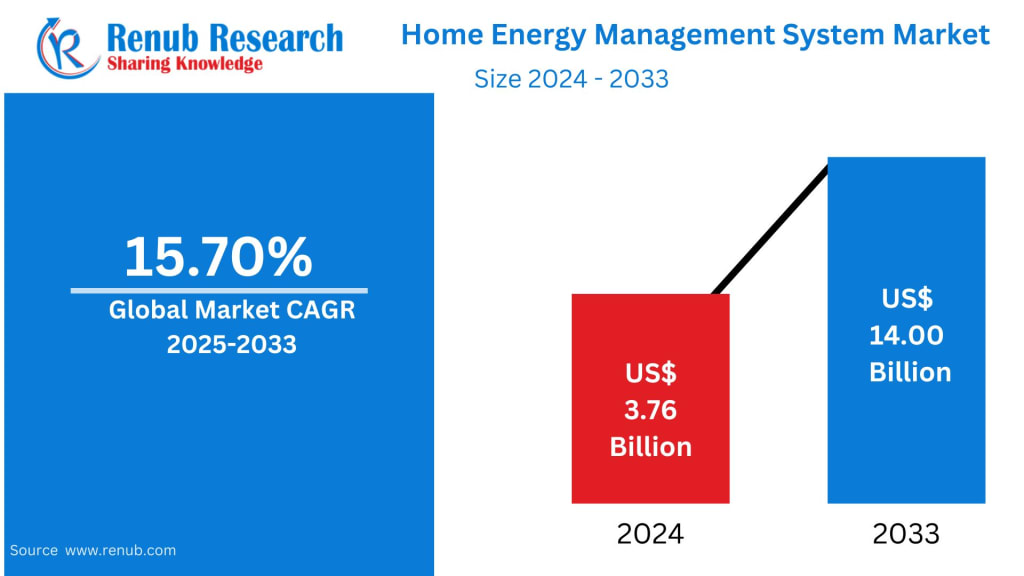
The global Home Energy Management System (HEMS) Market is expanding at one of the most dynamic growth rates in the residential technology landscape. According to Renub Research, the market stood at USD 3.76 billion in 2024 and is projected to reach USD 14.00 billion by 2033, registering a powerful CAGR of 15.70% during the forecast period. This rapid acceleration reflects the convergence of sustainability goals, rising energy costs, and widespread adoption of smart home technologies.
HEMS today is no longer a luxury technological add-on — it is becoming a necessity for households worldwide. With climate concerns escalating, governments launching energy-efficiency mandates, and consumers seeking ways to cut rising utility bills, the HEMS ecosystem is positioned at the intersection of modern living and responsible energy consumption.
Understanding the Role of Home Energy Management Systems
A Home Energy Management System is an integrated smart platform designed to monitor, control, and optimize household energy usage. By connecting with devices such as smart meters, HVAC systems, lighting systems, home appliances, solar panels, and even EV batteries, HEMS provides real-time visibility into energy consumption patterns.
Its core functions include:
Reducing energy wastage by identifying high-consumption appliances
Automating heating, cooling, and lighting to match occupancy and comfort levels
Integrating renewable energy sources such as solar and wind power
Enabling remote monitoring and control via smartphones and cloud platforms
Lowering utility costs while improving sustainability
Reducing carbon footprints at the household level
As AI and IoT technologies evolve, HEMS is becoming smarter and more intuitive — offering personalized recommendations, predictive energy usage forecasts, and seamless automation across home devices.
Key Market Growth Drivers
1. Rising Demand for Energy Efficiency
Across the world, consumers are becoming more aware of the environmental and financial impact of excessive energy usage. With electricity prices increasing and sustainability becoming a mainstream value, households are shifting toward tools that make energy more manageable.
HEMS offers real-time analytics and smart energy controls that empower users to reduce unnecessary consumption. These systems help households better understand their energy footprint, leading to behavioral changes and cost savings over time.
A key example of innovation in this space came in November 2023, when Schneider Electric integrated an OpenAI-powered tool into its energy and sustainability hub, allowing automated optimization of facility data in both commercial and residential environments. This signals a future where AI will become a central component in home energy management.
2. Smart Home Technology Advancement
The boom in IoT devices has transformed HEMS from a niche innovation into a mainstream smart home essential. Connected thermostats, smart lighting, intelligent HVAC systems, smart plugs, and energy-optimized appliances have made home automation more accessible than ever.
AI-enhanced HEMS systems now provide:
Personalized energy-saving suggestions
Automated schedules based on user habits
Predictive maintenance alerts
Integration with EV batteries for energy backup or redistribution
A landmark development occurred in December 2023, when Ford Motor Company partnered with Resideo Technologies to launch the EV-Home Power Partnership. The initiative uses Ford EV batteries within a Vehicle-to-Home (V2H) setup to manage household energy. This underscores how HEMS is evolving into a holistic solution integrating mobility, storage, and home consumption patterns.
3. Government Incentives and Global Sustainability Goals
Energy efficiency has become a national priority across many regions. Governments are offering tax credits, rebates, and subsidies to incentivize the adoption of smart energy technologies.
By November 2023:
25 U.S. states had mandatory Energy Efficiency Resource Standards (EERS)
Several states offered tax rebates for installing energy-efficient appliances
Global regulations increasingly promote the adoption of smart meters and renewable-ready homes
These initiatives significantly boost the adoption of HEMS, positioning it as a central technology in transitioning toward low-carbon residential infrastructure.
Market Barriers: Challenges Slowing Down Adoption
High Upfront Costs and Technological Complexity
For many households, the initial purchase and installation cost of HEMS remains a barrier. Integration with existing home systems may require technical expertise, and the overall setup process can feel intimidating for less tech-savvy users.
Manufacturers are responding by simplifying user interfaces, offering modular systems, and reducing hardware costs — efforts essential for mass adoption in developing markets.
Data Security and Privacy Concerns
As a data-driven system, HEMS collects information about household behavior patterns and device usage. This raises valid concerns about:
Cybersecurity breaches
Unauthorized access to home data
Misuse of personal consumption records
Addressing these concerns is critical. The future success of the HEMS market will depend on transparent data practices and robust cybersecurity frameworks that reassure users their homes — and their data — remain safe.
Market Segments: A Closer Look
Lighting Controls
Lighting accounts for a significant share of home electricity usage, making lighting controls one of the most influential components of HEMS. Solutions such as motion sensors, dimmers, and automated timers reduce unnecessary consumption and enhance overall energy efficiency. These systems are essential in creating responsive, low-energy households.
Home Energy Management Software
The software layer forms the intelligence behind HEMS. These platforms offer:
Real-time dashboards
Remote control through mobile apps
Automated device management
Energy consumption analytics
AI-driven optimization
Software is increasingly becoming the most valuable segment, as cloud connectivity and AI integration continue to strengthen its capabilities.
Cloud-Based HEMS
Cloud platforms allow users to access their systems anytime, anywhere. Cloud-based HEMS benefits include:
Instant updates and scalability
Advanced predictive analytics
More efficient storage and data processing
As more households adopt smart home ecosystems, cloud HEMS is quickly becoming the preferred deployment model.
Regional Market Outlook
United States
The U.S. remains one of the most influential markets for HEMS. Rising energy prices, ambitious sustainability goals, and rapid adoption of smart home devices are driving growth. Integration with renewable energy — especially residential solar — is becoming standard practice.
A major milestone was achieved in June 2024, when ABB launched the ReliaHome Smart Panel, marking its entry into residential energy management in the U.S. and Canada. The panel offers real-time power management and grid optimization capabilities, positioning ABB as a strong competitor in this space.
United Kingdom
The U.K.’s strong commitment to achieving net-zero carbon emissions by 2050 is accelerating HEMS adoption. The combination of rising energy bills and government-supported smart meter deployment has created an environment where HEMS is increasingly essential.
In November 2024, U.K.-based Wondrwall introduced a high-performance heat pump integrated with an AI-powered HEMS platform, designed to optimize energy flow — a key step toward residential decarbonization.
India
India is emerging as a promising HEMS market due to:
Rapid urbanization
Increasing electricity costs
National Smart Cities Mission
Growing renewable energy installations
The market is price-sensitive, making affordable and simplified systems essential. In September 2024, ABB India launched ABB-free@home, an interoperable smart home automation platform enhancing energy efficiency and security for Indian households.
Saudi Arabia
Saudi Arabia’s Vision 2030 initiative is strongly focused on sustainability and energy diversification. With high household electricity usage and expanding solar installations, HEMS adoption is rising quickly.
The Kingdom is investing in advanced residential technologies that optimize energy flow and reduce grid load, making it a fast-growing regional market for energy management solutions.
Home Energy Management System Market Breakdown
By Product Type
Lighting Controls
Thermostats
Self-Monitoring Systems
Advanced Central Controllers
Intelligent HVAC Controllers
By Component
Hardware
Software
Services
By Deployment
On-Premise
Cloud
By Region (25 Countries Covered)
North America: United States, Canada
Europe: France, Germany, Italy, Spain, U.K., Belgium, Netherlands, Turkey
Asia Pacific: China, Japan, India, South Korea, Thailand, Malaysia, Indonesia, Australia, New Zealand
Latin America: Brazil, Mexico, Argentina
Middle East & Africa: Saudi Arabia, UAE, South Africa
Key Companies Profiled
Honeywell International, Inc.
General Electric Company
Comcast Cable (Xfinity)
Panasonic Corporation
Johnson Controls
Schneider Electric SE
Robert Bosch GmbH
Final Thoughts
The Home Energy Management System market is moving from a niche innovation into a global necessity. As electricity costs rise, climate goals tighten, and smart home ecosystems flourish, HEMS will soon become as essential as broadband internet or home security systems.
Its future lies in deeper AI integration, seamless IoT compatibility, renewable energy optimization, and consumer-friendly design. With governments, manufacturers, and consumers aligned toward a more energy-efficient world, the market’s growth trajectory toward USD 14 billion by 2033 reflects a transformational shift in how the world manages residential energy.
About the Creator
jaiklin Fanandish
Jaiklin Fanandish, a passionate storyteller with 10 years of experience, crafts engaging narratives that blend creativity, emotion, and imagination to inspire and connect with readers worldwide.
Keep reading
More stories from jaiklin Fanandish and writers in The Swamp and other communities.
System Integration Market Size and Forecast 2025–2033: A Rapidly Expanding Backbone of Global Digital Transformation
Introduction The global System Integration Market, valued at USD 461.36 billion in 2024, is accelerating into a new era of digital maturity. According to Renub Research, the market is projected to grow at a CAGR of 10.32% between 2025 and 2033, ultimately reaching an impressive USD 1,116.68 billion by 2033. This growth is driven by the global shift toward automation, cloud computing, big data analytics, and the widespread adoption of IoT technologies across industries such as manufacturing, healthcare, and finance.
By jaiklin Fanandishabout a month ago in The Swamp
Egypt Rejects What It Calls a “Fantastic” Emirati Offer: Power, Pride, and Politics in the Arab World
In a region where financial power often translates into political leverage, Egypt’s recent rejection of what officials described as a “fantastic” offer from the United Arab Emirates has drawn widespread attention. At a time when Egypt’s economy faces inflationary pressure, currency challenges, and rising public debt, turning down a lucrative proposal from one of the Gulf’s wealthiest states appears, on the surface, counterintuitive. Yet Cairo’s decision reflects deeper strategic calculations about sovereignty, long-term stability, and the limits of economic dependency. What Was Behind the “Fantastic” Offer? While official details remain limited, the Emirati proposal was widely understood to involve major investment, development rights, or long-term control over strategic assets. Such offers are not new in the Middle East. Wealthy Gulf states, particularly the UAE and Saudi Arabia, have increasingly used capital investment as a tool of regional influence, financing infrastructure, ports, real estate megaprojects, and energy ventures across the Arab world. From Egypt’s perspective, the offer was financially attractive—hence the term “fantastic.” In an era where foreign currency inflows are vital, Gulf investment has often been a lifeline for Cairo. Over the past decade, Egypt has relied heavily on deposits, loans, and investments from its Gulf allies to stabilize its economy and fund large-scale development projects. So why say no? Sovereignty Over Short-Term Relief At the heart of Egypt’s refusal lies a familiar concern: sovereignty. Egyptian officials signaled that while financial support is welcome, it cannot come at the expense of national control over strategic land, infrastructure, or decision-making authority. In other words, not all money is worth taking—especially if it risks long-term dependence or public backlash. Egypt’s leadership is acutely aware of domestic sensitivities. Public opinion has grown increasingly wary of foreign ownership of national assets, particularly land and ports. Accepting a deal perceived as selling off sovereignty could fuel social unrest, political criticism, and accusations of mortgaging the country’s future for short-term cash. By rejecting the offer, Cairo sent a clear message: economic cooperation must respect national red lines. A Shift in Egypt’s Negotiating Posture This decision also suggests a subtle shift in Egypt’s regional posture. Rather than passively accepting Gulf capital under unequal terms, Egypt appears to be asserting itself as a partner, not a client. This recalibration does not mean Cairo is distancing itself from the UAE—relations remain strong—but it does indicate a desire for more balanced agreements. Egypt has been working to diversify its economic partnerships, strengthening ties with Europe, Asia, and multilateral institutions. By widening its options, Cairo gains leverage, reducing the pressure to accept any single deal that may compromise long-term interests. Regional Implications The rejection carries implications beyond Egypt and the UAE. Across the Middle East and North Africa, countries facing economic strain are increasingly confronting a difficult question: how to attract foreign investment without surrendering strategic autonomy. Egypt’s stance may embolden other states to renegotiate terms with powerful investors, insisting on transparency, local ownership, and shared governance. At the same time, it may prompt Gulf investors to reassess how their offers are structured, recognizing that influence through capital has limits. For the UAE, the refusal is unlikely to trigger a rupture. Abu Dhabi is known for its pragmatic diplomacy and may return with revised terms more aligned with Egypt’s priorities. In regional politics, today’s rejection can become tomorrow’s renegotiation. Economic Reality Still Looms Despite the symbolism of saying no, Egypt’s economic challenges remain pressing. Inflation, currency devaluation, and debt servicing continue to strain public finances. Turning down major investment does not eliminate the need for foreign capital—it simply raises the stakes for finding deals that align with national strategy. The challenge for Egypt now is to translate this principled stance into sustainable alternatives: boosting exports, supporting local industry, attracting diversified investment, and implementing reforms that reduce reliance on external lifelines. More Than a Financial Decision Ultimately, Egypt’s rejection of the “fantastic” Emirati offer is about more than money. It reflects a broader debate playing out across the Global South: how nations balance urgent economic needs with long-term independence in an era of capital-driven geopolitics. For Vocal Media readers, this story resonates because it highlights a universal tension—between opportunity and caution, growth and control, partnership and power. Egypt’s decision reminds us that sometimes the most consequential choices are not about what a country accepts, but what it chooses to refuse. As negotiations continue behind closed doors, one thing is clear: Cairo has drawn its line, and the region is watching closely to see what comes next.
By Fiazahmedbrohi 6 days ago in The Swamp


Comments
There are no comments for this story
Be the first to respond and start the conversation.