
GCC Smart Home Market Size and Forecast 2025–2033: Connected Living Reshapes the Future of Gulf Homes
From AI-powered security to energy-efficient automation, smart homes are becoming the new standard across the GCC

Introduction: A Smarter Way of Living in the Gulf
The Gulf Cooperation Council (GCC) region is rapidly transforming into one of the world’s most technology-forward residential markets. From luxury high-rise apartments in Dubai to master-planned smart cities in Saudi Arabia and Qatar, the concept of connected living is no longer a futuristic idea—it is quickly becoming a mainstream reality. Smart homes, once seen as premium add-ons for tech enthusiasts, are now being embraced by a wider population seeking convenience, security, energy efficiency, and lifestyle enhancement.
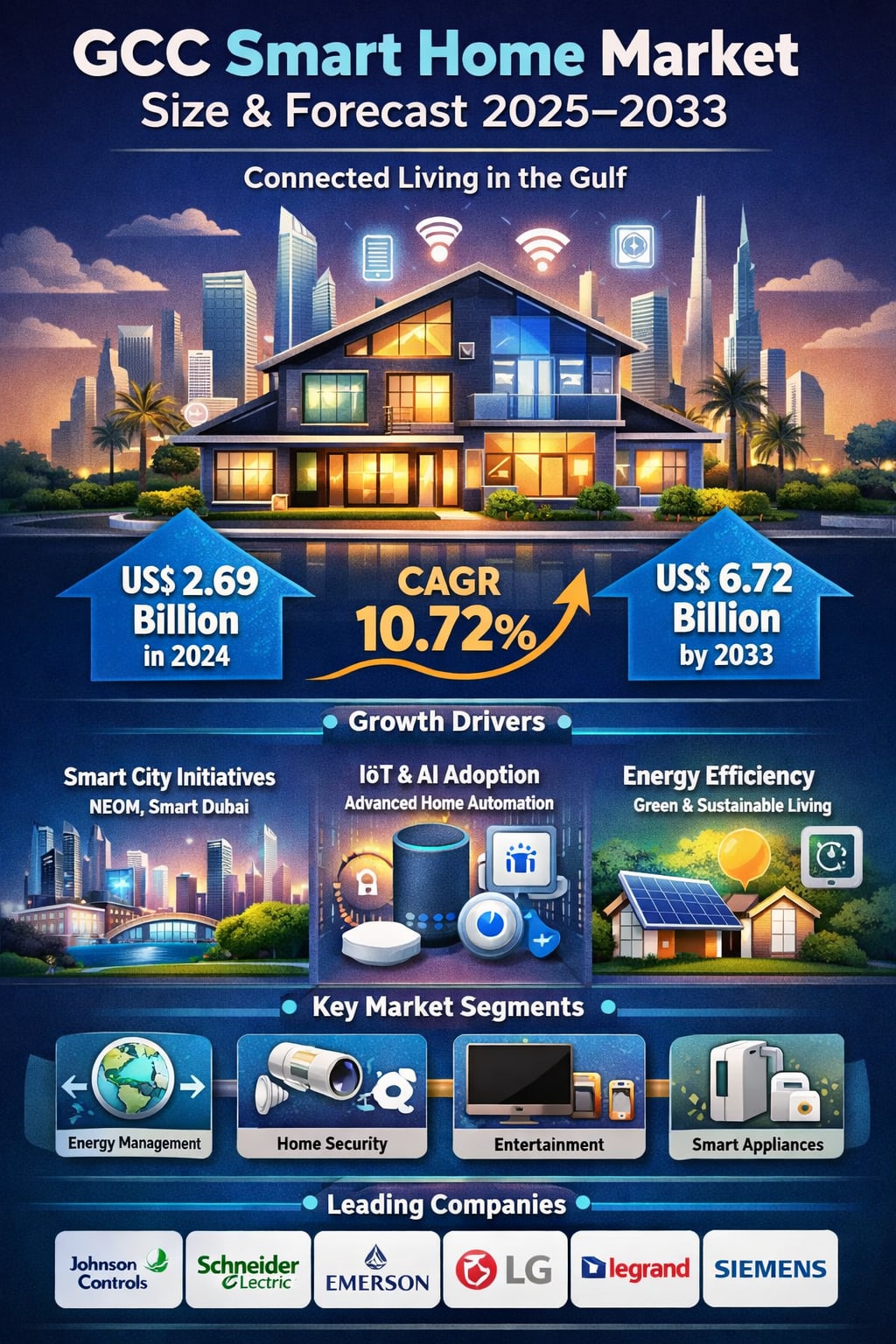
According to Renub Research, the GCC Smart Home Market is projected to grow from US$ 2.69 billion in 2024 to around US$ 6.72 billion by 2033, registering a compound annual growth rate (CAGR) of 10.72% starting from 2025. This strong growth trajectory reflects the region’s rising adoption of home automation technologies, the integration of artificial intelligence (AI) into security and energy systems, and the expanding ecosystem of Internet of Things (IoT) devices.
Beyond technology, several structural factors are shaping this expansion. Rapid urbanization, rising disposable incomes, a young and tech-savvy population, and ambitious government-led smart city initiatives are creating ideal conditions for smart home solutions to flourish. At the same time, the region’s climate and energy consumption patterns are pushing both policymakers and consumers toward more efficient, automated, and sustainable living environments.
GCC Smart Home Market Outlook
A smart home is a residence equipped with advanced technologies that enable the automation and remote control of household systems such as lighting, climate control, security, and entertainment. These systems are typically managed through smartphones, tablets, or voice-controlled assistants, offering users greater convenience, comfort, and operational efficiency.
In the GCC, the demand for smart homes is accelerating at a remarkable pace. The region’s affluent consumer base increasingly expects modern, connected living experiences, while developers and governments are embedding smart technologies into new residential and mixed-use projects from the ground up. Countries such as the UAE, Saudi Arabia, and Qatar are positioning smart living as a core pillar of their long-term urban development strategies.
The regional climate also plays a crucial role. With high temperatures dominating much of the year, energy-efficient cooling and climate control systems are not just desirable—they are essential. Smart thermostats, intelligent HVAC systems, and automated lighting controls help optimize energy consumption, reduce costs, and support broader sustainability goals. As awareness of these benefits grows, more households are willing to invest in smart home technologies, reinforcing the market’s strong growth outlook through 2033.
Growth Drivers in the GCC Smart Home Market
Urbanization and Smart City Development on the Rise
Urbanization and government-backed smart city initiatives are among the most powerful drivers of the GCC smart home market. Mega-projects such as NEOM in Saudi Arabia, Smart Dubai, and various digital transformation programs across the region are redefining how cities and homes are designed and operated. These projects place strong emphasis on connectivity, automation, energy efficiency, and data-driven urban management.
New residential developments increasingly come pre-equipped with smart lighting systems, automated climate control, integrated security solutions, and centralized control platforms. For consumers, this means smart living is no longer an optional upgrade—it is becoming a standard feature in modern housing. As smart city ecosystems expand, the demand for interconnected home solutions is expected to rise steadily across the GCC.
Increasing Use of IoT and AI-Based Home Automation
The rapid spread of IoT devices and AI-driven platforms is fundamentally reshaping the smart home landscape. High-speed internet, expanding 5G networks, and cloud computing infrastructure are enabling seamless connectivity between devices, applications, and users. Voice assistants, smart hubs, and AI-powered management systems are becoming the central nervous systems of modern homes.
These technologies allow for personalized experiences, predictive energy management, and enhanced security monitoring. For example, AI can learn household routines to optimize lighting and temperature settings, while IoT sensors provide real-time data on energy usage and security conditions. As consumers across the GCC become more digitally literate and comfortable with connected ecosystems, adoption of smart home solutions continues to accelerate.
Growing Emphasis on Energy Efficiency and Sustainability
Energy efficiency is a strategic priority for GCC countries as they work to diversify their energy mix and reduce carbon emissions. Smart home technologies play a critical role in this transition by enabling more precise control over electricity consumption. Smart meters, automated lighting, intelligent thermostats, and energy management platforms provide homeowners with real-time insights and control over their usage patterns.
Governments are also encouraging green building standards and sustainable construction practices, which further supports the adoption of smart home systems. For consumers, the benefits are twofold: lower energy bills and a reduced environmental footprint. This alignment between policy goals, economic incentives, and environmental awareness is significantly boosting demand for energy-efficient smart home solutions across the region.
GCC Smart Home Market Challenges
High Upfront Installation and Integration Costs
Despite strong interest and growing awareness, high initial costs remain a key barrier to mass adoption. Implementing a comprehensive smart home system often requires significant investment in hardware, software, networking infrastructure, and professional installation services. For many middle-income households, these upfront expenses can be a major deterrent.
In addition, compatibility issues between different device ecosystems can increase both complexity and cost. While prices are gradually declining as technology matures, advanced and fully integrated smart home systems are still perceived as premium offerings. This limits penetration in more price-sensitive segments of the market.
Data Privacy and Cybersecurity Concerns
As smart homes become more connected, concerns around data privacy and cybersecurity are growing. Smart devices continuously collect and transmit sensitive information, including usage patterns, personal preferences, and security data. This creates potential vulnerabilities to hacking, data breaches, or unauthorized surveillance.
Many consumers remain cautious about fully embracing smart home technologies due to these risks. The lack of unified cybersecurity regulations across the GCC further complicates the issue. To sustain long-term growth, manufacturers and service providers must prioritize robust security frameworks, data encryption, and compliance with international privacy standards to build and maintain consumer trust.
Key Segments of the GCC Smart Home Market
GCC Energy Management Smart Home Market
Energy management is one of the most important pillars of the smart home ecosystem in the GCC. These systems use connected sensors, smart meters, and AI-driven analytics to monitor and optimize electricity consumption. Homeowners can remotely control lighting, air conditioning, and appliances, significantly reducing energy waste.
With rising electricity costs and strong government support for energy efficiency initiatives, demand for smart thermostats and intelligent HVAC systems is growing rapidly. Integration with renewable energy sources, such as rooftop solar panels, further enhances the value proposition of smart energy management solutions. This segment is expected to remain one of the fastest-growing areas of the GCC smart home market.
GCC Smart Home Entertainment Market
The region’s high-income population and preference for premium lifestyles are fueling strong growth in smart home entertainment solutions. Connected televisions, multi-room audio systems, and immersive home theater setups are increasingly common in urban households. Integration with streaming platforms, voice assistants, and AI-driven personalization tools enhances the overall user experience.
The expansion of high-speed broadband and 5G networks is making high-definition streaming, cloud gaming, and interactive content more accessible than ever. In addition, real estate developers and hospitality providers are incorporating advanced entertainment automation into luxury residences and hotels, further boosting demand in this segment.
GCC Smart Home Security Market
Security remains one of the top priorities for homeowners across the GCC. Smart surveillance cameras, motion sensors, alarm systems, and biometric access controls are seeing strong adoption. These solutions provide real-time monitoring, instant alerts, and remote access via mobile devices, significantly improving peace of mind for users.
The integration of AI technologies, such as facial recognition and intelligent threat detection, is further enhancing the effectiveness of smart security systems. As urban populations grow and residential complexes become more sophisticated, the demand for advanced, connected security solutions is expected to remain robust.
GCC Smart Home Appliance Market
Smart appliances, including refrigerators, washing machines, ovens, and dishwashers, are becoming increasingly popular in GCC households. These devices can be monitored and controlled remotely, offering greater convenience, efficiency, and performance optimization. Manufacturers are introducing AI-powered features that improve energy efficiency, maintenance scheduling, and user experience.
The growth of e-commerce and digital retail platforms is also making smart appliances more accessible to consumers across the region. Combined with rising awareness of sustainability and convenience, this segment is set to play a major role in the overall expansion of the smart home market.
Country-Level Insights
UAE Smart Home Market
The UAE leads the GCC in smart home adoption, driven by rapid urbanization, high disposable incomes, and ambitious smart city strategies such as Smart Dubai and Abu Dhabi Vision 2030. The country’s advanced telecommunications infrastructure and widespread 5G deployment provide a strong foundation for IoT integration.
Luxury residential developments increasingly feature fully integrated smart home systems covering security, energy management, and entertainment. With strong government support and a tech-savvy population, the UAE remains at the forefront of smart home innovation in the region.
Kuwait Smart Home Market
Kuwait’s smart home market is expanding as consumers embrace technology-driven lifestyles and energy-efficient solutions. Government initiatives promoting digital infrastructure and smart development are supporting this trend. Demand is particularly strong for smart lighting, climate control, and entertainment systems in middle- and high-income households.
While high installation costs and cybersecurity concerns remain challenges, growing awareness of the benefits of smart living is expected to drive steady growth in the coming years.
Bahrain Smart Home Market
Bahrain is emerging as a promising smart home market, supported by its digital transformation agenda and strong ICT infrastructure. Real estate developers are increasingly integrating smart technologies into new housing projects to meet demand for modern, connected lifestyles.
Although smaller in scale compared to some neighboring markets, Bahrain’s focus on innovation and digital connectivity positions it as an important growth contributor within the GCC smart home landscape.
Qatar Smart Home Market
Qatar’s smart home market is gaining momentum, fueled by large-scale smart city projects such as Lusail and Msheireb Downtown Doha. High income levels, advanced infrastructure, and a strong focus on sustainability create a favorable environment for smart home adoption.
The modernization drive accelerated by major international events has further boosted technology uptake across residential and commercial spaces. With continued government support and strong consumer interest, Qatar is expected to maintain steady growth in smart home solutions.
GCC Smart Home Market Segmentation
By Application:
Comfort and Lighting
Control and Connectivity
Energy Management
Home Entertainment
Security
Smart Appliances
By Country:
UAE
Saudi Arabia
Qatar
Kuwait
Bahrain
Oman
Competitive Landscape and Key Players
The GCC smart home market features a mix of global technology leaders and specialized solution providers. Companies are competing on innovation, ecosystem integration, reliability, and after-sales support.
Key players include:
Johnson Controls
Schneider Electric
Emerson Electric
LG
Legrand SA
Siemens AG
Honeywell
Apple
These companies are actively investing in AI, IoT platforms, and energy management technologies to strengthen their positions in the rapidly evolving smart home ecosystem.
Final Thoughts: A Connected Future for GCC Homes
The GCC smart home market is entering a decisive growth phase. With the market expected to rise from US$ 2.69 billion in 2024 to around US$ 6.72 billion by 2033 at a CAGR of 10.72%, smart living is no longer a niche concept—it is becoming a core component of modern residential life in the region.
Driven by smart city initiatives, rapid digitalization, rising energy efficiency needs, and evolving consumer expectations, smart home technologies are set to redefine how people live, manage energy, and secure their homes. While challenges such as high upfront costs and cybersecurity concerns remain, continued innovation, supportive policies, and growing awareness are likely to overcome these barriers.
In the years ahead, smart homes will not just represent convenience or luxury in the GCC—they will become a symbol of sustainable, connected, and future-ready living.
About the Creator
The Saddest Thing - The Billionaires Who Rule America Aren't Even Enjoying Themselves
This single post says more about our ruling class than a thousand policy papers. The saddest thing about today's system is that the men robbing the rest of us - sabotaging our economic prospects, our pensions, our access to affordable healthcare - are not even happy.
By Scott Christenson🌴6 days ago in The Swamp
Astronomers Pinpoint a Repeating Fast Radio Burst to a Mysterious, Steady Source of Radio Emission
Space is full of surprises, but few have puzzled scientists as much as fast radio bursts (FRBs). These powerful flashes of radio energy last only milliseconds, yet they can outshine entire galaxies during that tiny moment. For years, astronomers have been trying to uncover where these mysterious signals come from—and now, they’ve made a major breakthrough.
By Sajida Sikandar2 days ago in The Swamp
Bartender
On the heels of grief, pain bears down hard. On the heels of death, pain awakens the quiet place between the end of our own life and now. Feeling anything is like seeing a film and in black and white, slow motion, all sound turned off. Just watching. Gritting teeth, awkward smiles and bloody red eyes move around, scanning the others who are feeling something I don't want to feel, but I do. Escapism is all I have ever known. ~
By ROCK aka Andrea Polla (Simmons)a day ago in Poets




Comments
There are no comments for this story
Be the first to respond and start the conversation.