
🇵🇱 European Elections and Rising Nationalism
"Election Season in Europe: National Identity vs. EU Unity"

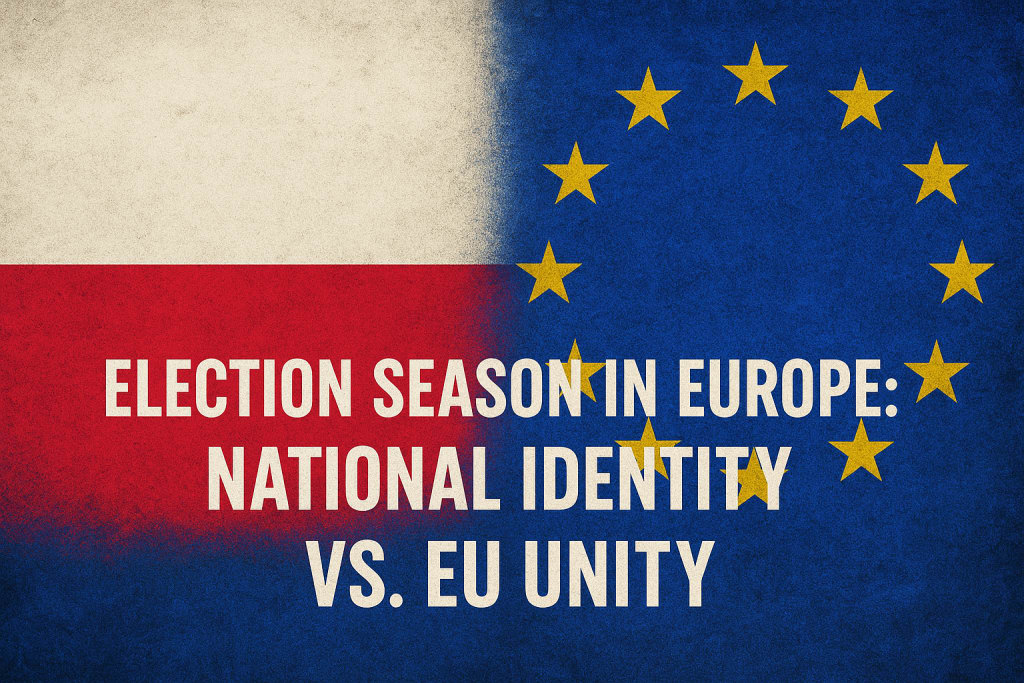
Election Season in Europe: National Identity vs. EU Unity
As spring 2025 turns to summer, voters from Warsaw to Lisbon—and from Bucharest to Dublin—are filing into gyms, town halls, and makeshift poll stations for the most consequential European election season in a decade. The headlines shout about populist surges, cyber-intrigue, and razor-thin polls, but the deeper story is an old question with new urgency: Can national identity comfortably coexist with the promise—and the constraints—of European Union unity?
---
A Continent of Parallel Referendums
Europe’s “super-cycle” of elections this year is unusually dense:
Poland is choosing a president;
Romania and Portugal hold general elections;
Austria elects a new parliament just four weeks later;
And in June, all 27 EU member states vote for the European Parliament.
Traditionally, these contests unfold on separate timetables. In 2025, however, they overlap, allowing a single, trans-continental conversation to echo from capital to capital. And the common denominator is identity politics—how a nation sees itself versus how it fits inside a 450-million-person union.
---
Poland: Between Civic Patriotism and Cultural Conservatism
Polls put Warsaw’s liberal mayor Rafał Trzaskowski neck-and-neck with conservative historian Karol Nawrocki. Trzaskowski frames Poland as a “responsible European stakeholder,” promising to repair bruised relations with Brussels and to unlock €35 billion in frozen recovery funds. Nawrocki counters that Europe’s technocrats “do not understand Polish culture or sacrifice,” highlighting Catholic values, strict border controls, and wary views of Germany.
The clash is not merely rhetorical; it could rewrite Poland’s constitution. Trzaskowski’s coalition wants to loosen one of the EU’s tightest abortion regimes and embed a stronger separation of church and state. Nawrocki vows to entrench an “unborn child protection” clause and elevate the Polish language’s constitutional status. Either path would become a test case for how far national constitutions can diverge from EU human-rights norms without triggering punitive measures from Brussels.
---
Romania: Populism Learns to Speak Brussels
If Poland exemplifies a tug-of-war between cosmopolitan and conservative definitions of nationhood, Romania’s far-right upstart George Simion demonstrates how nationalist rhetoric is evolving. Simion’s slogan “We Build Here” rails against perceived “colonial” investment by French banks and Austrian retailers, yet he also insists he would not take Romania out of the EU: “We respect the club—provided the club respects us.”
Analysts call this “Euro-sovereigntism”—a strategy of leveraging EU rules to defend local industries while fending off deeper political integration. Simion demands the same agricultural subsidy formula that benefits French farmers and threatens to veto any new EU climate regulation that “kills Romanian coal.” In other words, the union becomes both scapegoat and shield, proving how malleable the project has become in the populist imagination.
---
Portugal and Austria: The Centrist Counter-Punch
Not every ballot is bending rightward. In Portugal, Socialist incumbent Marta Carvalho is favored to win a fresh mandate running on a straightforward pro-EU platform: robust green-energy investment financed by the EU Recovery Fund, plus a pledge to hit NATO’s 2 percent defense target. Her rally crowds chant “Europa, Europa,” illustrating how southern Europe’s memory of the euro-crisis still ties prosperity to Brussels.
Austria, meanwhile, provides a textbook centrist comeback. Former chancellor Alexander Schallenberg rebuilt his battered People’s Party by adopting pragmatic migration quotas and clear support for EU enlargement in the western Balkans—policies that peel moderate voters away from the nationalist Freedom Party. Polls suggest a narrow People’s-Green coalition victory, hinting that disciplined centrism can still defeat identity-driven polarization.
---
Digital Battlefields and Cyber Borders
No modern European election escapes the digital arena. Poland’s intelligence service has traced thousands of social-media ads smearing Trzaskowski’s LGBTQ-rights stance to Russian-linked IP addresses. In Romania, deep-fake videos of Carvalho speaking broken Romanian—intended to mock elite Portuguese accents—were shared 1.8 million times on TikTok before being removed.
Brussels has rolled out the Digital Services Act (DSA) requiring platforms to delete demonstrably false electoral content within 24 hours, but critics say enforcement lags. Tech-policy scholar Dr. Liisa Väyrynen notes, “The irony is that online disinformation travels along the same borderless network that once symbolized Europe’s unity.” The EU thus faces a paradox: protecting national elections may demand new cross-border regulations that feel, to some voters, like further encroachment.
---
The Economics Underneath the Flags
Beyond culture wars and meme warfare lies a concrete economic dilemma. The European Commission’s latest forecast projects GDP growth of 0.7 percent in 2025, sluggish by global standards. Energy costs remain volatile despite lower natural-gas prices, and defense spending has surged because of Russia’s 2024 offensive near Kharkiv.
For many households, the EU’s single market still means cheaper flights and Erasmus scholarships; for small manufacturers in Łódź or Sibiu, it means German rivals outgunning them on scale. When Nawrocki decries “unequal competition,” or Simion demands “fair steel quotas,” they tap into legitimate discontent that Brussels often addresses with slow-moving funds rather than quick-fire narratives.
---
What Unity Looks Like Now
Is the European project fracturing? Not quite. Even the loudest nationalist leaders stop short of advocating a Brexit-style exit. The pragmatic calculus—access to €700 billion of recovery money, intelligence sharing against Russia, collective vaccine procurement—remains persuasive.
Yet the union is morphing into a looser, more transactional federation. Political scientist Prof. Lucía Reyna describes the emerging model as “variable-geometry Europe”: countries cluster into mini-alliances—Nordic digital champions, Visegrád migration hawks, Mediterranean energy cooperatives—pursuing tailored integration levels. Elections in 2025 are accelerating this trend by rewarding politicians who master the dual language of sovereignty at home and savvy bargaining in Brussels.
---
The Ballot-Box Forecast
Will voter angst translate into sweeping constitutional upheavals? Poll-averages as of mid-May suggest a mixed verdict:
The European Parliament could see the nationalist Identity & Democracy group rise from 84 to roughly 110 seats—significant, but still far from a majority in the 720-seat chamber.
In national capitals, at least two of four high-profile races (Poland, Portugal, Austria, Romania) look likely to keep centrist or center-left governments in power.
These numbers imply a pluralist parliament where coalitions will be messy but workable. For the EU, that means more debates on migration quotas, industrial-policy subsidies, and rule-of-law benchmarks—but no existential rupture.
---
Conclusion: A Reluctant Renegotiation
Europe’s 2025 election season underscores that national pride and European unity are not mutually exclusive, yet neither sits comfortably atop the other. Voters crave both the security of belonging to a powerful bloc and the reassurance that their unique languages, churches, and local industries will not be steamrolled by distant technocrats.
The likely outcome is a continuous, sometimes exhausting renegotiation of competences: border policy here, fiscal transfers there, digital rules everywhere. As ballots are counted and coalitions formed, the takeaway is clear: Europe’s story is no longer a linear march toward “ever closer union,” but a mosaic of identities learning, argument by argument, how to share a roof without erasing the paint on each other’s front doors.
In that sense, the contest between national identity and EU unity is not a battle to be won or lost in 2025; it is the defining conversation that will shape European democracy for decades to come.
About the Creator
World politics
shares simple and clear updates on global news, leaders, and events. We cover politics, conflicts, and international stories that shape the world. Stay informed and learn something new every day.
Keep reading
More stories from World politics and writers in The Swamp and other communities.
Trump & KSA: Power, Oil, and Politics
Trump & KSA: Power, Oil, and Politics Few alliances in modern geopolitics have generated as much intrigue, criticism, and speculation as that between former U.S. President Donald J. Trump and the Kingdom of Saudi Arabia. It is a relationship built not merely on diplomacy, but on towering stakes: oil, arms, influence, and ideology. From lavish state receptions in Riyadh to controversial arms deals and mutual interests in regional security, the Trump-KSA connection became one of the defining features of his foreign policy. As Trump reenters the global stage with renewed political ambitions, the echoes of his engagement with Saudi Arabia continue to shape the narrative of U.S. involvement in the Middle East—and may once again become central in his potential return to power.
By World politics 10 months ago in The Swamp
Parallel Protests
I haven't written for quite some time, but I have A LOT of thoughts about yesterday's protest rally against our government's involvement and complicity in America's war on Iran, on the harbourside of my home city Bristol, and I need to put them somewhere. My gorgeous girlfriend is always a loving and listening ear and sharing it all with her will always be a healthy and happy way of processing the mental and emotional weight, but getting it straight in my brain to share means writing it all down in straight lines, so, here we are and thanks for being here.
By Steph Cole10 days ago in The Swamp
Spain’s New Amnesty Offers Legal Status, Work Rights, and Hope to Hundreds of Thousands of Undocumented Migrants
Madrid — When Spain’s government unveiled a sweeping amnesty plan in late January designed to offer legal status to hundreds of thousands of undocumented migrants, reactions ranged from political controversy to deep relief among the very people the policy aims to help. For many undocumented residents struggling on the margins of Spanish society, the initiative has been described in deeply personal terms as a “gift” and a “lifeline.” The extraordinary regularisation scheme, approved as a Royal Decree by the coalition government of Prime Minister Pedro Sánchez, will open a temporary path to legal residency and work authorisation for foreign nationals who can show they were living in Spain before Dec 31 2025 and have maintained at least five months’ continuous residence. Applicants also must have a clean criminal record to qualify. Once the programme begins in April 2026, beneficiaries will receive a one‑year renewable residence permit that immediately allows them to work legally, access Spain’s public health system, and register for social security. Estimates of the number who could benefit vary: the government cites around 500,000, while some internal police estimates suggest the figure could be as high as 750,000 – 1.1 million. “It’s Going to Help Us in Every Way” For migrants who have lived for years in legal limbo, the news has sparked genuine optimism. Diana, a 40‑year‑old from Peru who spoke with reporters in Madrid, said that life without formal status has been extremely difficult — limited job options, exploitation by employers, and exclusion from basic services have left many struggling. “It will help us in every possible way,” she said, adding that being able to earn a regular wage, pay taxes, and even start a business were among the most meaningful aspects of the amnesty. Before the programme was announced, many undocumented workers laboured in Spain’s informal economy: cleaning, construction, hospitality, agricultural fields and other low‑wage sectors where a lack of legal status left them vulnerable to exploitation and under‑payment. For these workers, the amnesty offers not just legal protection but economic inclusion — an ability to negotiate fair wages and integrate into the formal job market for the first time. Manuel, a Peruvian caregiver, explained that after losing his job when his asylum claim was rejected, he struggled to find regular employment. “Companies don’t want to hire you without residency — and if they do, they pay you less than the minimum wage,” he said. The regularisation, he added, would “allow me to work and contribute to the social security system.” A Policy Rooted in Humanitarian and Economic Logic The Spanish government has defended the measure on both humanitarian and pragmatic grounds. Officials say it acknowledges the reality that hundreds of thousands of people have made lives in Spain, contributing informally to the economy, and deserve a chance to settle with dignity. Elma Saiz, Minister for Inclusion, Social Security and Migration, underlined that foreign workers make up a significant portion of the workforce and have been essential to economic growth — particularly at a time when Spain boasts one of Europe’s lowest unemployment rates. Supporters argue the policy will generate positive economic effects: bringing informal workers into the formal economy expands the tax base, makes labor markets more transparent, and helps reduce labour exploitation. Agricultural groups and major employers have echoed this view, noting that a legalised workforce could stabilise sectors that have faced labor shortages. Political Pushback and Polarisation As expected with a major immigration reform, the amnesty has triggered fierce political debate. Conservative parties such as the People’s Party (PP) have criticised the initiative, suggesting that it rewards “illegality” and could incentivise more irregular migration. The far‑right Vox party has characterised the policy as harmful to public services and national security. Meanwhile, European partners have expressed caution, stressing that while member states can manage immigration autonomously, they must also coordinate within Schengen and the broader European Union framework to avoid policy “pull” effects that could increase migratory pressures elsewhere. A Turning Point for Migrants and Society For beneficiaries, the significance of the legalisation goes beyond economic opportunity. It represents a chance at long‑term stability: eligibility for formal housing markets, access to social services, legal protection against exploitation, and the possibility of eventually pursuing permanent residency or family reunification. “Today’s decision,” said one legal advisor working with migrants, “transforms lives. It’s not just about paperwork — it’s about dignity, safety, and being recognised as part of this society.” In a Europe where migration debates have become increasingly restrictive, Spain’s amnesty stands out as a bold attempt at inclusion — and for those who have lived in uncertainty, it could indeed help in every way.
By Fiaz Ahmed 4 days ago in The Swamp



Comments
There are no comments for this story
Be the first to respond and start the conversation.