
EUR/USD Falls Toward 1.1850 Due to Safe-Haven Demand
Heightened market uncertainty and cautious investor sentiment drive demand for the US dollar, pushing the euro lower against its major rival


The EUR/USD currency pair slipped toward the 1.1850 level, reflecting a renewed wave of safe-haven demand for the US dollar as global markets turned cautious. The move underscores how shifts in investor sentiment, driven by economic uncertainty and geopolitical risks, continue to influence major currency pairs. While the euro has benefited in recent months from improving eurozone data, the latest bout of risk aversion has tilted the balance back in favor of the greenback.
---
Safe-Haven Flows Boost the US Dollar
At the heart of the EUR/USD decline is a classic market dynamic: when uncertainty rises, investors tend to seek refuge in assets perceived as safe and liquid. The US dollar, along with US Treasuries, remains one of the world’s primary safe-haven assets. As risk appetite weakened, demand for the dollar increased, putting downward pressure on the euro.
Global equity markets showed signs of strain, while volatility indicators ticked higher, signaling unease among investors. In such environments, capital often flows out of risk-sensitive currencies and into the dollar, even when US economic fundamentals are not uniformly strong. This defensive positioning has helped the dollar regain ground against most major currencies, including the euro.
---
Geopolitical and Macro Uncertainty Weigh on Sentiment
Geopolitical tensions and policy uncertainty have added to market caution. Ongoing conflicts, fragile ceasefires, and uncertainty around international trade relationships have kept investors on edge. Any escalation in global tensions tends to amplify demand for the dollar, as it is widely used in global trade and financial transactions.
At the same time, mixed signals from major economies have complicated the outlook. While some data points suggest resilience, others point to slowing growth momentum. This uneven picture has encouraged traders to reduce exposure to riskier positions and rotate into defensive assets, reinforcing downward pressure on EUR/USD.
---
Federal Reserve Outlook Supports the Dollar
Expectations surrounding US monetary policy have also played a role in supporting the dollar. Although markets broadly anticipate eventual interest-rate cuts by the Federal Reserve, the timing and pace remain uncertain. Recent comments from Fed officials have emphasized a data-dependent approach, signaling that policymakers are not in a hurry to ease policy aggressively.
This stance has helped keep US yields relatively supported, making dollar-denominated assets more attractive. Higher or stable yields tend to underpin the dollar, particularly against currencies like the euro, where rate-cut expectations are more firmly priced in. As long as the Fed maintains a cautious tone, the dollar is likely to retain a degree of safe-haven appeal.
---
European Central Bank Policy Expectations Pressure the Euro
On the euro side, expectations that the European Central Bank (ECB) will move toward further policy easing have weighed on the common currency. While eurozone inflation has moderated and economic data have shown pockets of improvement, growth remains fragile across several member states.
Markets increasingly expect the ECB to keep financial conditions supportive to avoid stalling the recovery. Anticipation of lower interest rates or prolonged accommodative policy reduces the euro’s yield advantage, making it less attractive compared to the dollar. This divergence in perceived policy paths between the Fed and the ECB has been a key driver of EUR/USD weakness.
---
Economic Data Divergence Between the US and Eurozone
Recent economic releases have highlighted a divergence between the two economies. In the United States, labor market data and consumer spending have remained relatively resilient, reinforcing the view that the economy can withstand tighter financial conditions for longer. Even when growth slows, the US economy continues to outperform many of its peers.
In contrast, the eurozone faces persistent challenges, including weak industrial output, sluggish demand in key economies, and structural issues in certain sectors. Although inflation pressures have eased, the trade-off between supporting growth and maintaining price stability remains delicate for European policymakers. This imbalance has made the euro more vulnerable during periods of global stress.
---
Technical Perspective: Key Levels in Focus
From a technical standpoint, the move toward 1.1850 places the EUR/USD pair near an important psychological and technical zone. This area has acted as a support level in the past, and traders are watching closely to see whether it holds.
A sustained break below 1.1850 could open the door for further downside, potentially exposing the pair to deeper losses if risk aversion intensifies. On the upside, any improvement in sentiment or softer US data could trigger a corrective rebound, but resistance levels above the 1.1900 handle may cap gains in the near term.
Momentum indicators suggest cautious bearish pressure, though not yet extreme, indicating that market participants are still evaluating incoming data before committing to larger directional bets.
---
Market Sentiment and Positioning
Investor positioning also plays a role in the pair’s recent movement. After periods of euro strength, some traders have opted to lock in profits, especially as uncertainty grows. This profit-taking has added to selling pressure on the euro, accelerating the slide toward 1.1850.
Meanwhile, institutional investors and hedge funds often increase dollar exposure during uncertain periods as part of broader risk-management strategies. Such flows can amplify short-term moves in major currency pairs, even in the absence of dramatic fundamental shifts.
---
Outlook: Volatility Likely to Persist
Looking ahead, the trajectory of EUR/USD will largely depend on global risk sentiment, central bank communication, and incoming economic data. Any signs of easing geopolitical tensions or a clear shift toward looser US monetary policy could weaken the dollar and provide relief for the euro.
Conversely, renewed market stress, stronger-than-expected US data, or a more dovish tilt from the ECB could push the pair lower. With markets highly sensitive to headlines and macro signals, volatility is likely to remain elevated.
---
Conclusion
The fall of EUR/USD toward 1.1850 highlights the enduring influence of safe-haven demand in global currency markets. As investors navigate a complex landscape of economic uncertainty, central bank divergence, and geopolitical risk, the US dollar continues to benefit from its status as a global refuge. For now, the euro remains under pressure, and traders will be watching closely to see whether key support levels can hold amid shifting market sentiment.
About the Creator
Keep reading
More stories from Salaar Jamali and writers in The Swamp and other communities.
Republicans Struggle to Respond to Shooting, Reflecting Political Peril
The recent fatal shooting of 37-year-old ICU nurse Alex Pretti by a federal immigration agent in Minneapolis has exposed deep fractures not just in national immigration policy but within the U.S. Republican Party itself. What might have been a unified party defense of law enforcement quickly transformed into a complex political quandary, highlighting internal disagreements, concerns about public perception, and the tension between supporting federal enforcement and protecting civil liberties.
By Salaar Jamaliabout 5 hours ago in The Swamp
Royal Mail Warns Customers It May ‘Suspend Deliveries to Your Address’
Royal Mail has issued a warning to certain customers, indicating that it may temporarily suspend deliveries to specific addresses under certain circumstances. This announcement has raised concerns among residents and businesses alike, highlighting the challenges facing postal services in the UK amid rising operational pressures.
By Aarif Lashari3 days ago in The Swamp
Global Printed Circuit Board Market Size and Forecast 2025–2033
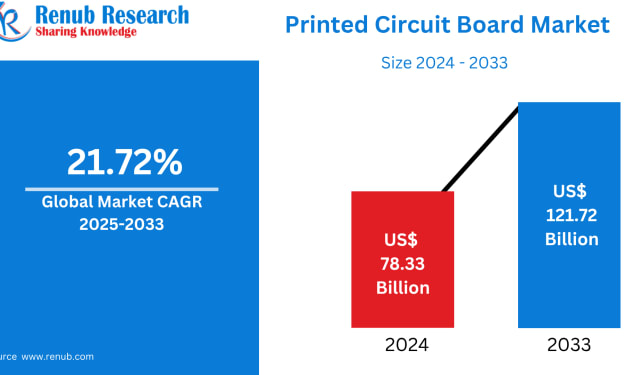
Introduction: The Backbone of the Digital World The Global Printed Circuit Board (PCB) Market is entering a decisive growth phase as electronics become more compact, powerful, and interconnected. According to Renub Research, the PCB market was valued at USD 78.33 billion in 2024 and is projected to reach USD 121.72 billion by 2033, expanding at a CAGR of 5.02% during the forecast period.
By Marthan Sir3 days ago in The Swamp



Comments
There are no comments for this story
Be the first to respond and start the conversation.