
Global Printed Circuit Board Market Size and Forecast 2025–2033
How Miniaturization, 5G, EVs, and Smart Technologies Are Powering the Next Decade of PCB Growth

Introduction: The Backbone of the Digital World
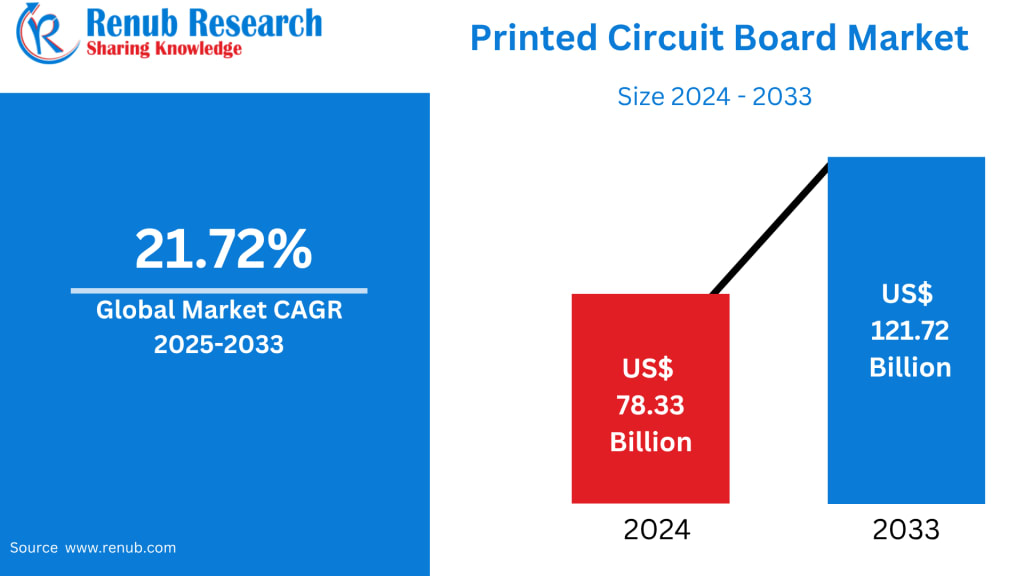
The Global Printed Circuit Board (PCB) Market is entering a decisive growth phase as electronics become more compact, powerful, and interconnected. According to Renub Research, the PCB market was valued at USD 78.33 billion in 2024 and is projected to reach USD 121.72 billion by 2033, expanding at a CAGR of 5.02% during the forecast period.
This steady expansion reflects the essential role PCBs play across nearly every electronic device we use today—from smartphones and laptops to electric vehicles, medical devices, and industrial automation systems. As technologies like 5G, IoT, AI, EVs, and Industry 4.0 gain momentum, demand for high-performance, multilayer, and high-density PCBs continues to surge worldwide.
Global Printed Circuit Board Market Outlook
A Printed Circuit Board is a flat board that mechanically supports and electrically connects electronic components using conductive tracks etched from copper sheets. These boards act as the nervous system of modern electronics, enabling devices to function reliably while remaining compact and energy efficient.
PCBs are embedded across a wide range of industries including consumer electronics, automotive, aerospace, telecommunications, healthcare, industrial machinery, and renewable energy systems. As devices become smaller and more complex, the market is shifting rapidly toward multilayer, HDI (High-Density Interconnect), rigid-flex, and flexible PCBs that support higher performance in limited space.
The growing complexity of electronic design, along with demand for durability and faster signal transmission, ensures that PCBs remain indispensable in the digital economy.
Key Growth Drivers of the Global PCB Market
1. Expansion of 5G and High-Speed Communication Networks
The global rollout of 5G infrastructure is one of the strongest growth catalysts for the PCB industry. 5G base stations, small cells, and network equipment require high-frequency and multilayer PCBs with superior signal integrity and thermal management capabilities.
As telecom operators invest in upgrading networks worldwide, PCB manufacturers are seeing rising demand for advanced materials and precision manufacturing. The transition from 4G to 5G is also accelerating innovation in high-speed, low-loss circuit boards, creating new opportunities for value-added PCB production.
2. Electrification of Vehicles and Autonomous Technologies
The automotive sector is undergoing a historic transformation. Electric vehicles (EVs), hybrid models, and autonomous driving systems require significantly more electronic content per vehicle than traditional cars.
PCBs are critical in battery management systems, power electronics, inverters, ADAS modules, infotainment systems, and charging infrastructure. With governments pushing for cleaner transportation and OEMs investing heavily in EV platforms, the demand for HDI, multilayer, and rigid-flex PCBs in automotive applications is accelerating at a remarkable pace.
3. Growth of IoT, Wearables, and Smart Consumer Devices
From smartwatches and fitness trackers to home automation systems and connected appliances, IoT devices are rapidly expanding across global markets. These products require miniaturized, lightweight, and high-density circuit boards to accommodate increasing functionality in compact designs.
Rigid-flex and flexible PCBs are becoming essential for next-generation wearables, foldable smartphones, and AR/VR devices. As consumers demand smarter, faster, and more connected devices, PCB manufacturers are continuously innovating to meet design challenges.
Challenges Facing the Global PCB Industry
Raw Material Price Volatility
PCB manufacturing relies heavily on copper foil, laminates, epoxy resins, and specialty substrates. Fluctuations in raw material prices—driven by geopolitical tensions, supply chain disruptions, or trade policies—can severely impact profit margins.
Manufacturers often face a dilemma: absorb rising costs or pass them on to customers. Extended lead times and supply shortages further add complexity, forcing companies to invest in inventory buffers and supplier diversification strategies.
Intense Competition and Margin Pressure
The global PCB market is highly competitive, particularly in Asia-Pacific, where manufacturers operate at massive scale with thin margins. Chinese, Taiwanese, and South Korean players dominate volume production, making price competition fierce.
To differentiate, companies must invest in advanced technologies such as HDI, high-frequency, and rigid-flex PCBs, but these upgrades require substantial capital investment. Smaller players often struggle to keep pace, leading to industry consolidation and a greater emphasis on niche, high-value applications.
Segment Analysis: Where PCB Demand Is Rising Fastest
Consumer Electronics
Consumer electronics remain the largest end-use segment of the PCB market. Smartphones, laptops, tablets, smart TVs, and wearable devices all rely on complex PCBs to deliver performance in compact designs.
Shorter product lifecycles, frequent upgrades, and rapid digitalization in emerging markets—especially in Asia-Pacific—are sustaining high-volume PCB demand. The rise of foldable phones, AR/VR devices, and smart home products further increases the need for advanced PCB designs.
Industrial Electronics and Automation
Industrial automation, robotics, and smart manufacturing systems are driving demand for rugged, high-reliability PCBs capable of operating in harsh environments.
Industry 4.0 adoption requires PCBs for sensors, control units, and wireless modules. High-temperature laminates and specialized coatings are increasingly used to ensure long-term reliability, making industrial electronics a stable and high-value growth segment.
Medical Devices and Healthcare Electronics
Healthcare electronics is emerging as one of the most promising PCB segments. Devices such as portable diagnostic tools, wearable health monitors, imaging equipment, and implantable devices require miniaturized, biocompatible, and highly reliable circuit boards.
Rigid-flex and HDI PCBs are critical for compact medical devices where space and precision are paramount. With aging populations and digital healthcare adoption increasing globally, demand for high-performance medical PCBs is expected to grow steadily.
Regional Market Insights
United States PCB Market
The U.S. PCB industry focuses on high-complexity, low-volume, high-value applications, particularly in aerospace, defense, medical, and industrial sectors. While mass production has largely moved offshore, domestic manufacturers specialize in advanced designs and quick-turn prototypes.
Government initiatives like the CHIPS Act and national security concerns are encouraging reshoring of critical electronics manufacturing.
June 2024: AdvancedPCB was launched as a future-ready PCB manufacturer, combining APCT, Advanced Circuits Inc., and San Diego PCB Design to strengthen U.S. capabilities in high-tech PCB fabrication.
Germany PCB Market
Germany’s PCB market is closely linked to its strengths in automotive engineering, industrial automation, and renewable energy systems. The country emphasizes high-quality, multilayer, and high-frequency boards used in precision applications.
Environmental regulations drive demand for RoHS-compliant and halogen-free PCBs, while Industry 4.0 initiatives fuel long-term growth.
April 2024: Thales Group expanded circuit board production at its Industrial Competence Center to support growing rail infrastructure modernization across Germany and Europe.
China PCB Market
China dominates the global PCB market, accounting for over 50% of worldwide production. Its strength lies in scale, vertical integration, and cost efficiency, serving consumer electronics, telecom, automotive, and LED lighting markets.
As China pushes forward in 5G, AI, EVs, and semiconductor self-reliance, demand for HDI and flex PCBs is increasing rapidly.
October 2024: WUS Printed Circuit announced a CNY 4.3 billion investment to expand production capacity for rising computing demand, signaling continued confidence in high-end PCB growth.
Saudi Arabia PCB Market
Saudi Arabia’s PCB market is still in its early stages but is gaining momentum under Vision 2030. Investments in smart cities, renewable energy, defense, and digital infrastructure are creating new demand for electronics and PCBs.
Although most boards are currently imported, government incentives and foreign collaborations aim to localize electronics manufacturing over time.
September 2024: Meituan’s expansion into Saudi Arabia reflects broader digital ecosystem growth, indirectly supporting electronics and PCB demand in the region.
Market Segmentation Overview
By Type
Single-Sided
Double-Sided
Multi-Layer
HDI
Substrate
By Structure
Rigid
Flexible
Rigid-Flex
By End Use
Consumer Electronics
IT & Telecom
Automotive
Industrial Electronics
Healthcare
Aerospace & Defense
Others
By Region
North America
Europe
Asia Pacific
Latin America
Middle East & Africa
Key Players in the Global PCB Market
Major companies analyzed across five viewpoints (Overview, Key Person, Developments, SWOT, Revenue) include:
Advanced Circuits Inc.
Zhen Ding Technology Holding Limited
Unimicron Technology Corporation
Würth Elektronik GmbH & Co. KG
Becker & Müller Circuit Printing GmbH
Jabil Inc.
Murrietta Circuits
Nippon Mektron Ltd.
Sumitomo Corporation
TTM Technologies Inc.
These players are investing heavily in automation, advanced materials, and next-generation PCB technologies to stay competitive in an increasingly demanding market.
Final Thoughts: A Market Built for the Future
The Global Printed Circuit Board market stands at the center of the digital transformation sweeping across industries. With growth fueled by 5G, EVs, IoT, healthcare electronics, and industrial automation, PCBs are no longer just components—they are strategic enablers of innovation.
Despite challenges such as material price volatility and intense competition, the industry’s long-term outlook remains strong. As electronic systems become smarter, smaller, and more interconnected, the demand for advanced PCB solutions will only accelerate.
For manufacturers, investors, and technology leaders, the next decade represents a powerful opportunity to shape the future of global electronics—one circuit board at a time.
About the Creator
Marthan Sir
Educator with 30+ years of teaching experience | Passionate about sharing knowledge, life lessons & insights | Writing to inspire, inform, and empower readers.
Keep reading
More stories from Marthan Sir and writers in The Swamp and other communities.
Power Quality Equipment Market Size and Forecast 2025–2033
Introduction: Why Power Quality Matters More Than Ever The global shift toward digitalization, automation, renewable energy, and electrified transportation has transformed electricity from a basic utility into a mission-critical resource. Modern economies now depend on continuous, distortion-free power to keep industries productive, data centers online, hospitals functioning, and smart cities operational. This growing reliance has brought power quality to the center of energy discussions worldwide.
By Marthan Sira day ago in The Swamp
Tragic Loss in Sydney Harbour: 12‑Year‑Old Dies After Shark Attack
Sydney, 24 January 2026 — A 12‑year‑old boy has died in hospital from critical injuries sustained in a shark attack in Sydney Harbour last week, leaving his family and community devastated and prompting renewed discussion about public safety and legal safeguards on waterways. The young victim, identified by family as Nico Antic, succumbed to his injuries on Saturday evening after spending nearly a week in Sydney Children’s Hospital fighting for his life. �
By Ayesha Lasharia day ago in The Swamp
With 'Personal Intelligence,' Google Finally Admits How Much It Knows About You. It's Scary-Good.
Google has long been known for its powerful algorithms, search engines, and AI-driven services, but the recent unveiling of “Personal Intelligence” marks a new era in just how much the tech giant knows about individual users. According to internal statements and demonstrations, Personal Intelligence can analyze, predict, and interact with personal data in ways that feel almost human — and for many, that’s both fascinating and unnerving. With Personal Intelligence, Google is not just offering smart suggestions or predictive text; the technology learns patterns in your behavior, preferences, and routines, effectively creating a digital mirror of your daily life. While Google promises privacy safeguards, the sheer depth of its insights is enough to make users pause and reflect on how much information they have willingly — or unknowingly — shared online. What Is ‘Personal Intelligence’? Personal Intelligence is a new AI framework from Google designed to leverage the company’s vast network of data collection points: Gmail, Google Maps, Search history, YouTube preferences, Android device usage, and more. The system is reportedly capable of: Anticipating needs: Suggesting actions based on habits, like reminding you of meetings or recommending restaurants at times you usually eat out. Predictive communication: Drafting emails, messages, or social media posts that match your typical tone and style. Decision support: Helping with daily decisions, from planning commutes to managing finances, by analyzing patterns in your behavior. Personalized learning: Offering suggestions for articles, videos, and courses tailored to your interests and knowledge gaps. Unlike previous AI tools, Personal Intelligence doesn’t just react to explicit input — it proactively interprets and predicts behavior, making it feel eerily intuitive. Why It Feels “Scary-Good” Many users report a mix of awe and unease when seeing what Personal Intelligence can do. There are several reasons for this reaction: Depth of Insight: The AI doesn’t just know what you search; it recognizes patterns, habits, and even emotional cues. Seamless Integration: Google combines data across multiple services, creating a holistic understanding of a user’s life. Proactive Behavior: Unlike traditional assistants, Personal Intelligence can initiate actions, not just respond. Human-Like Suggestions: Its ability to draft text, propose decisions, or suggest content based on your personality is almost uncanny. The “scary-good” factor isn’t that the AI is malicious — it’s that it knows you so well that your own digital self could almost stand in for you. The Privacy Debate With great intelligence comes great responsibility, and privacy advocates are raising serious concerns about Personal Intelligence: Data Centralization: Google aggregates vast amounts of personal data across all its platforms, which could be vulnerable to breaches or misuse. User Consent: While Google claims users opt-in, many might not fully realize how much information the AI analyzes. Algorithmic Bias: AI predictions might reinforce personal habits and biases rather than challenge them, creating digital echo chambers. Surveillance Concerns: Even with safeguards, critics argue that such comprehensive profiling gives Google unprecedented insight into private lives. The company insists that privacy controls and data anonymization are in place, but experts warn that the technology is only as safe as the policies and users’ understanding of them. How Personal Intelligence Could Change Everyday Life Despite concerns, there are significant benefits to the technology: Efficiency: Daily tasks could be automated or optimized, saving time in work and personal life. Personalized Learning: Students and professionals could receive highly customized recommendations for skill development. Health and Wellness: Predictive insights could help track habits, suggest healthier routines, and even alert users to behavioral risks. Seamless Integration Across Devices: From smart speakers to phones, the AI could unify tasks and notifications for a smoother experience. In essence, Personal Intelligence could make your digital ecosystem feel intelligent, responsive, and personalized like never before. The Broader Implications The introduction of Personal Intelligence highlights several trends in technology and society: AI as an Extension of Self: Our devices are no longer just tools — they increasingly act as digital extensions of our personalities, habits, and preferences. Trade-Off Between Convenience and Privacy: As AI becomes more capable, users must decide how much personal information they are willing to share. Shift in Human-AI Interaction: Predictive AI challenges the traditional “command-response” model, moving toward anticipatory intelligence that feels almost human. Ethical and Regulatory Pressure: Governments and regulators may soon need to establish rules around predictive AI, especially when it accesses sensitive personal data. Personal Intelligence is not just a Google product — it represents a turning point in how AI intersects with daily life. Expert Opinions Industry experts are divided on the technology’s potential: Tech Optimists: Argue that AI like Personal Intelligence can enhance productivity, creativity, and decision-making. Privacy Advocates: Warn that it represents a new frontier in surveillance capitalism, where corporations have unprecedented insight into personal lives. Behavioral Psychologists: Note that predictive AI could shape decisions and behaviors in subtle ways, influencing habits without conscious awareness. This mix of perspectives illustrates that Personal Intelligence is both exciting and potentially disruptive, depending on how it is used and regulated. Final Thoughts Google’s Personal Intelligence demonstrates how advanced AI has become at understanding humans. It is simultaneously a tool for convenience, efficiency, and personalization, and a reminder of how much of our lives are already visible to large tech companies. For users, the key takeaway is awareness: while these technologies can be extremely helpful, it is essential to understand the data they access, the predictions they make, and the privacy choices available. Personal Intelligence may be scary-good, but it is also a call to examine the relationship between humans and machines, and to ensure that innovation does not outpace privacy, ethics, and user consent.
By Muhammad Hassanabout 22 hours ago in The Swamp




Comments
There are no comments for this story
Be the first to respond and start the conversation.