
Empire, Chains, and Blood: The Unholy Trinity of Imperialism, Oppression, and Genocide
How Empires Rise on the Backs of the Oppressed..

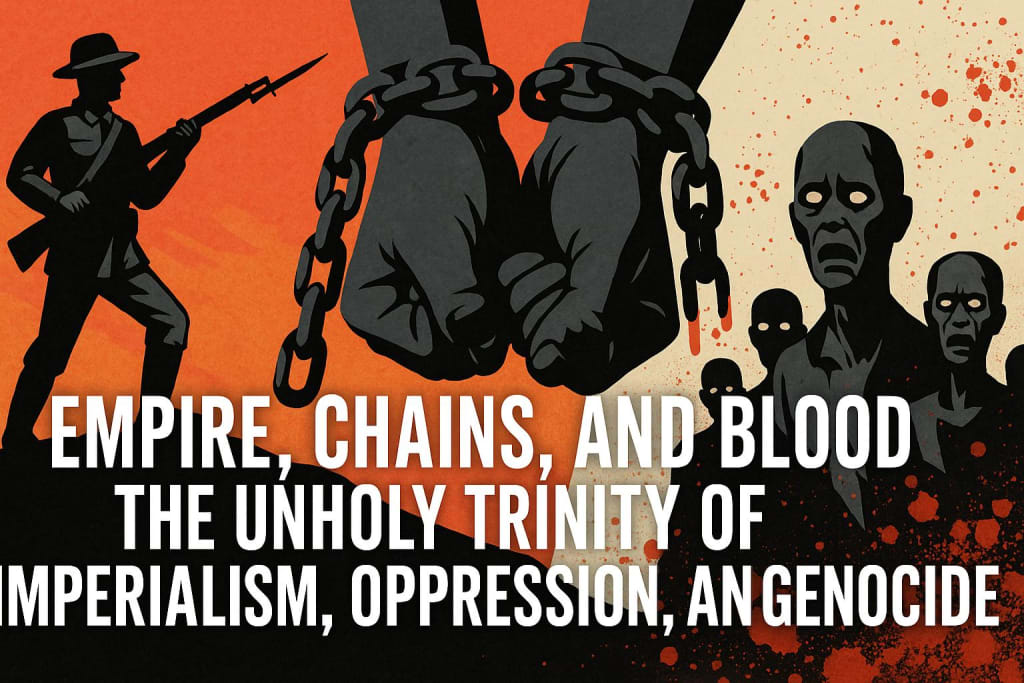
Throughout history, the pursuit of power has led to some of humanity’s most brutal chapters. Imperialism—the expansion of nations through domination—has been a driving force behind political oppression and genocide. From the colonization of the Americas to the scramble for Africa, from the Holocaust to modern-day atrocities, the pattern remains the same: powerful nations and regimes exploit, suppress, and exterminate those who stand in their way.
However, why does this cycle continue? And in what ways are global conflicts still shaped by imperialism's echoes today? The intertwined histories of empire-building, systemic oppression, and mass violence are examined in this article to demonstrate how the human desire for control continues to exacerbate human suffering.
Imperialism: The Engine of Exploitation
The practice of extending a nation's authority through the acquisition of territory or political dominance, frequently by means of force, is known as imperialism. Modern imperialism, particularly from the 15th to the 20th centuries, reshaped the world through European colonization, despite the fact that empires have existed for millennia.
Europe's "Scramble for Africa," which lasted from 1884 to 1914, saw its resources and people exploited by European powers. Millions of people died as a result of being forced to work as slaves under King Leopold II of Belgium's personal fiefdom in Congo. Millions of people perished as a result of famines and the loss of wealth caused by Britain's occupation of India.
Imperialism wasn’t just about land—it was about control. Indigenous cultures were erased, economies were restructured for colonial profit, and resistance was met with brutal force.
Political Oppression: The Tool of Tyrants
To sustain dominance, imperial powers and authoritarian regimes rely on political oppression—systematic suppression of dissent through laws, violence, and propaganda. Tactics include:
- Censorship & Propaganda – Controlling media to shape public perception.
- Police States & Surveillance – Using fear to silence opposition.
- Arbitrary Arrests & Torture – Eliminating critics through intimidation.
Punitive laws forced famines like the Great Hunger of 1845–52, and violent crackdowns were all used by the British Empire to prevent Irish independence for centuries. Irish culture was systematically destroyed, and political dissent was made a criminal offense.
This legacy is carried on today by regimes like China, which persecutes Uyghurs, and North Korea. Even democracies engage in neo-imperialism—economic domination through corporations and global financial systems that keep poorer nations dependent.
Genocide: The Ultimate Crime of Empire
The most sinister effect of imperialism is genocide, or the deliberate extermination of a racial, ethnic, or religious group. History is stained with examples:
The Holocaust (1941–1945)
Nazi Germany’s quest for dominance led to the industrialized murder of 6 million Jews, alongside Roma, disabled individuals, and political dissidents. This was imperialism turned inward, fueled by racial ideology.
The Armenian Genocide (1915–1923)
In order to eradicate a Christian minority that was seen as a threat, the Ottoman Empire executed 1.5 million Armenians in a systematic manner. This genocide is still being denied today.
Colonial Genocides: The Americas & Australia
Native populations were decimated when European settlers in North America and Australia waged wars and introduced diseases. Bounties were sometimes applied to Indigenous scalps to encourage their extinction.
Why Does Genocide Happen?
- Dehumanization – Propaganda paints victims as "less than human."
- Resource Greed – Land and wealth motivate mass killings.
- Fear of Resistance – Eliminating a group prevents future uprisings.
The Lingering Shadows of Imperialism
Economic Exploitation & Modern Warfare
Economic imperialism persists despite the decline of formal empires. While Western military interventions, such as the Iraq War, continue to destabilize regions for the purpose of gaining geopolitical advantage, multinational corporations extract resources from developing nations.
Cultural Erasure & Resistance
Indigenous languages, traditions, and histories have been erased—but resistance remains. Movements like Black Lives Matter, Palestinian liberation struggles, and Indigenous land rights activism challenge systemic oppression.
Can the Cycle Be Broken?
Awareness is the first step. We can resist the patterns of imperialism and genocide by acknowledging historical atrocities, supporting reparations, and holding governments accountable.
A Call to Remember and Resist
Genocide, political oppression, and imperialism are not things of the past; rather, they develop, change, and persist. The struggle for justice continues, from the blood-soaked fields of colonized nations to the contemporary halls of corporate power.
The question is: Will we confront this legacy, or repeat it?
Engage With the Discussion
What examples of modern imperialism do you see today? How can societies heal from historical genocide? Share your thoughts in the comments.
About the Creator
Morsalin Russell
I’m a passionate writer with a knack for dissecting the issues that matter. Whether it’s culture, politics, or everyday life, I don’t just observe—I take a stand. My articles are more than just words; they also provoke thought.
Keep reading
More stories from Morsalin Russell and writers in The Swamp and other communities.
The Hunt for Alien Life Just Got Real
For centuries, humanity has gazed at the stars, wondering if we are alone in the universe. Today, we may be on the brink of answering that age-old question. The James Webb Space Telescope (JWST), NASA’s most advanced observatory, has detected potential signs of life on a distant exoplanet—an ocean-covered world named K2-18b, located 120 light-years away in the constellation Leo.
By Morsalin Russell9 months ago in Futurism
Europeans Prepare Military Exercises in Greenland
The Arctic is no longer a quiet, frozen frontier. Once seen as remote and geopolitically dormant, Greenland has suddenly become one of the world’s most strategically sensitive regions. As former U.S. President Donald Trump renews his controversial interest in acquiring the island, European nations are responding with something more tangible than diplomatic statements — military exercises on Greenlandic soil.
By Aqib Hussain5 days ago in The Swamp


Comments (1)
This article exposes the brutal legacy of imperialism, political oppression, and genocide as intertwined tools of power, exposing their contemporary echoes. It emphasizes resistance while challenging readers to confront historical and ongoing systemic violence from a critical and justice-centered perspective. The message is urgent and aims to educate as well as inspire action against oppression of any kind.