
The Hunt for Alien Life Just Got Real
A potential biosignature detection excites scientists, but the search for definitive proof continues

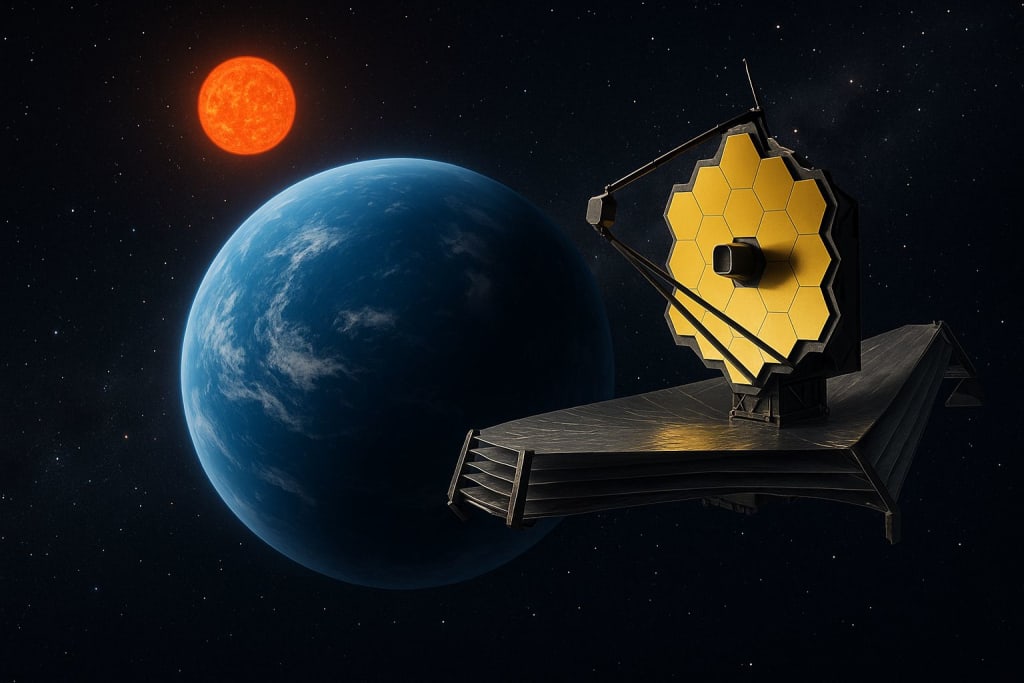
For centuries, humanity has gazed at the stars, wondering if we are alone in the universe. Today, we may be on the brink of answering that age-old question. The James Webb Space Telescope (JWST), NASA’s most advanced observatory, has detected potential signs of life on a distant exoplanet—an ocean-covered world named K2-18b, located 120 light-years away in the constellation Leo.
The discovery has sent shockwaves through the scientific community, reigniting debates about extraterrestrial life and the possibility of habitable worlds beyond our solar system. Could this be the first concrete evidence that we are not alone?
A Water World with a Life-Supporting Atmosphere
K2-18b is a Hycean planet, a relatively new class of exoplanets with vast oceans of liquid water and atmospheres rich in hydrogen. Due to their potential to host microbial or even more complex organisms, these worlds, first proposed in 2021, are considered prime candidates for the search for extraterrestrial life.
Using its powerful Near-Infrared Spectrograph (NIRSpec), Webb analyzed the planet’s atmosphere as it passed in front of its host star. The data revealed the presence of dimethyl sulfide (DMS), a molecule that, on Earth, is only produced by living organisms—primarily phytoplankton in marine environments. Additionally, the telescope detected methane and carbon dioxide, further strengthening the case for possible biological activity.
“This is the first time we’ve detected a potential biosignature on an exoplanet,” said Dr. Nikku Madhusudhan, an astrophysicist at the University of Cambridge and lead researcher on the study. “While we must remain cautious, the presence of DMS is incredibly exciting because, on Earth, there’s no known non-biological way it can be produced in significant quantities.”
Why K2-18b? The Perfect Candidate for Life
K2-18b orbits within the habitable zone of its red dwarf star, where temperatures allow liquid water to exist. But what makes this planet particularly intriguing?
- Size and Composition: At 8.6 times Earth’s mass, K2-18b is classified as a "super-Earth" or "mini-Neptune." Unlike rocky planets, it likely has a thick hydrogen-rich atmosphere over a massive global ocean, possibly with high-pressure ice layers beneath.
- Temperature: Despite its star being cooler than the Sun, tidal heating and greenhouse effects from its atmosphere could maintain a stable climate.
- Chemical Balance: The presence of CO₂ and methane suggests an active carbon cycle, possibly similar to Earth’s before the rise of oxygen.
However, not all scientists are convinced. These molecules might also be produced by abiotic processes like photochemical reactions or volcanic activity, according to some.
“Extraordinary claims require extraordinary evidence,” warns Dr. Sara Seager, an MIT planetary scientist. “We need follow-up observations to rule out geological explanations.”
What If It’s Really Life?
If confirmed, the discovery of life on K2-18b would be one of the most profound scientific breakthroughs in history. Here’s why:
- Redefining the Search for Life: Until now, the hunt for extraterrestrial life has focused on Earth-like planets. But Hycean worlds like K2-18b suggest that life could thrive in environments vastly different from ours.
- A Universe Teeming with Life: If life exists on K2-18b, the odds increase dramatically that it exists elsewhere. With trillions of exoplanets in the Milky Way alone, we may be looking at a galaxy filled with living worlds.
- The Future of Astrobiology: Webb’s findings will drive future missions, such as the Habitable Worlds Observatory (HWO), set to launch in the 2040s, which will directly image exoplanets and analyze their atmospheres in even greater detail.
Skepticism and the Road Ahead
Scientists advise caution despite the tantalizing prospect of DMS detection. There must be no other explanation for the faint signal. Some possible next steps are:
- More Webb observations to confirm the presence of DMS and other biosignatures.
- Modeling non-biological processes that could produce similar atmospheric chemistry.
- Future telescopes, like the European Extremely Large Telescope (ELT), may provide higher-resolution data.
“We’re not saying we’ve found life,” emphasizes Madhusudhan. “We’re saying this is the best candidate we’ve had so far.”
Humanity’s Place in the Cosmos
Whether or not K2-18b hosts life, this discovery marks a pivotal moment in astronomy. For the first time, we have the technology to probe the atmospheres of distant worlds for signs of biology.
We would be forced to reevaluate our place in the universe if life were discovered. Are there other civilizations as well as ours? Or is Earth a unique oasis in a mostly barren universe?
As Webb continues its mission, one thing is certain: We are closer than ever to answering the ultimate question—are we alone?
Final Thoughts
The detection of potential life signatures on K2-18b is a monumental step forward in astrobiology. The repercussions are staggering, even though additional data is required. We are reminded of the limitless mysteries of the universe and of humanity's unrelenting drive to solve them, regardless of whether this discovery leads to definitive proof of extraterrestrial life.
What do you think? Is this the breakthrough we’ve been waiting for, or should we temper our excitement until further evidence emerges? Share your thoughts in the comments!
About the Creator
Morsalin Russell
I’m a passionate writer with a knack for dissecting the issues that matter. Whether it’s culture, politics, or everyday life, I don’t just observe—I take a stand. My articles are more than just words; they also provoke thought.
Keep reading
More stories from Morsalin Russell and writers in Futurism and other communities.
The Scary Truth About Superintelligent AI
Over the course of the past few decades, artificial intelligence (AI) has progressed rapidly, moving from basic rule-based systems to sophisticated machine learning models that can reason like humans. Superintelligence, on the other hand, is a brand-new and contentious idea that emerges as AI advances.
By Morsalin Russell11 months ago in Futurism
The Refactor Command in Claude: Code 8 Underrated Tricks I Wish I Knew on Day One
I remember the exact moment I realized I’d been using Claude Code all wrong. It was 1:13 a.m., my third cup of coffee was going cold, and I was staring at a function so bloated it should’ve come with its own zip code. I typed a desperate prompt into Claude about “cleaning this up” and expected the usual: some polite suggestions, maybe a renamed variable or two.
By abualyaanart3 days ago in Futurism
Air France Evacuation Flight Turns Back Because of Missile Fire
A planned evacuation flight operated by Air France was forced to abruptly turn back mid-route after missile activity was detected near its intended flight corridor, highlighting the growing dangers civilian aircraft face in conflict zones. The incident occurred late Tuesday evening as the aircraft, carrying evacuees and humanitarian personnel, attempted to depart a volatile region amid escalating military exchanges. According to aviation officials familiar with the situation, the aircraft had been chartered to transport civilians and diplomatic staff seeking to leave an area experiencing intensified hostilities. The flight had taken off successfully and climbed to cruising altitude when air traffic control and security monitoring systems detected missile launches within range of the aircraft’s projected flight path. Within minutes, pilots received instructions to alter course and return to the departure airport. Air France confirmed the diversion in a brief statement, emphasizing that the decision was made purely as a precaution to ensure passenger safety. “Our crew followed established international safety procedures after receiving security alerts regarding missile activity in the vicinity,” the airline said. “The aircraft returned safely without incident.” While the airline did not publicly identify the exact location of the event, aviation monitoring groups said the flight was operating in an area where military forces have recently exchanged long-range strikes. Civil aviation authorities frequently issue warnings when missile launches or air defense systems pose potential risks to passenger aircraft. Passengers aboard the flight described a tense but orderly situation. Shortly after the aircraft turned around, the captain reportedly addressed passengers over the intercom, explaining that security conditions along the route had deteriorated. Some travelers initially feared a technical issue but were reassured when the aircraft began descending back toward the airport. “We didn’t know exactly what was happening at first,” said one passenger who asked not to be identified. “The crew stayed calm and professional. Later they explained that missile launches had been detected and that it was safer to return.” Aviation safety experts say such diversions, while rare, have become more common as geopolitical conflicts increasingly intersect with international flight routes. Modern commercial aircraft rely on multiple sources of threat intelligence, including military radar feeds, satellite monitoring, and alerts from international aviation organizations. After the catastrophic downing of Malaysia Airlines Flight 17 in 2014, global aviation regulators strengthened procedures for monitoring conflict zones. Airlines now routinely adjust routes to avoid regions where missile systems could threaten high-altitude aircraft. “Airlines are extremely cautious today,” said a European aviation security analyst. “If there is even a small possibility that missile systems are active near a flight path, the safest option is to divert or cancel the flight.” The aborted evacuation mission underscores the growing challenges faced by governments trying to move civilians out of unstable regions. Evacuation flights often operate under tight time windows, relying on coordination between airlines, diplomatic services, and military authorities. Officials said discussions were underway to determine whether another evacuation attempt could be organized once conditions stabilize. In many such operations, governments work with commercial carriers like Air France because they have the logistical capacity and experienced crews needed to conduct large-scale passenger transport under difficult circumstances. Air France crews are trained for crisis operations, including sudden rerouting and emergency returns. In this case, airline officials praised the cockpit team for reacting quickly to the threat warning and maintaining clear communication with both passengers and air traffic control. Despite the tension surrounding the incident, all passengers and crew landed safely, and no injuries were reported. The aircraft returned to the airport approximately two hours after departure, where passengers were taken to a secure terminal area while authorities assessed the situation. Security analysts warn that the incident illustrates a broader trend: civilian aviation is increasingly affected by geopolitical conflict. As missile technology spreads and military confrontations become more unpredictable, airlines must constantly reassess flight paths and safety procedures. For now, the aborted evacuation flight stands as another reminder that even high-altitude commercial aircraft are not immune to the dangers created by modern warfare. Aviation officials say vigilance, intelligence sharing, and rapid decision-making remain the most effective tools to keep passengers safe when global tensions intrude into the skies.
By Fiaz Ahmed 6 days ago in Futurism
📢 Raise Your Voice Thread: 03/05/2026
Our “Raise Your Voice Threads” are hosted most alternating Thursdays at 12PM ET to offer creators more avenues to uncover exceptional stories on Vocal. As we are continuously searching for fresh creators and inspiring stories, this thread provides an opportunity to exchange and discuss the stories that have moved and motivated us on Vocal.
By Raise Your Voice by Vocal6 days ago in Resources




Comments (1)
This could be the discovery we’ve waited for—but we must stay cautious. If confirmed, life on K2-18 b would change everything. Either way, Webb has brought us closer than ever to answering humanity’s biggest question.