
Consumer Electronics Repair and Maintenance Market Size, Growth & Forecast 2025–2033
Why Repair Is Becoming the New Replacement in a Sustainability-Driven World

Introduction: The Global Shift from Replacement to Repair
The global Consumer Electronics Repair and Maintenance Market is undergoing a profound transformation. Once seen as a secondary service, repair has now become a strategic necessity as consumers, governments, and manufacturers respond to rising device costs, environmental concerns, and sustainability goals.
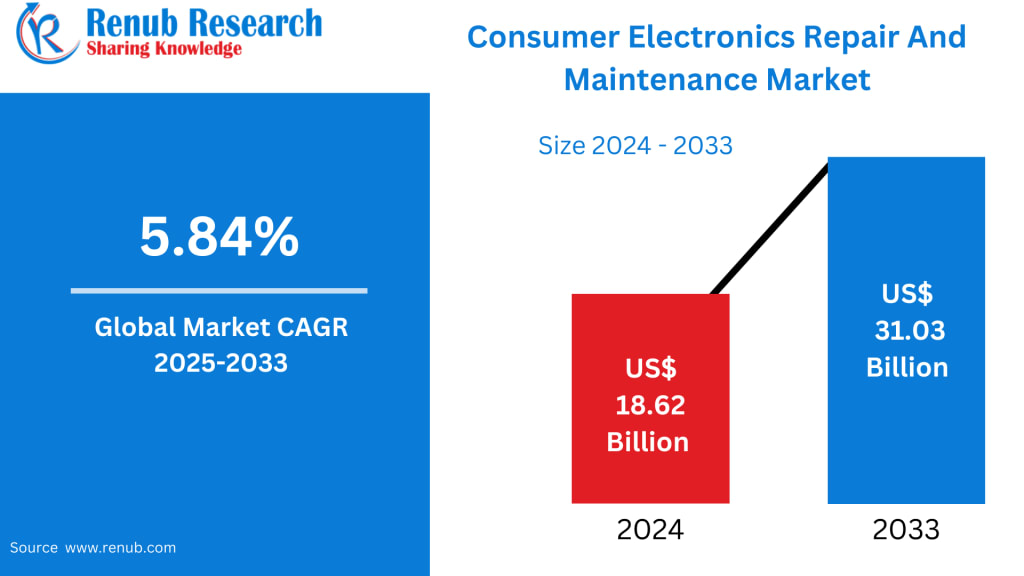
According to Renub Research, the global consumer electronics repair market was valued at US$ 18.62 billion in 2024 and is projected to grow steadily to reach US$ 31.03 billion by 2033, expanding at a CAGR of 5.84% from 2025 to 2033. This growth is fueled by the increasing demand for longer device lifecycles, affordable repair services, and growing awareness of sustainability and electronic waste reduction across the world.
From smartphones and laptops to TVs, washing machines, and gaming consoles, repair services are becoming an essential part of the global electronics ecosystem. As the cost of new electronics rises and environmental regulations tighten, repairing is no longer just a cost-saving decision—it is a responsible one.
Global Consumer Electronics Repair and Maintenance Market Outlook
Consumer electronics repair and maintenance involve inspection, diagnosis, servicing, and restoration of electronic devices to ensure optimal functionality and extended lifespan. Services range from hardware replacements and software updates to cleaning, refurbishment, and troubleshooting physical or electrical faults.
Globally, this market plays a crucial role in reducing electronic waste (e-waste), conserving natural resources, and enabling affordable access to technology. Both developed and developing economies depend heavily on repair services to sustain the circular economy, close the digital divide, and ensure devices remain usable for longer periods.
With rising environmental consciousness and the high price of new devices, consumers are increasingly opting for professional repair services rather than replacement. At the same time, right-to-repair legislation and green policies are empowering independent service providers and strengthening the repair ecosystem worldwide.
Key Growth Drivers in the Consumer Electronics Repair Market
1. Rising E-Waste and Environmental Awareness
The global e-waste crisis is one of the strongest drivers of the repair and maintenance market. In 2022 alone, the world generated 62 million tonnes of electronic waste, an 82% increase from 2010, and this is expected to reach 82 million tonnes by 2030.
Despite containing valuable materials such as gold, copper, and rare earth elements, only 1% of rare earth demand is currently met through recycling. Repairing devices helps keep electronics out of landfills, reduces carbon footprints, and preserves valuable resources—making repair services central to sustainability strategies.
As consumers become more environmentally conscious, repair is increasingly viewed as an eco-friendly alternative to disposal.
2. Cost-Effectiveness Compared to Replacement
The price of high-end consumer electronics continues to rise, pushing households and businesses toward repair instead of replacement. Smartphones, smart TVs, laptops, and appliances now cost significantly more than a decade ago, making repair the financially smarter option.
This trend is especially strong in emerging economies, where cost-conscious consumers prefer maintaining their devices for as long as possible. The availability of affordable spare parts and skilled technicians has made repair services both accessible and economical, further accelerating market growth.
3. Government Support and Right-to-Repair Laws
Right-to-repair movements are reshaping the global electronics landscape. Governments are introducing regulations that grant consumers and third-party repair providers access to spare parts, manuals, and diagnostic tools, reducing manufacturers’ monopoly on repairs.
In March 2023, the European Commission proposed a “Right to Repair” directive covering appliances, TVs, smartphones, and servers.
In the U.S., New York became the first state to pass the Digital Fair Repair Act, effective July 2023.
In India, a repairability index was introduced in August 2024 to guide consumer decisions and encourage repair-friendly design.
These reforms lower barriers to entry for independent repair businesses, boost consumer confidence, and support sustainable consumption—driving market growth worldwide.
Challenges Facing the Repair and Maintenance Industry
Limited Access to Spare Parts and Repair Information
One of the biggest challenges in the market is restricted access to proprietary components and repair manuals. Many manufacturers still control their supply chains tightly, making it difficult for independent repair shops to compete and increasing repair costs for consumers.
Without strong enforcement of right-to-repair laws, this issue can slow down service delivery and discourage market expansion, particularly in regions with weaker regulatory frameworks.
Rapid Technological Complexity
Modern electronics are increasingly complex, featuring AI chips, IoT connectivity, sealed batteries, and integrated components. While these innovations enhance user experience, they make devices harder to repair.
Repair providers now require specialized training and advanced tools, raising operational costs. Frequent product updates also mean technicians must continuously upgrade skills and inventory, making repairs more expensive and sometimes pushing consumers back toward replacement.
Market Segmentation Analysis
Home Appliances Repair and Maintenance
Home appliances—including refrigerators, washing machines, air conditioners, and microwaves—represent a major segment of the market. As appliance prices rise, households are increasingly investing in repair to extend product life.
The demand for maintenance contracts, energy-efficient appliances, and sustainability-focused lifestyles is further strengthening this segment globally.
Authorized Service Centers
Authorized service centers remain a preferred option for high-end and complex devices. These centers provide manufacturer-approved repairs, original parts, and trained technicians, often with warranty protection.
Their reliability, compliance with regulations, and partnerships with electronics brands give them a strong position in the global market.
Residential Repair Market
Residential users form the largest end-user segment, driven by widespread use of smartphones, laptops, TVs, and kitchen appliances. With rising living costs and increased reliance on electronics for remote work and online learning, repair services are becoming essential.
The growth of smart homes is also creating new opportunities for skilled technicians capable of maintaining connected devices and systems.
Commercial Repair Market
Commercial users—such as businesses, hospitals, schools, and retailers—rely heavily on electronics for operations. Regular maintenance prevents downtime, reduces capital expenditure, and improves productivity.
Many organizations sign annual maintenance contracts with service providers, ensuring steady demand for repair services across sectors like logistics, finance, healthcare, and retail.
Regional Market Insights
United States
The U.S. leads the global repair market due to strong consumer awareness and regulatory support. Right-to-repair legislation, high device costs, and sustainability concerns are pushing consumers toward repair rather than replacement.
A robust network of authorized and independent service providers continues to support steady market growth.
France
France is a pioneer in sustainable electronics through its repairability index, which informs consumers about how easy a product is to repair. This has influenced purchasing decisions and encouraged manufacturers to design repair-friendly products.
Government investment in repair training and local repair shops has created a strong repair culture across the country.
India
India is one of the fastest-growing repair markets, supported by a vast electronics user base and cost-conscious consumers. Repair is often the preferred option due to affordability, especially in rural and semi-urban regions.
The government’s repairability index initiative (2024) and strong informal repair network are further strengthening the ecosystem.
Saudi Arabia
Saudi Arabia’s Vision 2030 program is driving rapid digital transformation. Increased electronics usage, extreme climate conditions, and rising sustainability awareness are boosting demand for repair services.
Both local and international service providers are expanding their presence as the country invests heavily in technology infrastructure.
Market Segmentation Overview
By Product
Home Appliances
Personal Devices
Entertainment Devices
By Service Provider
Authorized Service Centers
Independent Repair Shops
By End User
Residential
Commercial
By Region
North America
Europe
Asia Pacific
Latin America
Middle East & Africa
Competitive Landscape
Leading companies covered with four viewpoints (Overview, Key Persons, Strategies, Revenue) include:
The Cableshoppe
Redington Services
Electronix Services
B2X Care Solutions
Encompass Parts
uBreakiFix
Asurion, LLC
Best Buy Co. Inc.
These players are investing in technician training, digital platforms, and partnerships with manufacturers to strengthen their global footprint.
Final Thoughts: Repair Is the Future of Electronics
The global consumer electronics repair and maintenance market is no longer just a service industry—it is a pillar of sustainability, affordability, and digital inclusion. As governments push right-to-repair laws, consumers demand longer device lifespans, and companies embrace circular economy models, repair services are set to become even more essential.
With the market projected to reach US$ 31.03 billion by 2033, repair is not just a trend—it is the future of responsible electronics consumption.
About the Creator
Marthan Sir
Educator with 30+ years of teaching experience | Passionate about sharing knowledge, life lessons & insights | Writing to inspire, inform, and empower readers.
Keep reading
More stories from Marthan Sir and writers in The Swamp and other communities.
Sodium-ion Battery Market Trends & Summary 2025–2033
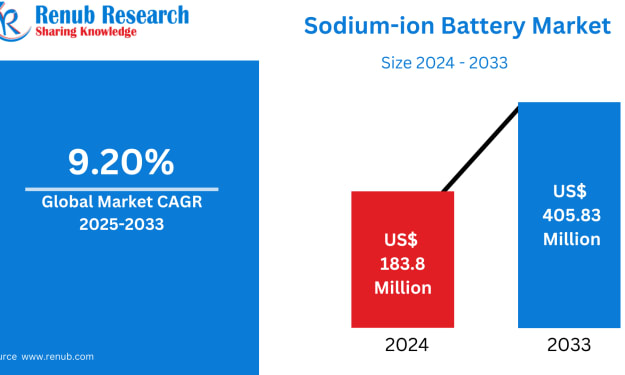
Global Sodium-ion Battery Market Outlook The global Sodium-ion Battery Market is emerging as one of the most promising alternatives to lithium-ion technology, driven by rising concerns over lithium supply constraints, high costs, and geopolitical dependencies. According to Renub Research, the sodium-ion battery market is expected to grow from US$ 183.8 million in 2024 to US$ 405.83 million by 2033, expanding at a CAGR of 9.20% from 2025 to 2033.
By Marthan Sir2 days ago in The Swamp
Coercion Without Ownership: The Real Trump Playbook on Iran
From grandiose promises of crushing the Iranian regime to last‑minute deals with Tehran over prisoner exchanges, the policy of former President Donald Trump toward Iran often appeared contradictory, transactional, and ultimately unconsolidated. What consistent logic underlay this approach? The answer lies in a framework that scholars and strategists might call “coercion without ownership” — an effort to force desired outcomes from Tehran without building or sustaining the political, diplomatic, and strategic consensus necessary to make those outcomes durable.
By Aqib Hussain7 days ago in The Swamp
Europe Threatens to Strike Back Against Trump Over Greenland Tariffs
Europe is bracing for a new chapter of transatlantic tension after former US President Donald Trump warned of imposing tariffs linked to Greenland, triggering sharp reactions from European leaders. The threat has reignited concerns about trade wars, geopolitical leverage, and the fragile balance between long-standing allies. As Brussels weighs its options, European officials are making it clear: if Washington moves forward, Europe is prepared to strike back.
By Aarif Lashari5 days ago in The Swamp
Affection and Healing for Yourself
During the night of the last quarter moon, I gathered my ritual supplies. I carefully handled the chunk of black tourmaline that would protect me from your overall negative and narcissistic energy. I carefully walked the house with my stick of selenite in hand, asking the universe to cleanse our working space.
By Alisha Wilkins ✒️🦋🖋️4 days ago in Fiction



Comments
There are no comments for this story
Be the first to respond and start the conversation.