
Sodium-ion Battery Market Trends & Summary 2025–2033
The Rise of Sodium-ion Batteries: A Cost-Effective Alternative Powering the Future of Energy Storage

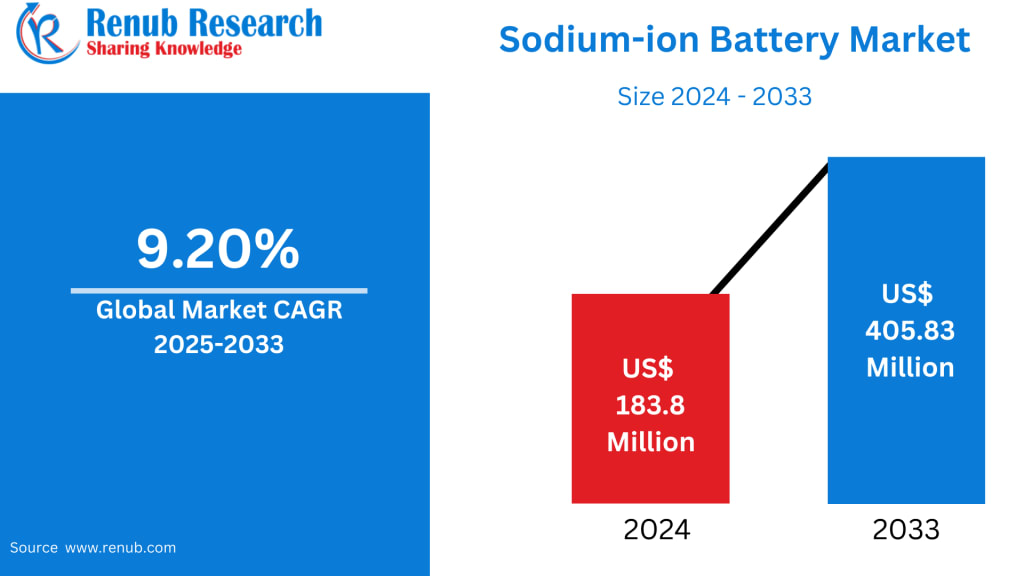
Global Sodium-ion Battery Market Outlook
The global Sodium-ion Battery Market is emerging as one of the most promising alternatives to lithium-ion technology, driven by rising concerns over lithium supply constraints, high costs, and geopolitical dependencies. According to Renub Research, the sodium-ion battery market is expected to grow from US$ 183.8 million in 2024 to US$ 405.83 million by 2033, expanding at a CAGR of 9.20% from 2025 to 2033.
This impressive growth is supported by the abundance of sodium resources, rising demand for sustainable energy storage, expanding renewable energy installations, and continuous technological advancements. Sodium-ion batteries are now being positioned not just as a backup solution but as a mainstream energy storage technology for grid systems, electric mobility, and industrial applications.
Why Sodium-ion Batteries Matter in the Global Energy Transition
As the world accelerates toward renewable energy and electrification, energy storage has become the backbone of modern power systems. Sodium-ion batteries function similarly to lithium-ion batteries but use sodium ions as charge carriers, offering significant advantages in cost, availability, safety, and sustainability.
Unlike lithium, sodium is abundantly available in seawater and the Earth’s crust, making it a more reliable long-term resource. This abundance significantly reduces raw material costs and supply chain risks. As a result, sodium-ion batteries are gaining strong momentum in large-scale energy storage, grid stabilization, data centers, and low-speed electric vehicles.
Major investments in R&D across North America, Europe, and Asia-Pacific are accelerating commercialization, while pilot-scale and commercial manufacturing facilities are rapidly coming online.
Industry Milestones Accelerating Market Growth
A major breakthrough occurred in April 2024, when Natron Energy Inc. announced the launch of commercial-scale sodium-ion battery production at its manufacturing facility in Holland, Michigan. This marked the first time sodium-ion batteries were produced commercially in the United States.
Natron’s batteries offer:
Longer cycle life
Higher power density
Improved safety
A fully domestic supply chain
UL certification (first in the category)
This milestone significantly strengthened confidence in sodium-ion technology and demonstrated its readiness for industrial-scale deployment.
Similarly, BYD unveiled the world’s first high-efficiency sodium-ion BESS in 2024 — the MC Cube-SIB ESS, featuring a 2.3 MWh capacity, enhanced safety, and fast charge/discharge capabilities. These developments are pushing sodium-ion batteries closer to mass adoption.
Key Growth Drivers of the Sodium-ion Battery Market
1. Abundant and Accessible Sodium Resources
Sodium’s availability is one of the strongest drivers of market expansion. It is found in massive quantities (282,000 ppm) in the Earth’s crust compared to lithium’s limited 20 ppm. This abundance eliminates concerns over resource scarcity and geopolitical supply disruptions.
With lithium supply chains increasingly strained, sodium-ion batteries offer a stable, globally accessible alternative that reduces dependence on critical minerals, making them especially attractive for developing and energy-importing nations.
2. Cost Efficiency Compared to Lithium-ion Batteries
Cost remains one of the most compelling advantages of sodium-ion technology. The lower raw material cost of sodium translates into cheaper battery production, making these batteries ideal for grid-scale storage, consumer electronics, and entry-level electric vehicles.
Additionally, sodium-ion batteries perform better in a broader temperature range, making them suitable for diverse climates and reducing the need for expensive thermal management systems. This improves overall system economics and accelerates adoption across multiple sectors.
3. Rising Demand for Sustainable Energy Storage
As renewable energy adoption grows worldwide, energy storage systems are critical to managing the intermittency of solar and wind power. According to the European Environmental Agency, renewable sources accounted for 24.1% of the EU’s total energy consumption in 2023, a figure that continues to rise.
Sodium-ion batteries offer:
Long-duration energy storage
Improved safety for grid installations
Lower environmental impact
Compatibility with renewable integration
These features make them increasingly attractive for utilities and governments investing in clean energy infrastructure.
Challenges Facing the Sodium-ion Battery Industry
Material and Electrolyte Stability Issues
Despite strong progress, material stability remains a challenge. Sodium ions are larger and more reactive than lithium ions, leading to faster electrode degradation and structural stress during repeated charge-discharge cycles.
Electrolyte stability is another concern, as many formulations struggle to maintain chemical integrity over long-term use. Addressing these issues through advanced material engineering and next-generation electrolyte formulations is essential for improving battery lifespan and performance.
Performance Limitations in Extreme Temperatures
Sodium-ion batteries can experience reduced performance in extremely hot or cold environments. Low temperatures slow ionic movement, while high temperatures increase the risk of electrolyte breakdown and thermal instability.
This sensitivity currently limits adoption in automotive, aerospace, and extreme climate applications, though ongoing research aims to improve thermal resilience.
Regional Market Insights
United States Sodium-ion Battery Market
The U.S. sodium-ion battery market is gaining momentum due to strong policy support and domestic manufacturing initiatives. Natron Energy’s Michigan facility represents a major step toward energy independence and domestic supply chain resilience.
Federal initiatives such as the Energy Storage Grand Challenge are encouraging the development of next-generation battery technologies, positioning sodium-ion batteries as a strategic solution for:
Data centers
Grid-scale storage
Low-range EVs
Industrial backup power
Germany Sodium-ion Battery Market
Germany is actively advancing sodium-ion technology as part of its broader energy transition strategy. Government-funded projects such as ENTISE and SIB:DE FORSCHUNG bring together academic institutions and industry leaders to develop high-performance, eco-friendly sodium-ion systems.
The Federal Ministry of Education and Research is supporting these initiatives to reduce dependence on lithium-based systems and strengthen Germany’s clean energy infrastructure.
China Sodium-ion Battery Market
China is leading the global sodium-ion battery race through aggressive investments and government-backed programs. Major players such as CATL, BYD, and HiNa Battery are rapidly scaling production.
Key highlights include:
BYD’s 30 GWh sodium-ion battery plant in Xuzhou
CATL’s Naxtra sodium-ion battery series
A 100 MWh sodium-ion BESS project in Nanning
Expected production capacity of 275.8 GWh by 2025
China’s rapid expansion demonstrates its commitment to diversifying battery chemistries and reducing lithium dependence.
United Arab Emirates Sodium-ion Battery Market
The UAE is emerging as a regional hub for sodium-ion battery development, driven by its focus on renewable energy, grid modernization, and sustainability. While the market is still at an early stage, government support and international collaborations are expected to accelerate adoption.
Sodium-ion batteries are particularly attractive for:
Off-grid electrification
Rural energy projects
Renewable energy integration
Grid stabilization in hot climates
Sodium-ion Battery Market Segmentation
By Type
Sodium-Sulphur Battery
Sodium-Salt Battery
Sodium-Air Battery
By Application
Stationary Energy Storage
Transportation
By End User
Consumer Electronics
Automotive
Industrial
Energy Storage
Others
By Country (25 Viewpoints)
North America: United States, Canada
Europe: France, Germany, Italy, Spain, UK, Belgium, Netherlands, Turkey
Asia-Pacific: China, Japan, India, Australia, South Korea, Thailand, Malaysia, Indonesia, New Zealand
Latin America: Brazil, Mexico, Argentina
Middle East & Africa: South Africa, Saudi Arabia, UAE
Key Company Analysis
Major players shaping the global sodium-ion battery market include:
Altris AB
Faradion Limited
AMTE Power plc.
Natron Energy Inc.
Aquion Energy
NGK Insulators Ltd.
HiNa Battery Technology Co. Ltd.
Tiamat Energy
NEI Corporation
Each company has been analyzed from four perspectives: Overview, Key Persons, Recent Developments, and Financial Insights, offering a comprehensive view of competitive positioning.
Final Thoughts
The sodium-ion battery market is transitioning from experimental innovation to commercial reality, supported by strong fundamentals, global policy support, and technological breakthroughs. With a projected market size of US$ 405.83 million by 2033, sodium-ion batteries are poised to become a critical component of the global energy storage ecosystem.
As renewable energy adoption accelerates and the world searches for cost-effective, safe, and sustainable alternatives to lithium-ion batteries, sodium-ion technology stands out as a game-changing solution. With continued investment, innovation, and scale-up, sodium-ion batteries are set to play a decisive role in shaping the future of clean energy and electrification.
About the Creator
Marthan Sir
Educator with 30+ years of teaching experience | Passionate about sharing knowledge, life lessons & insights | Writing to inspire, inform, and empower readers.
Keep reading
More stories from Marthan Sir and writers in The Swamp and other communities.
Managed Services Market Size and Forecast 2025–2033
Global Managed Services Market Overview The global managed services market is entering a new era of accelerated growth as organizations across industries increasingly rely on third-party IT experts to manage complex digital environments. According to Renub Research, the managed services market is projected to expand from US$ 279.16 billion in 2024 to US$ 572.15 billion by 2033, registering a CAGR of 8.30% from 2025 to 2033.
By Marthan Sirabout 15 hours ago in The Swamp
UK Drinks Firm Crashes Into Administration – Famous for Popular Gin
A leading UK drinks company, widely recognized for its popular gin brands, has entered administration amid financial difficulties, sending shockwaves across the beverage industry. The firm, which built a reputation for high-quality spirits and innovative marketing campaigns, faces uncertainty as administrators are appointed to manage its operations. Financial Troubles Lead to Administration The UK drinks company cited mounting debts, rising operational costs, and challenging market conditions as primary factors behind its collapse. Administration is a legal process designed to protect struggling businesses from creditors while allowing time to reorganize or sell assets. Executives revealed that despite strong sales of their signature gin products, the company struggled to maintain profitability due to increased production costs, supply chain disruptions, and competitive pressures in the premium spirits market. Iconic Gin Brands at the Center The company is best known for its flagship gin, which has gained widespread recognition both domestically and internationally. Its distinctive branding, creative packaging, and bold marketing campaigns helped it capture a loyal customer base. Industry analysts suggest that the brand’s popularity could make it attractive to potential buyers, who may acquire its assets, intellectual property, and production facilities during the administration process. Impact on Employees Entering administration typically raises concerns for staff, and employees of the drinks firm are no exception. The company employs hundreds across production, marketing, and distribution, and administrators have been tasked with evaluating staffing levels while exploring options to continue operations. Unions and workers’ representatives have called for transparency and assurances that jobs will be protected where possible, emphasizing the social impact of a high-profile business collapse. Market Pressures and Competitive Landscape The premium gin sector in the UK has grown rapidly over the last decade, with many new entrants competing for consumer attention. While demand for gin remains strong, profit margins are under pressure from increased raw material costs, fluctuating supply chains, and regulatory constraints, including alcohol duty increases. Smaller and mid-sized producers, like this company, face particular vulnerability. Analysts note that even brands with strong consumer recognition can struggle financially if operational costs rise faster than revenue growth. Consumer Reaction News of the company entering administration has sparked concern among fans of its gin products. Social media platforms were flooded with messages of support, with customers expressing hope that the brand would survive and continue producing their favorite spirits. Some enthusiasts have also highlighted the potential for the brand to be purchased by a larger competitor, which could help stabilize production while preserving the iconic products. Potential Buyers and Future Prospects Industry insiders suggest that several multinational drinks firms may be interested in acquiring the company’s assets, including its trademarks, distillation equipment, and distribution channels. Such acquisitions could safeguard the brand’s legacy while providing new investment to revitalize operations. Administrators are tasked with evaluating all potential offers, prioritizing proposals that protect employees, creditors, and the company’s intellectual property. The process could take several weeks or months, depending on interest from investors and buyers. Wider Implications for the Drinks Industry The collapse of a high-profile gin producer underscores the challenges facing mid-sized beverage companies in the UK. Despite strong consumer demand for premium spirits, market volatility, increased production costs, and rising competition are placing pressure on businesses across the sector. Industry analysts warn that other smaller brands could face similar financial pressures, highlighting the need for careful financial management and adaptability in a rapidly evolving market. Government and Regulatory Perspective While administration is a private legal process, the government monitors such developments closely due to potential impacts on employment, trade, and tax revenues. Officials have stressed that the administration process is designed to maximize value for creditors and employees, and to preserve brands where possible. Regulatory bodies may also oversee the sale of alcoholic beverages to ensure compliance with licensing laws, production standards, and consumer safety requirements. Lessons for Entrepreneurs and Investors The collapse of this UK drinks firm provides lessons for entrepreneurs and investors in the premium spirits market. Strong branding and product popularity alone may not guarantee financial stability; careful attention to cost management, supply chain resilience, and market trends is essential. Experts suggest that companies should diversify revenue streams, explore strategic partnerships, and plan for unexpected challenges to remain competitive in the long term. Conclusion: Uncertain Future for a Beloved Brand The UK drinks firm’s entry into administration marks a significant moment for the beverage industry, particularly for fans of its popular gin products. While the process introduces uncertainty, it also presents opportunities for investment, restructuring, and potential acquisition by larger players. For employees, consumers, and industry observers, the focus now is on how the administration unfolds and whether the brand can survive, maintain its reputation, and continue producing the spirits that made it a household name.
By Aarif Lashariabout 16 hours ago in The Swamp
How to Succeed at the Benson Directory®
Congratulations and welcome to the Benson Directory® employee #22391! As our newest call handler, you will have the privilege of speaking with dozens of unique and interesting people on a daily basis as well as the opportunity to earn bonuses for high performance. Contained within this handbook you will find a set of ease to follow instructions designed to help you settle in to your new role and begin paving the way to success.
By S. A. Crawford5 days ago in Fiction




Comments
There are no comments for this story
Be the first to respond and start the conversation.