
China's Net Gold Imports Through Hong Kong Fall 24% in December, but Premiums and Retail Demand Soar in January
A year-end slowdown in bullion inflows gives way to renewed buying appetite as prices, policy signals, and festive demand reshape China’s gold market

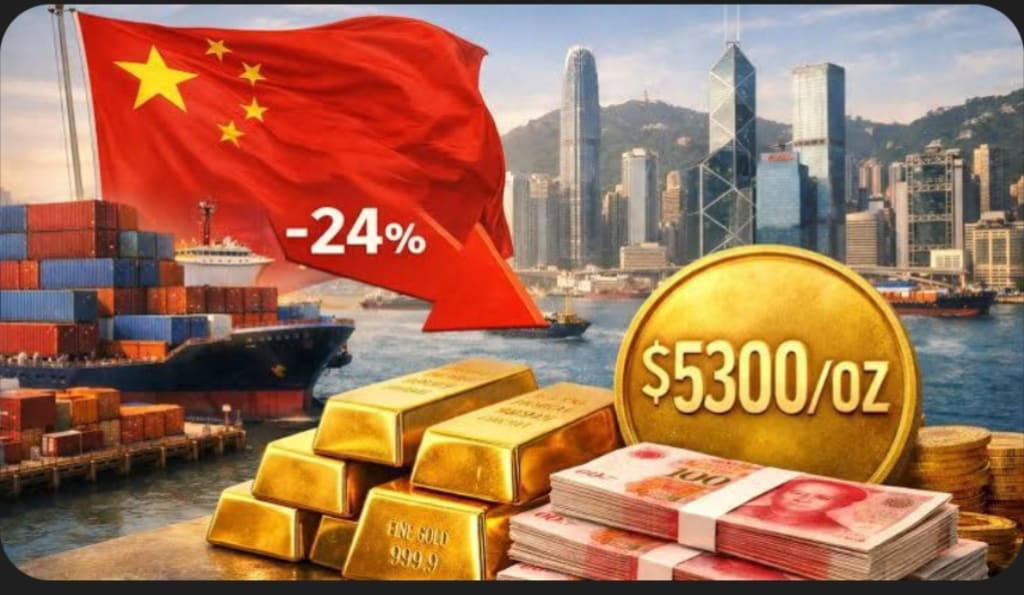
China’s gold market sent mixed signals at the turn of the year. Net gold imports through Hong Kong — a key conduit for bullion flows into mainland China — fell by 24% in December, reflecting a seasonal slowdown and tighter price conditions. Yet by January, domestic premiums jumped and retail demand surged, underscoring resilient appetite among Chinese consumers and investors despite global price volatility.
The contrasting trends highlight how timing, policy expectations, and consumer behavior interact in the world’s largest gold-consuming nation. While December’s decline pointed to caution, January’s rebound suggests demand was delayed rather than destroyed.
---
December Dip: Why Imports Slowed
December’s sharp drop in net gold imports through Hong Kong followed a familiar year-end pattern, amplified by several market-specific factors.
First, international gold prices remained elevated, discouraging bulk purchases by wholesalers and banks. When global prices rise quickly, importers often pause to reassess inventory levels, especially if domestic prices fail to justify the cost of fresh inflows.
Second, seasonal dynamics played a role. Chinese buyers typically scale back purchases toward the end of the year as businesses close books and manage cash flows. Importers prefer to stock up closer to peak demand periods rather than hold inventory through quieter weeks.
Third, policy and quota considerations mattered. Gold imports into China are tightly regulated, and banks operate within approved quotas. As institutions approached year-end, some likely conserved remaining quotas for the new year, anticipating stronger demand around the Lunar New Year.
Together, these factors contributed to the 24% month-on-month fall in net imports, signaling caution rather than a structural shift away from gold.
---
January Turnaround: Premiums Tell a Different Story
The picture changed quickly in January. Domestic gold premiums — the amount Chinese buyers pay over international benchmark prices — widened noticeably, a classic indicator of tight supply and strong local demand.
Rising premiums suggested that available stocks were insufficient to meet renewed buying interest. In China’s gold market, premiums are closely watched because they reflect real-time demand conditions more accurately than import volumes alone.
Several forces drove this rebound:
Festive buying ahead of the Lunar New Year, traditionally one of the strongest periods for jewelry sales.
Investment demand, as households sought safe assets amid economic uncertainty and concerns about property and equity markets.
Expectations of policy support, including hopes for looser monetary conditions, which tend to boost gold’s appeal as a store of value.
As a result, retailers reported brisk sales of gold bars, coins, and jewelry, even as prices hovered near multi-month highs.
---
Retail Demand: Confidence in Gold Remains Strong
China’s retail gold demand has shown remarkable resilience over the past year. For many households, gold remains a trusted form of savings, deeply rooted in cultural traditions and financial prudence.
In January, retail investors returned to the market, viewing pullbacks in global prices as buying opportunities. The surge in premiums indicated that consumers were willing to pay extra for physical gold rather than wait for cheaper prices that might never arrive.
Jewelry demand also benefited from wedding season purchases and gift-giving traditions, which are less sensitive to short-term price movements. For these buyers, gold’s symbolic and long-term value often outweighs concerns about immediate cost.
---
The Role of Global Markets and the Yuan
External factors also shaped China’s gold dynamics. Movements in the U.S. dollar and interest rate expectations influence global gold prices, which in turn affect Chinese buying behavior.
At the same time, currency considerations matter. When the yuan faces depreciation pressure, gold becomes more attractive as a hedge against currency weakness. Even modest fluctuations can tilt household preferences toward physical assets perceived as stable.
These global-local interactions help explain why imports slowed in December while domestic demand surged shortly after. The market adjusted, not collapsed.
---
What the Data Really Says
At first glance, falling imports might suggest weakening demand. But the January premium spike paints a different picture. Analysts caution against reading too much into a single month’s import data, especially given China’s regulated import system and strong seasonality.
Instead, the combination of lower December imports and higher January premiums points to a timing mismatch: supply slowed just as demand picked up. This imbalance is likely to prompt higher imports in subsequent months as banks respond to tight domestic conditions.
---
Implications for the Global Gold Market
China’s gold demand is closely watched because of its outsized influence on global prices. A resurgence in Chinese retail buying, even after a brief import lull, supports the broader bullish narrative for gold.
If premiums remain elevated, it signals ongoing appetite that could translate into stronger import volumes in the months ahead, potentially tightening global supply. For international markets, this adds another layer of support at a time when central bank buying and geopolitical uncertainty already underpin prices.
---
Looking Ahead
The late-December slowdown and January rebound illustrate the flexibility and depth of China’s gold market. Rather than signaling weakness, the data shows how demand can shift quickly in response to prices, policy signals, and seasonal drivers.
As 2026 unfolds, much will depend on interest rate trends, economic confidence, and the yuan’s trajectory. But one thing is clear: Chinese consumers and investors have not lost faith in gold. The January surge in premiums and retail buying suggests that when conditions align, demand can return with force.
For now, the December import dip looks less like a warning sign and more like a pause before renewed momentum — a reminder that in China’s gold market, timing is everything.
About the Creator
Keep reading
More stories from Salaar Jamali and writers in The Swamp and other communities.
Is Silver a Good Investment? Pros, Cons, and What Investors Should Know
Silver has long occupied a unique place in global markets. Often overshadowed by gold, the precious metal is both a store of value and a critical industrial commodity, used in everything from electronics to solar panels. As economic uncertainty, inflation concerns, and shifting interest-rate expectations dominate investor thinking, many are asking a timely question: Is silver a good investment?
By Salaar Jamalia day ago in The Swamp
The Secret Sauce in Heated Rivalry? Canada
In the crowded world of sports romance, very few stories manage to feel authentic, emotionally sharp, and culturally grounded all at once. Yet Heated Rivalry—a novel that has quietly become a phenomenon—does exactly that. While readers often praise its enemies-to-lovers tension, sharp dialogue, and unforgettable chemistry, there’s a subtler ingredient powering its success. That secret sauce is Canada. Not just as a setting, but as a sensibility. Canada’s hockey culture, emotional restraint, values of humility, and quiet intensity seep into the bones of Heated Rivalry, shaping its characters, pacing, and emotional payoff in ways that feel real rather than performative. Strip Canada away, and the story loses much of what makes it resonate so deeply. This is not just a romance set around hockey. It is a love story grown out of hockey culture—specifically, Canadian hockey culture. Hockey Isn’t a Sport in Canada—It’s an Identity To understand Heated Rivalry, you must first understand what hockey means in Canada. In many countries, sports are entertainment. In Canada, hockey is inheritance. It’s learned before walking, absorbed before language, and internalized as a code of behavior. Canadian hockey culture emphasizes discipline, endurance, and teamwork over flashiness. Emotions are controlled. Pain is endured quietly. Bragging is frowned upon. This cultural framework defines the emotional rhythm of Heated Rivalry. The characters don’t explode into dramatic confessions every chapter. Instead, their feelings simmer—pressed down by professionalism, rivalry, and unspoken rules. Desire isn’t just romantic; it’s something that threatens careers, reputations, and identities forged on frozen rinks. That slow burn isn’t accidental. It’s Canadian. Rivalry as a Love Language In Heated Rivalry, competition isn’t just external—it’s intimate. Canadian hockey culture trains players to measure themselves constantly: against teammates, opponents, expectations, and legacy. Winning isn’t only about trophies; it’s about proving worth. That mindset transforms rivalry into something deeply personal. The protagonists aren’t merely trying to beat each other on the ice. They’re challenging each other’s self-concepts. Every game, every clash, every stolen glance becomes a way of saying: “See me. Match me. Don’t let me disappear.” In many romances, rivalry is a plot device. Here, it’s emotional grammar. Emotional Restraint: The Canadian Way of Loving One of the most striking elements of Heated Rivalry is how long it takes for emotions to surface openly. This is where Canada’s cultural DNA shines. Canadian masculinity—especially in professional hockey—often values stoicism. Feelings are managed privately. Vulnerability is rationed. Love, when it appears, is shown through consistency rather than declarations. This makes every emotional breakthrough in Heated Rivalry land harder. A small gesture carries weight. A pause in dialogue becomes deafening. A single honest sentence feels monumental. Readers don’t fall in love with dramatic speeches; they fall in love with the accumulated restraint finally cracking. Canada as a Moral Compass Canada’s influence isn’t only emotional—it’s ethical. The story reflects Canadian ideals of fairness, respect, and quiet accountability. Characters make mistakes, but they’re rarely cruel without consequence. Power dynamics are acknowledged rather than ignored. Growth is slow, earned, and uncomfortable. Even fame is treated differently. In many sports narratives, stardom is glamorous. In Heated Rivalry, success is heavy. It isolates. It complicates relationships. It demands sacrifice. This grounded approach mirrors how Canadian sports culture often frames excellence: Not as entitlement—but as responsibility. The Cold That Sharpens Desire Canada’s climate plays an unspoken role in the story’s emotional intensity. Cold environments create intimacy through proximity. Winter compresses space. People huddle. Silences stretch longer. Touch becomes more meaningful because it’s scarce. Heated Rivalry thrives in that atmosphere. Desire feels sharper because it’s restrained. Loneliness feels deeper because it’s quiet. Connection feels precious because it’s rare. The cold doesn’t numb the story—it concentrates it. Why This Story Feels Different Readers often say Heated Rivalry feels “real” in a way many romances don’t. That realism isn’t just about sports accuracy or believable dialogue. It comes from cultural alignment. The emotional logic of the story matches the world it inhabits. The characters behave the way people raised in that system would actually behave. Nothing feels exaggerated for shock value. Nothing is rushed for convenience. Canada doesn’t just host the story. It disciplines it. The Universal Appeal of a Canadian Story Ironically, what makes Heated Rivalry so Canadian is also what makes it universal. Restraint. Yearning. Slow, earned vulnerability. Love expressed through action rather than words. These are experiences that transcend borders. Readers from everywhere recognize themselves in the silences, the almost-confessions, the moments where love is obvious to everyone except the people feeling it. Canada provides the structure—but the emotions belong to us all. Conclusion: Canada Is the Quiet Flame If Heated Rivalry were louder, flashier, or more dramatic, it might have blended into the crowd. Instead, it chose a different path—one shaped by Canadian values of patience, discipline, and emotional depth. That choice is its greatest strength. Canada is the quiet flame beneath the story. Not always visible. Never shouting. But absolutely essential. And that is the real secret sauce.
By Zahid Hussainabout 14 hours ago in The Swamp
Trump News at a Glance: Pretti Killing a ‘Wake-Up Call,’ Say Obamas as Clinton Urges Americans to Speak Out
A series of developments tied to former President Donald Trump have once again placed the United States at the center of intense political and social debate. From reactions to the killing of Pretti—described by former President Barack Obama and former First Lady Michelle Obama as a “wake-up call”—to former Secretary of State Hillary Clinton urging Americans to speak out, the news cycle reflects growing concern about political violence, polarization, and the future of democratic discourse.
By Aarif Lashari5 days ago in The Swamp




Comments
There are no comments for this story
Be the first to respond and start the conversation.