
...And The Use Of Protest Votes
Third-party voters were blamed for indirectly helping Trump win his election in 2016. This year, some took a more active role.


– electoral-vote.com, 11/18/24
When the Democratic party rigged the primaries against Bernie Sanders during the 2016 election cycle, they fatally damaged their relationship with many of his supporters. While Donald Trump pretends to be a populist (ask any of the people he has cheated by refusing to pay his bills how pro-worker he is), Bernie gave an actual voice to the victims of the corporatists who control the Democratic and Republican parties. By silencing this voice, the Democratic Party confirmed the belief by many that neither major political party cared about the issues that were important to them. The results were catastrophic.
In the 2016 Presidential Election, 6,464,094 people voted for someone other than the two major party candidates, encompassing approximately 5% of the total vote. This was more than Hilary Clinton’s 2,868,691 vote margin of victory over Donald Trump. It was also significantly higher than the previous three elections:

Clinton may have decisively won the popular vote, but the undemocratic Electoral College system gave the presidency to Trump. This is where “other” is credited by some for changing the political landscape.
Trump won the Electoral College vote 306 to 232 in 2016. However, if Green Party candidate Jill Stein’s votes in three states were added to Clinton’s, Trump would have lost the lead. Clinton would have then won the Electoral College 278 to 260.

Of course, this projection severely oversimplifies a very complicated electorate. First, it assumes that if voters did not have the option to vote for Stein, they would not have stayed home or left that line blank in their ballot. Similarly, there is no guarantee that Stein’s voters would have automatically chosen Clinton in her absence. Finally, the Libertarian candidate was also on the ballot in the three flippable states, winning three times the votes for Stein. If we are going to fantasize about removing Stein, should we also remove Johnson? There is a good chance that his absence would have increased Trump’s count.
With the remote possibility that Stein cost Clinton the election, what did her voters accomplish with their vote? The common refrain from third-party voters is that there is no difference between the two parties, but is this accurate? While both are controlled by corporate interests that prevent policies that would help non-billionaires from being enacted, there are clear differences between the two. For example, with Clinton as president, we would not have a Supreme Court that decimated protections for women or granted Presidents king-like protection from accountability when breaking the law.
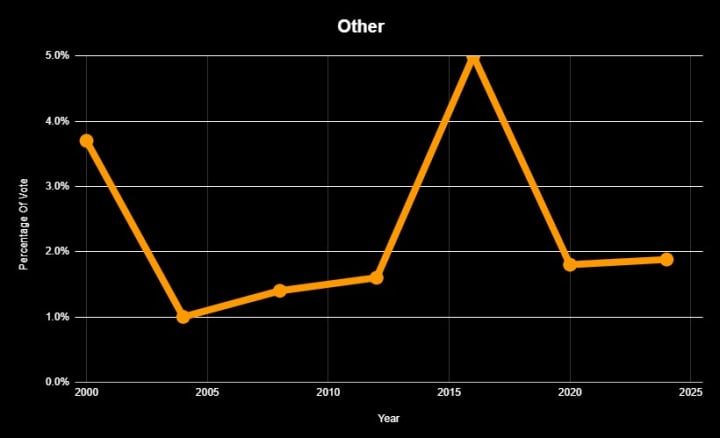
Amid the chaos of Trump’s presidency, the percentage of “other” voters in the 2020 election dropped back down to previous levels. Perhaps it was the hundreds of thousands of people needlessly dying because of his mishandling the COVID crisis or maybe it was the abhorrent reaction to demands for justice in the wake of the murder of George Floyd, but the electorate did not seem to have the stomach for a protest vote.
In the runup to the 2024 election, there was much handwringing over what effect third-party candidates would have on the results. Would the return of Jill Stein to the ballot, joined by Cornel West, drain votes away from Biden (then Harris)? Would Chase Oliver draw voters away from Trump or would the Libertarian hurt Harris by taking “Never Trumpers” away from her?
Nobody bought into this hype more than Robert Kennedy Jr. whose effect on the race was hotly debated. He tried to use this to his advantage as he offered to drop out and sell his support to the highest bidder. Harris passed and Kennedy endorsed Trump. He then spent his time in court either trying to remove or add his name to the ballot depending on whether he thought his presence in that state would harm or help Trump. He was rewarded with a nomination to run the Department of Health and Human Services despite his lack of medical experience and willingness to embrace every conspiracy that floats past the worm in his brain.
When the votes were counted, third-party candidates had no real effect on the race. Jill Stein and the Green Party only secured third place in the race, winning about .50% of the vote. Despite his “strategic” withdrawal, Kennedy received .49%. West earned the votes of a paltry 0.05% of the electorate.

These results should have been expected as the trendline over the past 25 years is flat, showing just a slight downward tilt. Americans talk a lot about the need for a third party, but very few seem willing to back that up with their vote.
What was surprising to me was the number of voters who instead of depositing their protest vote with a third party gave it to Trump. It is bewildering that the man who continues to rally against the Central Park 5 despite their proven innocence was able to increase his share of the black vote. Despite his rhetoric against immigrants and promises of mass deportations, Hispanic men also increased their support of Trump. Most perplexingly, Muslims in Dearborn, Michigan bragged about helping Trump defeat Harris even though he instituted a Muslim immigration ban during his first term. Even if these voters believed that Biden should have done more to end Israel’s continued killing of Palestinian civilians, do they think that Trump will do any better?
_____
Carl Petersen is a parent advocate for public education, particularly for students with special education needs, who serves as the Education Chair for the Northridge East Neighborhood Council. As a Green Party candidate in LAUSD’s District 2 School Board race, he was endorsed by Network for Public Education (NPE) Action. Dr. Diane Ravitch has called him “a valiant fighter for public schools in Los Angeles.” For links to his blogs, please visit www.ChangeTheLAUSD.com. Opinions are his own.
About the Creator
Carl J. Petersen
Carl Petersen is a former Green Party candidate for the LAUSD School Board and a longtime advocate for public education and special needs families. Now based in Washington State, he writes about politics, culture, and their intersections.
Reader insights
Nice work
Very well written. Keep up the good work!
Top insights
Compelling and original writing
Creative use of language & vocab
Easy to read and follow
Well-structured & engaging content
Expert insights and opinions
Arguments were carefully researched and presented
Heartfelt and relatable
The story invoked strong personal emotions
Masterful proofreading
Zero grammar & spelling mistakes
On-point and relevant
Writing reflected the title & theme
Keep reading
More stories from Carl J. Petersen and writers in The Swamp and other communities.
A Gathering of Evil Bosses
“I’m the queen of chin jutting while I smooth my hair, attacking, insulting, and deflecting to protect my appointer.” “Oh, please, Blondi, my hair is curled, highlighted, and longer than yours. I feature television commercials telling immigrants that we will give them a free plane ride home, and if they voluntarily turn themselves in, they will be allowed to legally apply for re-entry. It runs everywhere, and I look good in it! You can’t compete because of your blond hair. Mine is nicer, and my lips are prettier than yours.”
By Andrea Corwin 18 days ago in The Swamp
Emma Raducanu hopes to rediscover ‘natural’ style that has been ‘coached out of me
British tennis star Emma Raducanu has revealed that she is working to rediscover the instinctive style of play that propelled her to global fame, saying that years of structured coaching have partly taken away the natural instincts that once defined her game. The 2021 champion of the US Open believes reconnecting with her original approach could be the key to reviving her form as she prepares for the upcoming Indian Wells Open. Raducanu’s comments come during a period of reflection in her young career. Since her historic breakthrough at the US Open, where she became the first qualifier in the modern era to win a Grand Slam title, the British No. 1 has experienced an uneven journey marked by injuries, fluctuating results, and frequent coaching changes. Now ranked around the top 25 in the world, she is determined to regain control of her playing identity. Speaking ahead of Indian Wells, Raducanu explained that her priority is to reconnect with the natural instincts that originally helped her play freely and aggressively on the court. She admitted that years of detailed tactical instruction have sometimes made her overthink situations during matches. “I want to come back to my natural way of playing,” Raducanu said, adding that it would take time to relearn because “that’s something that has been coached out of me a little bit.” Her remarks highlight the tension many elite athletes face between structured coaching and individual creativity. While coaching can refine technique and strategy, Raducanu believes too many voices advising her game may have complicated what once came naturally. The 23-year-old also indicated she may not rush into appointing a single permanent coach. Instead, she plans to draw guidance from multiple trusted figures rather than committing immediately to a long-term coaching partnership. According to Raducanu, having one coach can sometimes create expectations that make it difficult to experiment or change direction if the collaboration does not work. In recent months, Raducanu ended her partnership with Spanish coach Francisco Roig after an early exit at the Australian Open. For the North American hard-court swing, she has reunited with former mentor Mark Petchey, someone she trusts and has previously worked with successfully. Petchey’s presence could help provide stability while allowing Raducanu the flexibility she desires. The former coach of Andy Murray has often emphasized building confidence and encouraging players to trust their instincts—an approach that may align with Raducanu’s current goals. Raducanu acknowledged that the constant cycle of coaches throughout her career has contributed to the challenge of maintaining a clear playing identity. Since her US Open triumph in 2021, she has worked with several coaches, each bringing a different philosophy and tactical approach. While each partnership offered valuable lessons, the constant adjustments may have diluted her natural rhythm on the court. Beyond coaching decisions, Raducanu has also had to cope with injuries and intense media attention, both of which have added pressure to her development. The expectations placed on her after her Grand Slam victory were immense, and navigating that spotlight while still learning the professional circuit has not been easy. However, the British star remains optimistic about her future. She believes that reconnecting with her instincts and simplifying her game could help her regain confidence and consistency. Her approach heading into Indian Wells is therefore less about chasing immediate results and more about rediscovering enjoyment in competition. By focusing on instinct rather than overanalysis, Raducanu hopes to play with the same fearless energy that once stunned the tennis world. For fans and analysts alike, the upcoming tournaments will provide an opportunity to see whether Raducanu’s renewed philosophy translates into improved performances. If she succeeds in blending natural instinct with the lessons learned from coaching, she could once again become one of the most exciting players on the women’s tour. After all, the raw talent that carried her to one of the most remarkable victories in tennis history remains intact. The challenge now is simply to let it shine again.
By Fiaz Ahmed 2 days ago in The Swamp
From ad men to mad men
It's after 2am in the morning when a local police patrol vehicle in Northern New Jersey spots a figure costumed as Quasimodo, The Hunchback of Notre Dame, proceeding southbound on the sidewalk along Lydecker Street. Though the hunchback’s costume stuffing offers added insulation, it's January, and friggin’ freezing. Carefully, the officers slow down, gently question the subject, and offer him a ride home.
By David W. Maury3 days ago in Humor


Comments (13)
A valid and insightful piece. I, for one, am tired of voting for the lesser of two evils. I would love to see some qualified and dynamic opponents. Thought provoking article, for sure.
Worth looking at preferential voting system in Australia. There’s an excellent satirical group called Australien Government (note the e) that has an explanation of how preferential voting works. The major parties are doing everything they can to nullify it.
Thank you for this well-researched and eloquently expressed piece! As someone who has been torn between third-party and lesser-of-two-evils voting for the past couple of elections, this discussion is wonderfully thought-provoking.
I protest didn't vote. Well, since 1992. None of those people are on your side IMHO. It's like leaving a suggestion card in a restaurant with 350 million customers, and thinking the chef will cook your steak better the next time you go thee.
Back in the 90s when Bill Clinton was President, I had voted Libertarian. People mocked me and said that I wasted my vote. They told me that I was Republican, but I knew that the party platforms were different. Though 5% of the votes were on "losers" and many will continue to state that voting for a 3rd party is "wasteful" I disagree. I'm glad to know that those votes have increased. It is a statement from voters saying "We do not want to vote for the lesser of two evils." We want to vote for good even if good is a loser. Our vote matters even if you call it wasteful.
Thank you so much for sharing your insight. It clarifies some specific points but sadly, doesn't soften the blow of the outcome. 4 years of antics, here we come!
Crazy times and politics. Great article and congrats on the Top Story!! 🎉🥳
Carl, congrats on your top story.
You should also take into account the elections in 1992 and 1996, and arguably, 2000. In 1992 the first time I could vote, Ross Perot used his fortune to actually buy prime time airtime so he could present the problems America was facing and his solutions. This was key because no other third party candidate has these resources, and the networks won't allow anyone in the debates aside from the major parties, so most of America, unless they're already dialed in to the alternative candidates, has no idea what anyone else stands for. They're just thought of as the fringe, crackpot candidates. As a result of putting himself out there, huge numbers of Americans voted for Perot. It wasn't quite a three-way tie, but Clinton only won by a plurality. He received 5 million more votes than George Bush, Sr. and Perot had 19.7 million votes. Far more people voted against Clinton than voted for him, and it was assumed that those who voted for Perot would have voted for Bush. If Perot hadn't run, the Clintons would be a footnote in history. Perot wasn't sure he was going to run in 1996, so he came in late, which made his supporters wonder if his heart was in it the second time. He also had a very weak running mate, so he only had about half as many votes as in the previous election. Still, if you added Perot's votes to Bob Dole's, the difference between Clinton and Dole would have been only about 200,000 votes, a narrow victory. This was forgotten in the highly contested election of 2000. That time Gore won the popular vote by about 540,000 votes, but George W. Bush won by 5 electoral votes. Ralph Nader was the big third party candidate that time, with 2.8 million votes. If his votes had been added to Gore, the victory would have been decisive, not narrow and divisive. His supporters largely ignored the irony of Gore only being Vice President because Perot ran, giving Clinton his victory. Also, people who vote third party may actually be voting their conscience. I've seen these statements on social media before and after this year's election, as people discussed whether the votes were wasted. If you find both candidates objectionable, are you obligated to vote for them or should you actually vote for a candidate you'd like? Some said voting for who you actually wanted to win rather than one of the two parties makes a statement, one that's growing, as you've shown, that we need more alternatives. Finally, in some states, it doesn't quite matter. There are deep red and deep blue states. If you live in one, and you vote the other way, in the big scheme of things, your vote is lost. Your state will still go red or blue. I live in one of those states, and I voted my conscience just so my vote would be counted in the popular vote total, knowing how much people point to it as evidence of popular opinion.
Congratulations on Top Story!!
I appreciated the research that went into this story.
Its weird how 3rd party voting persists. At best, understanding that it won't matter and can only hurt them, they'll suggest that it will at some point in the future matter. How? Idk. Like after the election is over, everyone who voted for major party candidates and circle back and feel bad that they were unmotivated and change our constitution to some parliamentary system or something. In reality, the party that wins has the power and they're glad you didn't vote. And then we just repeat 4 years later. As if the country just started or third parties just started. Anyway ...
The voting system does need adjusting, how I don’t know. I live in Canada where we allow too many parties to run and not enough people to support that system. It always ends up with a minority Gov’t.