
From ad men to mad men
family history celebrating writer Richard F. Maury
It's after 2am in the morning when a local police patrol vehicle in Northern New Jersey spots a figure costumed as Quasimodo, The Hunchback of Notre Dame, proceeding southbound on the sidewalk along Lydecker Street. Though the hunchback’s costume stuffing offers added insulation, it's January, and friggin’ freezing. Carefully, the officers slow down, gently question the subject, and offer him a ride home.
Hours earlier, our mother Carole has quit the costumed social event to drive herself home in the family station wagon, leaving our dad, who wanted nothing more than to be last to leave the party, to fend for himself. Arriving at the house, he thanks the officers and exits the patrol car.
The great thing about the 2am hour is that it's dark, neighbors are asleep, so nobody sees or hears any of this.
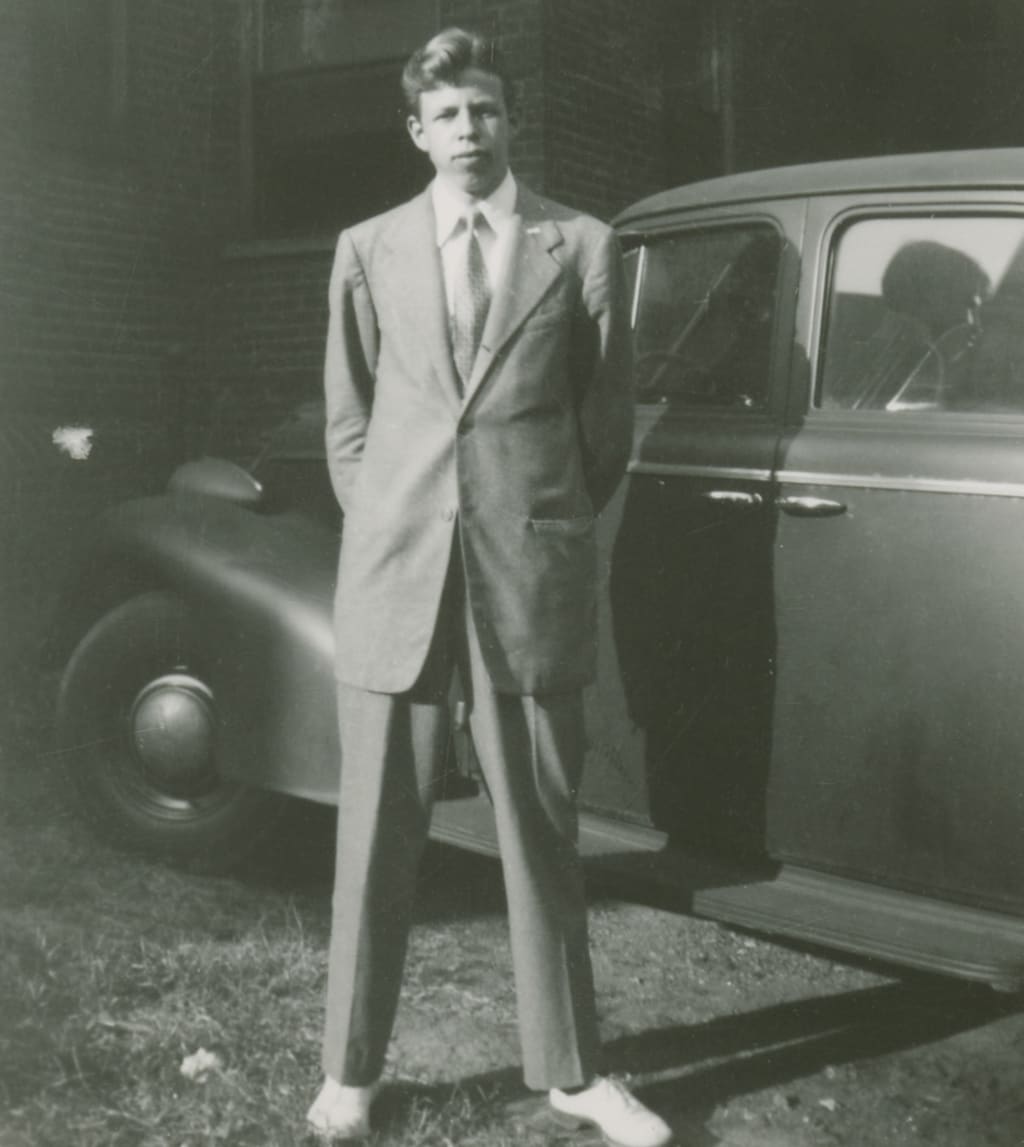
We dredge up this early 1960s remembrance in celebration of our dad’s would-be 100th birthday. Since we won't be around for his 200th or 300th, we're throwing in more than enough material— some of it posted previously— to cover those milestones as well. What's on his resume. What’s not on his resume.
But first, a quick obit: Richard Fontaine Maury, born March 3, 1926 in Chevy Chase, Maryland, passed away in March 2000, his remains joining his beloved mother, Edna, and other family members, all resting peacefully (as far as we know) on Nantucket. At the time of his passing, he is survived his former spouse, Carole, his two brothers, his five kids including yours truly, and six grandchildren.
Back to the early 1960’s era: When not being driven around in patrol cars dressed as a cathedral bell ringer, our dad is a creative writer who pens new model announcement shows, radio spots and television commercials with the ad agency MacManus, John, and Adams, Inc., at 444 Madison Avenue, in New York. He’s paid to come up with ideas. He stares at the wall, types something up, crumbles the paper, and tries again. The office has nice modern equipment, but his best desktop publishing device when at home is his manual Royal typewriter. The imperfect letter type on various drafts and scraps are not unlike what we might see from the Unabomber.
While working full time for the agency, RFM also continues as a freelancer, writing scripts for industrial films, new product shows, Broadway, and off-Broadway revue shows. It’s what he did before joining the ad agency full time.
Among dozens and dozens of scripts “approved for production” by the agency, there are commercials for Pontiac Grand Prix, Bonneville Lemans, Catalina, Tempest. Comedian Victor Borge is featured in a series of Pontiac commercials for television.
“The Golden Wheel, — A Musical, Starring the 1960 Cadillac,” presented by Cadillac Motor Car Division for the new model announcement meetings, is a fully staged production with a composer, lyricist, choreographer, stage director, scenery, costumes, lighting, a cast of twelve players. The program for “The Golden Wheel,” is printed on expensive textured matte paper. Richard F. Maury cowrites the musical with director Ed Reveaux.
Writer and Director Ed Reveaux is the closest thing we have to a favorite de-facto uncle— After moving from our Riverside Drive seventh floor apartment in 1959, “Mr. Reveaux,” as we know him, is among the first guests to stay in the third floor guest room of our new home. And he invites us up to his Connecticut home to take us fishing on Long Island Sound.
Finishing breakfast one morning, our dad shares that he’s going to Detroit that day: It’s not uncommon for him to go to Detroit. He goes, and makes it back in time for dinner. We don't get to go. Occasionally, he goes to the West Coast. We don't get to go there either.
Advertising influences viewers of all ages. As young children, we irrevocably pledge our lifelong automobile brand loyalty to Pontiac. But, MJA, representing an array of General Motors brands, is bigger than Pontiac.
Arriving home one day, our dad brings a 45-RPM disk with typewritten label. We are among the first in the country to hear creative director and songwriter Mark Lawrence’s fully orchestrated 1964 campaign jingle, “Wouldn’t you really rather have a Buick.” Amidst an invasion of British pop and Motown hits, the nation will be hearing this tune many times.
For those on foot, there are scripts for Wolverine Hush Puppies. For those in the air, there are scripts for US Air Force ROTC. The United States gets into the Project Gemini era with astronauts performing tethered space walks outside the capsule. Airing nationally— I saw it— then taken off the air over concerns somebody might try it, is a Pontiac commercial with a tethered passenger floating just outside of a station wagon traveling on a highway.
RFM’s freelance projects make him a double agent. If Buick and Cadillac aren’t disloyal enough, there’s “Ford-I-Fy Your Future,” a 1959 presentation for the Ford tractor audience. For the 1965 Chrysler - Plymouth dealer announcement meetings, there are motion picture and presentation scripts.
Following a trip to the West Coast spending several days on a project with legendary surfer Greg Noll, a delivery truck shows up unexpectedly with a very long box. Inside the box is Greg Noll’s signature “Da Cat” surfboard, brand new, complimentary.
The day comes when our dad sits us down to announce a big change: He’s leaving his current job for a position at a larger agency, J. Walter Thompson, in the Graybar building at 420 Lexington Avenue. No longer writing spots for Pontiac, he’s instead going to the dark side: Ford. What?
As part of the ritual of moving to a new agency, he is asked to write an autobiographical sketch. Straight from the source, what he writes covers his life, from his teens, up until that point in the mid-1960's. For whatever reason, there’s no mention of any 2am courtesy rides in patrol cars. Tucked away for decades, we share it now, word-for-word:
(the following was written by Richard F. Maury)
Where you live usually has little to do with determining your eventual vocation. But for me, growing up in wartime Washington, D.C. was significant. Only there could I have had the job, and met the people who had a great influence on my decision to be a writer.
In 1942, I was sixteen years old, attending public high school and counting the days until I could join the services. My father had died four years before, forcing my mother to return to work after years of leisure. We were poor but honest and any income I could contribute to the family was more than welcome. And so when a friend of my older brother’s told me that the Office of War Information desperately needed copy boys to work at night, I applied for a job, and was accepted.
For fourteen months, I worked in the OWI after school from four to twelve midnight. Although I used to get very sleepy about Thursday, I loved it. I worked with some of the finest newspapermen and writers in the country (Robert Sherwood, Pat Frank, Elmer Davis were all working there.) Imagine being sixteen years old and having a boss named “Black Jack” Acklemayer who would roar, “you’re the best goddam copy boy we’ve got, but you’re too young to buy liquor!” These wild, cynical, intelligent and kind men dubbed me GP (for Growing Pains), but treated me as an adult. All insisted that writing was the only civilized occupation for a grown man. I began to agree with them.
One of them also told me I would be a fool not to go to St. John’s College in Annapolis, M.D., “the hundred Great Books” school. St. John’s required only two years of high school if you could pass their entrance examination. Thanks to a small legacy from a godmother, I decided to skip the last year of high school, and go to St. John’s. Although I later graduated from Princeton, St. John’s gave me my most exciting college year.
In 1944, I entered the Naval Air Corps as a cadet. I was put in the V-12 College program, but by the time I was ready for pre-flight training, the Navy had all the pilots it needed, and I was transferred to NROTC. At Princeton, of all places. In 1946, I was mustered out, and because St. John’s would not accept credit from other colleges because of its radical curriculum, I decided to finish college at Princeton. There I wrote stories for the Princeton Tiger and The Nassau Lit, plus a musical comedy for the Theatre Intime. I graduated with honors in English and the Humanities in the Class of 1948, and immediately came to New York to be a writer.
Mark Lawrence, later a creative director for MacManus, John & Adams, Inc., but then a would-be playwright, contacted me about doing the book of a musical. He had heard about the show at Princeton. We got along well, and wrote many great things together, most of them un-produced.
After about a year in New York, I got a job as assistant to the director of a Broadway revue, Small Wonder. While the show was in New Haven, I wrote a monologue and showed it to the director. To my astonishment, he put it in the show, where it was performed by Tom Ewell. For a few months, I had the thrill of living on royalties.
Inspired by “overnight” success, I began to write monologues and special material for nightclub performers, but without much success. The Dramatist’s Guild accepted me in their New Dramatist’s Program to encourage young playwrights. Though I got to see shows in rehearsal, and was talked to by established titans of the theatre, my money was running out. An old friend wrote me from Lynchburg, VA, offering me a job as a reporter, and I was seriously thinking of accepting when a chance meeting on the street changed my life . . .
Encountering a friend I’d known only slightly in Washington, D.C., I asked what he was doing.
“Oh, I and a couple of guys have started a documentary film company,” he said.
“Wonderful,” I said. “I’m a natural-born film writer.”
“Is that so?” he said. “What films have you written?”
“None,” I replied. “But I’m a natural-born film writer.”
“Tell you what,” he said. “How’d you like to re-write a narration for a film? We’ll pay you fifty bucks.”
And that’s how I became a film writer.
Over the next five years, I wrote treatments and scripts for over fifty industrial and sales films, producing and directing many of them as well. Although I always worked on a free-lance basis, most of these films were written for Unifilms, Inc.
But all was not work. A sociologist once discovered the average American goes seventeen and a half blocks to find a wife. I am apparently seventeen blocks below average because I married the exquisite brunette who lived across the street in New York. We now have five children, two girls and three boys.
In 1955, I tasted genuine success in the theatre by writing two sketches for The Shoestring Revue, an off-Broadway production given nine raves by the first-string critics. Later, I wrote for New Faces of 1956 and ’62 and four or five other revues.
It was almost inevitable that my experience in film and theatre, plus the needs of a growing family, would lead to the industrial show field. My old friend Mark Lawrence offered me the job of writing and supervising the Pontiac new car announcement meeting for MacManus, John & Adams. After doing it for two years as a free-lance, MJA invited me to take a permanent job with them as a radio and tv copywriter.
There I remained until a certain agency requested this autobiographical sketch.
(end of the Richard F. Maury quotation)
•
For an overview of the J. Walter Thompson ad agency golden era, read the one-page column “The glory days at JWT,” by Joe Winski, Advertising Age, September 5, 1988. "It was an institution: the Vatican, Tiffany, Lloyd's of London, the House of Rothschild . . . It was still a place of decorum, though not quite as rigid as it was under (Stanley) Resor, who reportedly fired a young account man for saying good morning from the adjoining urinal . . . They had a fleet of limos in the Pan Am Building garage, license number JWT 1, JWT 2 and on up, ready to whisk account men off to meetings."
There’s a show-biz theme going on in Richard Maury’s family. His older brother, John Jr., and sister-in-law, Terry, are involved with Nantucket community theatre. This explains the unannounced delivery, a day or two before the Christmas holiday, of a ginormous box. To the consternation of the delivery man, heiroglyphics are visible through the box's torn corner. Inside is a full size mummy case, beautifully constructed for a community theatre production. It will now be spending its afterlife with us.
Jumping back into the world of 1950’s theatre:
It’s 1955 and producer Ben Bagley is 21 years of age when he puts together “Shoestring Revue.” Theatre critics, including New York Times’ Walter Kerr, Wall Street Journal, NY Post, New York Journal-American, and World Telegram single out the sketches “In Bed with Reader’s Digest” and “Group Analysis” by writer Richard Maury. Two then-unknown actresses— Bea Arthur and Chita Rivera— perform in “Group Analysis.”
Leonard Sillman— who left home at age 14 to make it in show biz— produced as many as 13 “New Faces” shows, ranging from 1934 to 1968. Sadly, New Faces of ’62 is a flop, closing after 30 days, but “New Faces of 1956” is a success, with a total of 220 performances from June to December, 1956. Paul Lynde and Richard Maury are among the sketch writers. Along the way, two sketches will be removed from the show.
The first is “Madame Interpreter,” penned by an emerging young playwright named Neil Simon and his brother Danny, in which a then-unknown but very British Maggie Smith represents France in a satire about the UN. By November 6, 1956, amidst the Suez Canal crisis, The New York Times reports, “SATIRE ABOUT U.N. DELETED BY SHOW.” Along with 40 ships, the Suez Crisis sinks the show’s opening act.
The second, in which that same Maggie Smith introduces and performs, is "The Broken Kimona,” sketch and lyrics by none other than Richard Maury, with music by Robert Stringer.
The name Robert Stringer may not ring a bell— but you’re probably familiar with the Stravinsky-inspired music he composed for the poppy scene in “The Wizard of Oz.” Years earlier, Stringer had worked in the MGM music department as an assistant to Herbert Stothart. Stothart, who won an academy award for his score to “Wizard of Oz,” included Stringer’s piece in the motion-picture score.
But Wizard of Oz credentials won’t save “The Broken Komona,” which, at some point, is removed from “New Faces of ’56.” The music score does not make it into the show's LP cast album. But as a conciliation, a photo from a scene in the sketch survives at New York Historical Society.
Our dad mentions more than once how he wrote material for Dean Martin and Jerry Lewis. IMDB does credit Richard Maury with providing special material for an episode of Startime, a variety show that aired 1959 - 1961.
In “Here lies Leonard Sillman, Straightened out at last; an autobiography,” author and producer Sillman mentions bringing an unknown actor named Henry Fonda into his New Faces show. But Sillman can’t accept everybody who knocks on his door—Among his many declines is a newly arrived Danish pianist-comedian named Victor Borge. The book is a great read.
From these 1950’s live shows, a handful of unknown or barely known talent emerge to end up in iconic Broadway roles in West Side Story, Mame, and Fiddler on the Roof. Some, like Arte Johnson, will pop their heads through windows on Rowan and Martin’s Laugh-in. Eventually, some of these once unknown 1950’s players will go on to appear in Maude, Golden Girls, Downton Abbey, Hollywood Squares, and in the Harry Potter movie series.
These shows produce long-term friendships. Sometime in the mid-1960’s, our family visits Shoestring Revue performer Bea Arthur and her husband Gene Saks at what was then their little getaway cottage in New York State. My two brothers and I don’t really want to sit around listening to grown-ups talk, so we go outside to run and roughhouse. Next thing you know our brother Stephen has fallen into the tiny outdoor fish pond— This is November, fallen leaves stew in the icy pond water. The grown-ups all go into a frenzy racing to find towels to save Stephen, bringing the visit to an end.
More on the name Mark Lawrence: According to his NY Times obit dated August 30, 1991, “Mr. Lawrence was the founder of Mark-L Enterprises, which produced movies and plays, including the 1963 film version of ‘Lord of the Flies’ and on Broadway ‘The Owl and the Pussycat,’ ‘The Subject Was Roses’ and ‘Beyond the Fringe.’ . . . He composed the score for the film "David and Lisa" and produced an Academy Award-winning documentary on the cellist and conductor Pablo Casals.
"Mr. Lawrence's award-winning advertising jingles included ‘Wouldn't You Really Rather Have a Buick.’ In the late 1950's he was a vice president and director of radio and television for MacManus, John & Adams in New York. Later he was director of communications for U.S. News & World Report, the magazine founded and published by his father, David Lawrence.”
•
Counting her son, Richard’s mother, born Edna McKahan, is surrounded by no fewer than five close relatives all in show biz, starting with her sister-in-law “Zounie Maury,” a show girl who performed in “The Passing Show of 1913”.
Edna’s other sister-in-law, Gretchen Hartman, was a well-known silent film star during the Charlie Chaplin Days. Edna’s brother—Richard’s uncle— Rufus McKahan, appears in silent films also, but his name has been changed to “Alan Hale.” Alan Hale’s lifelong marriage to actress Gretchen Hartman began when he reportedly proposed to her on the set.
With the advent of talkies, Gretchen retires but Alan Hale continues as a Warner Brothers character actor. You may recognize him as the driver who screeches to a halt and backs up for two hitchhikers played by Clark Gable and Claudette Colbert, in Frank Capra’s 1934 motion picture, “It Happened One Night,” He’s frequently cast with Errol Flynn— he plays Little John in the 1938 epic, “The Adventures of Robin Hood.”
Hale’s daughter, Karen Wookey or Karen Hale Wookey— not to be confused with an Australian actress by the same name, was a well-known script supervisor in a long list of motion pictures.
Alan Hale’s son, Alan Hale Jr., appears in numerous 1950’s westerns, B-movies, and the television series Casey Jones, before being cast as The Skipper in the iconic series, Gilligan’s Island. Credits for Alan Hale Sr. and Alan Hale Jr. are frequently confused on various sites. One clue is that Alan Hale Sr. passed away in January, 1950. One of the better articles about Alan Hale, Jr. is “All About The Skipper,” published by womansworld.com.
•
So now Richard Maury is with the new J. Walter Thompson agency, and he’s written a television commercial scheduled to be filmed nearby in suburban New Jersey. My brother, Richard Jr., and I are invited— the only time we will ever be invited— to attend the outdoor film shoot. Off the set, they’ve hired a puppeteer to animate the seat belts inside a vehicle. My brother and I won’t get to see that portion of the filming, but what we do get to watch is an attractively dressed woman emerging from the house, entering the vehicle, and driving away in her Ford LTD. Later, music and dialogue will be added. The commercial will soon be broadcast nationally, and we’ll view it on our wood paneled living room TV set.
We can’t possibly know it at the time, but the persuasive voice narration is none other than Canadian actor Douglas Rain, who, within a year or two, will become the voice of HAL in Stanley Kubrick's, "2001 A Space Odyssey."
On special assignments for J. Walter Thompson introducing the Capri and Maverick in Brazil and England, our father was away for six months. Word got back that in Brazil, “Pinto” was not the best choice of brand names. Our father mentioned filming horses along the beach followed by a Ford Mustang. Our mother held down the fort at home, then traveled to meet our dad in Brazil. This includes meeting Mrs. Villa-Lobos at the Villa-Lobos Museum in Rio de Janeiro, celebrating the late composer.
RFM’s freelance double-agent activities continue: He works on Volkswagen of America new model presentations for 1967, “Less is More,” and the 1971 and 1973 VW dealer meetings.
By the late 1960's, Tim Warriner, another favorite de-facto uncle, joins our dad over many weekends at our house, and together over a folding card table they cowrite a film script for which they are offered, and subsequently decline, an offer of ten thousand dollars. Good money back then.
During the 1970s, RFM leaves the world of advertising to write for Big Blue Marble, the corporate-funded public television series featuring children from around the world. His idea was themed, “If children ruled the world.” Some examples: Episode 100: “The child reprimands her father for dressing sloppily.“ Episode 105: “. . . children have something to say about their parents' bedtime. “ Episode 106: “The child reprimands her mother about her choice in friends.”
Footage arrives from countries all over the map, but episodes of ‘if children ruled the world’ are staged. And it's who you know that matters. Accordingly, our younger sister Nicole, in a speaking role, rules the world for the duration of at least one episode. The footage of a kid hang-gliding the skies of a foreign nation is voiced over by our younger brother Stephen.
The National Academy of Television Arts and Sciences graciously honored Richard F. Maury. Big Blue Marble earned a Peabody award and a dozen Emmy’s, but it no longer seems to officially exist anywhere. The site www.coolvariety.com lists the Big Blue Marble episodes. The segments with “If Children Ruled the World” include 29 episodes ranging between 100 and 149. YouTube hosts isolated episodes, but none of the 29 we’d like to revisit.
By this time in the 70’s, Richard Maury is writing the scripts for the Porsche-Audi November ’75 dealer presentations. He also writes 17 episodes for the Bobby Goldsboro Show, airing from 1973 to 1975. He writes Radio and TV spots for The American Cancer Society ’75 Cancer Crusade. Although I was then too big to appear as a child ruling the world in any Big Blue Marble episodes, the power of nepotism provides me a role as instrumentalist for a background score for an American Cancer Society instructional film on breast self-examination, with actress Jennifer O'Neil as instructor. They've already filmed the instruction portion, so she won't be present for the recording of the musical score.
After two seasons with Big Blue Marble, RFM leaves to write for a different Ford— This time it’s the one serving as president, who now wants to be elected, but of course it’s normally not done in that order. So the Committee to Elect the President hires Richard Maury to write for the campaign. Ford's opponent in the general election is the then-unknown former Georgia governor Jimmy Carter. How unknown? At the airport during his weekly commutes between Laguardia and DC, a woman approaches our dad and says, “Mr. Carter, I’d like your autograph.”
So there you have it. From ad men to mad men.
About the Creator
Keep reading
More stories from writers in Humor and other communities.
Two Grumpy Old Men Solve the Problem
Marty and Steve were two grumpy old men who lived together. They had known each other for years. Marty had been a bachelor all his life. Steve said it was because no one could stand to ever live with. Marty’s standard reply was “Well, you are, so what sort of a moron does that make you!”
By Calvin Londona day ago in Humor
Ten things I’ve Learned from watching Naked and Afraid…So Far…
10. The world is not a safe place, all kinds of little wildlife is out there that can seriously cause harm or death. Season 1, Episode 1 producer Steve Rankin was bitten by a Fur-de-lance and nearly lost his life while scouting a location for the first episode of Naked and Afraid.
By Cassie Moore6 days ago in Humor


Comments
There are no comments for this story
Be the first to respond and start the conversation.