
America in Flux: The Bold Moves and Backlash Shaping the U.S. in 2025
Subtitles: Trump’s Second Term Spurs Controversial Immigration and Media Policies Protests, Economic Surges, and a Nation on Edge How Americans Are Responding to a Rapidly Changing Political Landscape

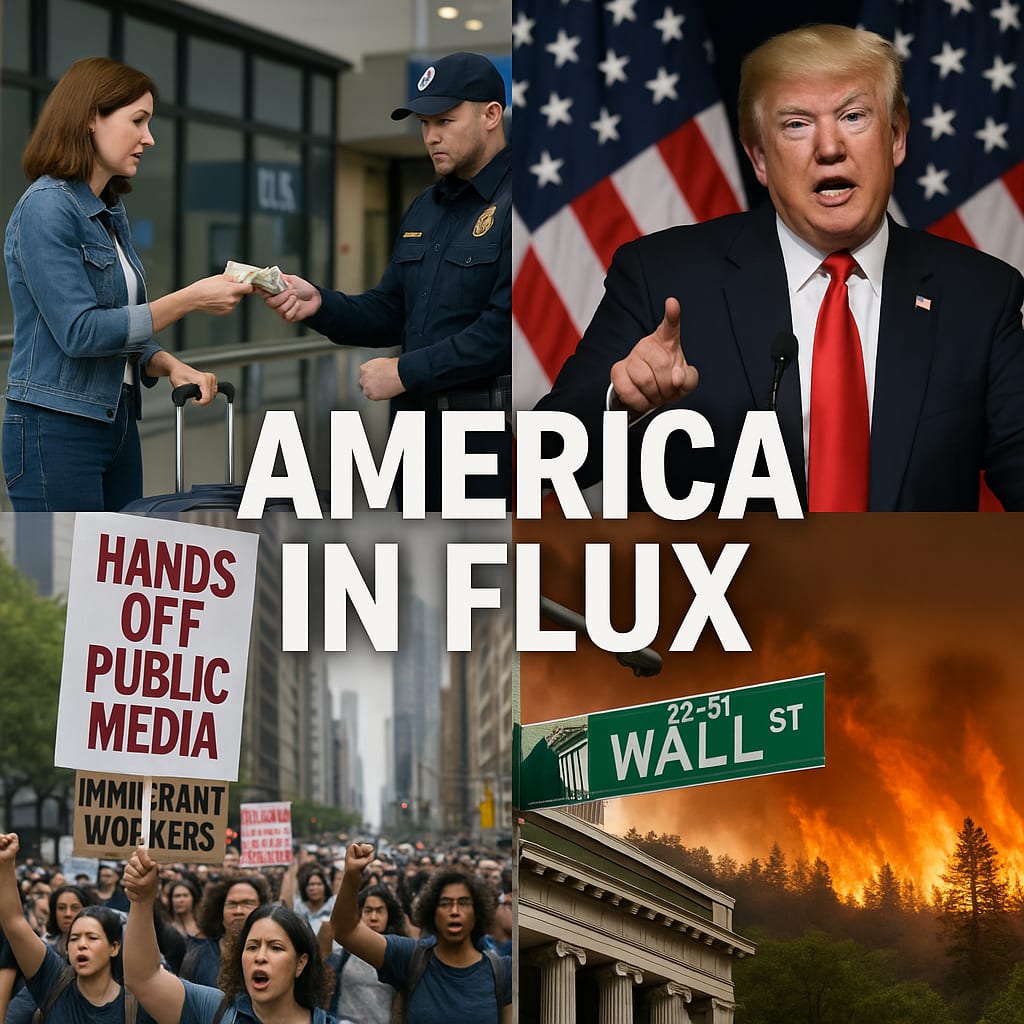
America in Flux: The Bold Moves and Backlash Shaping the U.S. in 2025
The United States is in the midst of a transformative period in 2025, driven by sweeping policy changes, rising public dissent, and economic developments that are redefining the national landscape. Under the renewed leadership of former President Donald Trump, the federal government is introducing initiatives that are being praised by some as "bold leadership" and criticized by others as authoritarian overreach.
Let’s take a closer look at what’s unfolding across America in real time—and what it means for the future.
Trump’s Second Term: An Aggressive Agenda Unfolds
In his second term, President Trump has wasted no time reshaping federal priorities. One of the most talked-about measures is the introduction of a program offering undocumented immigrants $1,000 and a plane ticket to voluntarily leave the country. Critics argue that the initiative manipulates vulnerable populations and could potentially bar them from future legal reentry.
At the same time, a controversial executive order is eliminating federal funding for public broadcasters such as NPR and PBS. Trump’s administration claims it’s about stopping taxpayer funding of “biased media,” while journalists and civil liberties groups warn this could threaten press freedom and diminish the public’s access to nonpartisan information.
Perhaps most surprising is Trump’s order to reopen Alcatraz prison. Once a notorious penitentiary shut down in 1963, Alcatraz’s revival is raising eyebrows, especially as many state officials claim they weren’t consulted.
Public Backlash: Protests and Grassroots Movements Surge
In response to these sweeping changes, Americans are taking to the streets. On May 1, a massive movement labeled “50501”—a nod to the date—mobilized protesters in cities like New York, Los Angeles, and Chicago. Their grievances ranged from anti-immigration policies and worker rights to broader concerns about authoritarianism.
The movement is diverse and intersectional, uniting labor activists, immigrants’ rights organizations, and student groups. Social media has played a major role in organizing the protests, signaling a resurgence of online-driven activism reminiscent of the Black Lives Matter and Women’s March movements.
These protests are not isolated incidents—they reflect a growing sense of urgency among Americans who fear the erosion of democratic norms.
A New Economic Chapter: Investment and Instability
While the political climate may be turbulent, the U.S. economy is sending mixed signals. Pharmaceutical giant Bristol Myers Squibb recently announced a $40 billion investment in domestic operations over the next five years. This signals strong confidence from the private sector, especially in biotech and healthcare.
At the same time, economists are analyzing the latest services PMI (Purchasing Managers' Index) data to gauge inflation trends and potential interest rate changes by the Federal Reserve. Although inflation has stabilized since its pandemic-era spike, uncertainty remains.
This economic balancing act between corporate optimism and public concern illustrates the complexity of today’s market landscape.
Civil Liberties and Controversial Proposals
Another source of public concern is the Trump administration's proposal to create a national database to track individuals on the autism spectrum. While the government claims it aims to improve services, disability rights advocates are calling it intrusive and potentially discriminatory.
“People with autism deserve privacy and respect, not government surveillance,” said a spokesperson for the Autistic Self Advocacy Network. The issue underscores broader debates over data privacy and government control—topics that are gaining traction in today’s digitized world.
International Affairs: Sanctions and Cybersecurity
On the global stage, the U.S. has imposed sanctions on a Myanmar warlord and his militia for running cyber scam operations targeting Americans. This move highlights the growing threat of international cybercrime and Washington’s attempt to curb foreign actors exploiting digital vulnerabilities.
Such actions indicate the Biden-Trump policy overlap in some areas, particularly regarding cybersecurity and global accountability. Still, critics argue the sanctions are reactive rather than preventive.
Environmental Outlook: Climate Caution Amid Policy Shifts
Meanwhile, the U.S. Climate Prediction Center has released its May 2025 outlook, warning of potential drought conditions in the West and unseasonably warm temperatures across the South. Although environmental policy has taken a backseat in recent headlines, scientists warn that the effects of climate change continue to intensify.
There’s a stark contrast between federal priorities and scientific recommendations, with many calling for more robust environmental protections. As natural disasters become more frequent, this disconnect could have long-term consequences.
Media Freedom in Jeopardy?
Perhaps no issue exemplifies the current tensions more than Trump’s war on public media. By halting funding for NPR and PBS, the administration has sparked a fierce national debate over media freedom.
Journalists are sounding the alarm. “Public broadcasting is one of the few remaining sources of unbiased reporting in America,” said a veteran NPR correspondent. “This isn’t just a budget cut—it’s a political message.”
The ripple effect is already being felt, with layoffs and reduced coverage areas affecting millions who rely on these outlets for trusted information.
A Nation at a Crossroads
In 2025, the United States is undeniably at a crossroads. On one side lies a government emboldened by a political mandate and pursuing radical policy changes. On the other side are millions of citizens demanding transparency, justice, and a recommitment to democratic values.
Whether these opposing forces will find balance or lead to deeper polarization remains to be seen. One thing is certain: America’s next chapter is being written not just in the halls of power, but in the streets, businesses, and homes of its people.
Conclusion:
The unfolding story of the U.S. in 2025 is one of contrasts—power and protest, innovation and inequality, policy and pushback. For every executive order issued, a counter-movement emerges. For every economic gain, there’s a parallel social strain.
As Americans grapple with these changes, one truth remains: the choices made today will shape the nation's trajectory for decades to come.
About the Creator
Saqib Ullah
Saqib Ullah is a content creator and writer on Vocal.media, sharing SEO-friendly articles on trending news, lifestyle, current affairs, and creative storytelling. Follow for fresh, engaging, and informative reads.
Keep reading
More stories from Saqib Ullah and writers in The Swamp and other communities.
India-Pakistan Conflict 2025: Inside the Pahalgam Attack and Rising Tensions in Kashmir
The Pahalgam Tragedy That Sparked a Storm On April 22, 2025, a horrific terrorist attack in the Baisaran Valley near Pahalgam, a tourist haven in Indian-administered Kashmir, sent shockwaves across South Asia. Disguised as Indian soldiers, a group of militants opened fire on Hindu pilgrims, killing 26 and injuring over 20 others. The attackers fled into dense forests, evading capture. This incident immediately reignited hostilities between India and Pakistan.
By Saqib Ullah9 months ago in The Swamp
UK Ready to 'Tighten Chokehold' on Russia's Shadow Fleet: What It Means for Global Shipping and Geopolitics
The United Kingdom has signaled its intent to tighten its grip on Russia’s so-called “shadow fleet”, a network of tankers and cargo ships that have continued operating despite sanctions imposed in response to the ongoing conflict in Ukraine. The move reflects the UK’s broader strategy to limit Moscow’s ability to profit from global trade while sending a strong signal to allies and adversaries alike: international maritime law and sanctions will be enforced. Understanding the shadow fleet The term “shadow fleet” refers to vessels that circumvent sanctions through tactics such as renaming ships, changing flags, or engaging in “ship-to-ship” transfers at sea. These vessels have become a lifeline for Russia, particularly in the energy sector, enabling Moscow to export oil and gas even as traditional buyers face restrictions. Analysts estimate that the shadow fleet is worth billions of dollars in annual revenue, making it a key component of Russia’s economic resilience in the face of Western sanctions. The UK’s tightening measures UK officials have made it clear that existing sanctions enforcement will be strengthened, with a focus on monitoring and intercepting shadow fleet operations. Measures may include: Enhanced surveillance of shipping lanes used by sanctioned vessels. Closer coordination with international partners, including NATO allies and EU members, to track ship movements and prevent sanctions evasion. Legal tools to seize ships or freeze assets connected to the shadow fleet. A senior UK minister commented, “We are determined to ensure that Russia cannot evade accountability. Our chokehold is set to tighten, and we will take action against any vessel attempting to flout international rules.” Implications for global shipping The UK’s move will inevitably have ripple effects across global trade. Major shipping hubs and ports are already under pressure to scrutinize incoming vessels, which could slow down maritime traffic. Shipping companies, particularly those operating in energy logistics, may need to reassess routes and compliance procedures to avoid inadvertently violating sanctions. Experts warn that while the shadow fleet represents a small fraction of global shipping tonnage, its strategic importance makes it a geopolitical flashpoint. The UK’s actions may push Russia to adopt more covert methods, increasing the risk of maritime disputes or confrontations in busy shipping lanes. Russia’s response and potential escalation Moscow has historically dismissed sanctions as illegitimate and may respond to tighter restrictions with countermeasures. This could include: Deploying naval escorts for its commercial vessels, particularly tankers transporting oil. Increasing the use of third-party intermediaries, such as non-Russian companies or neutral-flagged ships, to maintain exports. Engaging in cyber or hybrid tactics targeting tracking systems used by Western enforcement agencies. While a direct naval confrontation remains unlikely, analysts caution that the shadow fleet issue could spark localized tensions, especially in strategic waterways like the English Channel, the North Sea, and the Mediterranean. A message to the international community Beyond its immediate economic impact, the UK’s strategy sends a broader diplomatic message. It demonstrates that the enforcement of sanctions is not optional and underscores the importance of multilateral cooperation in holding states accountable for aggressive or unlawful actions. Other countries may be encouraged to adopt similar measures, creating a more unified front against sanction evasion. At the same time, critics argue that overzealous enforcement could disrupt legitimate trade, harm global energy markets, and increase shipping insurance costs. Balancing enforcement with economic stability will be key to avoiding unintended consequences. Looking ahead The UK’s efforts to tighten its chokehold on Russia’s shadow fleet mark the next phase of sanctions enforcement in the Ukraine conflict. By tracking, intercepting, and legally challenging these vessels, the UK aims to curtail Moscow’s financial lifelines and assert its influence in international maritime security. For global observers, the situation highlights a critical lesson: maritime law and global trade are inseparable from geopolitics. As nations leverage shipping regulations to enforce sanctions, the stakes for compliance, monitoring, and diplomacy are higher than ever. The shadow fleet saga is far from over, and its outcome will shape not only the economic future of Russia but also the operational landscape for international shipping. With the UK leading efforts to clamp down, the world is watching closely, aware that the oceans are no longer just trade routes—they are arenas of strategic power and political contestation.
By Fiaz Ahmed Brohi5 days ago in The Swamp


Comments
There are no comments for this story
Be the first to respond and start the conversation.