
6.7 Million and Counting: Albany, New York's School-Zone Speed Cameras Raise Questions
A closer look at how Albany, New York's school zone cameras raised millions, and where the money really goes.


This article was co-created with the assistance of AI, together with editorial input from DJ for Change.
When the City of Albany, New York installed speed cameras in school zones, officials promised two things: safer streets for children and a modest but reliable stream of municipal revenue. The latest numbers—over $6.7 million in fines issued since the program began—have sparked heated debate.
Is this primarily about protecting kids, or about padding budgets and enriching private contractors?
The Albany Speed Camera Program: A Quick Breakdown
Launch & Coverage: The City of Albany signed a long-term contract with Sensys Gatso, a multinational traffic enforcement company, to install and operate cameras in up to 35 locations across 20 school zones. The deal runs through 2029.
Ticket Price: Each violation costs drivers $50 per citation.
Revenue Generated: Reports show between $5.25M and $6.7M in total fines issued to date.
Tickets Issued: Roughly 107,000–189,000 violations recorded, depending on source and timeframe.
Who Gets the Money? The Split Between Albany and Sensys Gatso
Here’s where the controversy deepens:
For every $50 ticket:
Albany, NY keeps just $17 (about one-third).
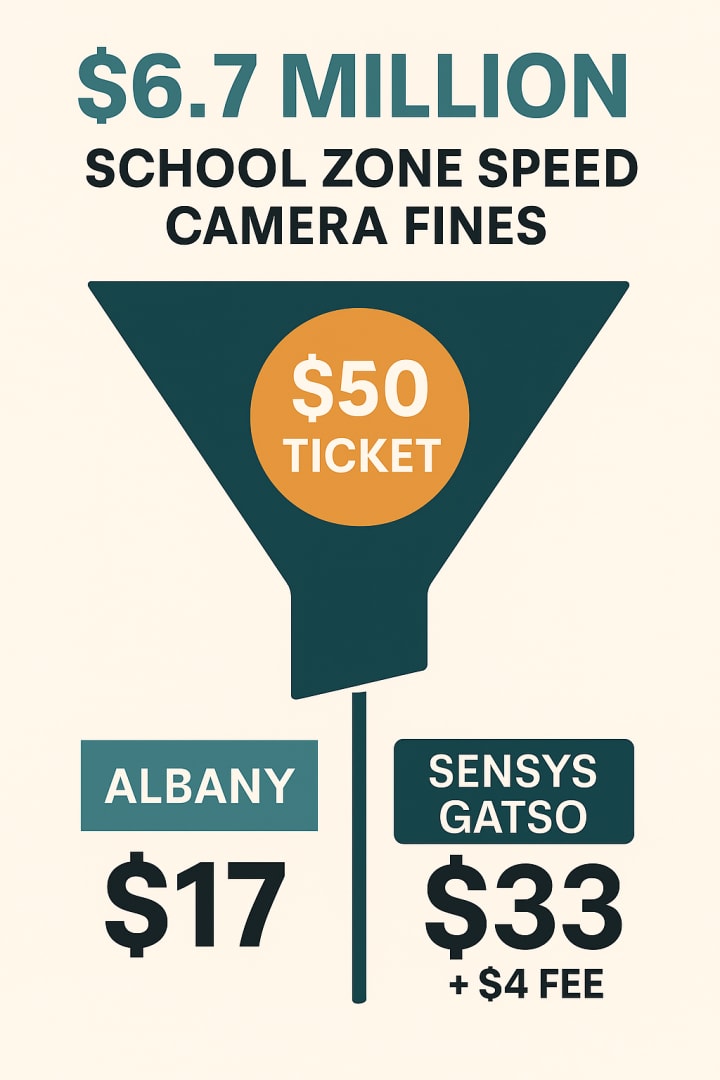
Sensys Gatso collects the other $33—around 60–66% of the revenue.
The company also tacks on a $4 processing fee per payment.
That means that while Albany residents see millions of dollars leaving their wallets, a majority of the funds flow to a private, for-profit vendor headquartered outside New York State.
Budget Goals vs. Reality
The City of Albany budgeted $6 million in expected revenue for 2025 from the speed cameras, roughly 2.7% of the city’s total operating budget. But independent analysts note:
Collection gaps: Only around two-thirds of tickets are paid in full.
Seasonal dips: Citations fall significantly during summer months when schools are out.
Projected shortfall: Estimates suggest Albany may collect 30–40% less than budgeted.
In short: while the cameras have generated millions, Albany may not actually realize the windfall it expected.
Safety Gains: Real or Overstated?
Officials argue that speed cameras aren’t just about money—they save lives. Data supports some of these claims:
After Albany reduced its citywide speed limit to 25 mph and introduced cameras, traffic crashes dropped across multiple corridors.
Columbia University and the New York State DOT have published findings that automated enforcement significantly reduces speeding and pedestrian injuries near schools.
Still, critics ask: if safety is the primary goal, why is the system designed so heavily in favor of a private company’s profit margins?
The Bigger Picture: Albany, New York vs. Other Cities
Albany is not alone. Cities across the U.S.—from New York City to Chicago to Washington, D.C.—use speed cameras. But the revenue splits vary widely:
New York City keeps a much larger share of ticket revenue, with contractors simply providing equipment and maintenance.
Chicago has seen years of criticism for overreliance on fines, with disproportionate impact on low-income drivers.
Albany’s model—where a private vendor takes the majority cut—has been singled out by some residents as especially lopsided.
Is $6.7 Million Absurd, Not Enough, or Justified?
Absurd? Many Albany residents think so, pointing out that the city is losing millions to a private vendor when local schools, infrastructure, and social programs could use that funding.
Not enough? From a budget perspective, the program is underperforming its $6M projection, meaning Albany may need to make up shortfalls elsewhere.
Justified? Supporters argue that even if the money flow isn’t perfect, the safety benefits near schools in Albany, New York outweigh the drawbacks.
Quick Facts: Albany, NY Speed Cameras
Aspect Details
Tickets Issued ~107,000–189,000
Fines Generated $5.25M–$6.7M
City of Albany Share $17 per ticket (~34–39%)
Sensys Gatso Share $30+ per ticket (~60–66%) + $4 processing fee
Budget Target $6M annually
Outcome Likely 30–40% shortfall
Safety Impact Fewer crashes, lower speeds near schools
Final Thoughts
Albany, New York’s school-zone speed cameras highlight a national dilemma: how do we balance public safety with fair financial practices?
If protecting children is the priority, the program can be defended. But if the majority of revenue flows out of Albany and into corporate hands, residents are right to question whether the system is serving the community—or serving shareholders.
About the Author
DJ for Change is dedicated to uncovering truth, questioning power, and amplifying community voices in New York’s Capital District. Using AI tools alongside grassroots insight, DJ brings clarity to complex issues that affect everyday people.
About the Creator
DJ for Change
Remixing ideas into action. I write about real wealth, freedom tech, flipping the system, and community development. Tune in for truth, hustle, hacks, and vision, straight from the Capital District!
https://buymeacoffee.com/djforchange
Keep reading
More stories from DJ for Change and writers in The Swamp and other communities.
Why Do American Citizens Keep Paying for Israel's Wars?
This article was written with the assistance of AI to help present information in a clear and accessible way. Every year, U.S. taxpayers send billions of dollars overseas—not just for weapons in general, but specifically to fund Israel’s military. While politicians in Washington frame this as “supporting an ally,” the reality is that ordinary American citizens are paying for bombs to be dropped thousands of miles away, in conflicts that rarely benefit them directly.
By DJ for Change5 months ago in The Swamp
Israel, Syria Agree to Dedicated Communication Line in US-Brokered Talks
In a rare diplomatic breakthrough in the volatile Middle East, Israel and Syria have agreed to establish a dedicated communication line, aimed at preventing accidental military confrontations and improving crisis management between the two nations. The agreement, brokered by the United States, comes amid heightened regional tensions and marks a subtle yet significant step toward stabilizing one of the world’s most conflict-prone borders. Bridging a Historical Divide Israel and Syria have long shared a turbulent history marked by wars, territorial disputes, and decades of mistrust. While the countries have technically remained at war since 1948, various periods of ceasefire have punctuated their relations, often brokered by external powers. The creation of a direct communication channel represents a pragmatic move to reduce misunderstandings, particularly in the tense and militarized Golan Heights region. For years, incidents along the border have risked escalating into larger conflicts, with accidental airstrikes, miscommunications, and proxy actions by regional allies adding to the volatility. Analysts suggest that a dedicated line can act as a lifeline to prevent minor incidents from spiraling out of control, providing both nations with an immediate platform to verify intentions and de-escalate tensions. The Role of US Diplomacy The agreement was facilitated by US officials, who have been actively mediating between Israel and its neighbors in recent months. Washington’s approach emphasizes crisis management and conflict prevention rather than full diplomatic normalization, reflecting the delicate realities on the ground. A senior US diplomat involved in the talks stated, “The goal is simple: prevent accidental clashes and provide a mechanism for dialogue in moments of tension. Both sides recognized the potential benefits of having a direct line of communication.” The US sees this development as a strategic win, enhancing its influence in the region while contributing to broader stability efforts. Practical Implications The dedicated communication line is expected to function much like traditional military hotlines seen in other high-tension regions, such as the India-Pakistan Line of Control or US-Russia Cold War-era channels. Military officials on both sides will have immediate access to counterparts in the event of border incidents, including airspace violations, troop movements, or drone activity. In addition to preventing accidental clashes, the line could facilitate coordination on humanitarian issues. With the ongoing Syrian civil war and complex involvement of multiple regional actors, there are frequent scenarios where civilians, aid convoys, or displaced persons might inadvertently enter conflict zones. Prompt communication can ensure such situations are handled safely and efficiently. Cautious Optimism Among Analysts While the development is being hailed as a positive step, experts urge caution. Dr. Leila Haddad, a Middle East policy analyst, notes, “A communication line is a practical tool, not a peace treaty. It reduces the risk of unintended escalation but doesn’t address the underlying political and territorial disputes between Israel and Syria.” The Syrian government has indicated that the hotline is a confidence-building measure rather than a sign of improved diplomatic relations. Meanwhile, Israel views the line as an operational necessity, particularly as it continues to monitor Iranian-backed militias and other actors in Syrian territory. Regional Repercussions The agreement could have wider implications for the Middle East. Neighboring countries and international observers are closely monitoring the arrangement, viewing it as a potential model for other tense borders in the region. Experts suggest that while the hotline is a modest step, its successful implementation could pave the way for more comprehensive agreements, including intelligence sharing, border monitoring, or limited coordination on security threats. Looking Ahead Both nations face significant challenges in maintaining trust and stability. The success of the dedicated communication line will depend on consistent engagement, clear protocols, and the willingness of military leadership to prioritize conflict prevention over political signaling. Nonetheless, the agreement signals a willingness to explore pragmatic solutions amid a region historically defined by entrenched animosities. In the short term, the hotline may not resolve the decades-long disputes between Israel and Syria, but it represents a tangible mechanism to prevent unnecessary escalation and safeguard lives on both sides of the border. Conclusion The establishment of a dedicated communication line between Israel and Syria underscores the importance of crisis management in a region fraught with volatility. While not a political breakthrough or a step toward normalization, the US-brokered initiative highlights how even small, operational measures can play a crucial role in reducing the risks of unintended conflict. For a part of the world often defined by instability, the line may serve as a modest yet meaningful bridge toward greater security and understanding.
By Fiazahmedbrohi 5 days ago in The Swamp
Where's the Glory?
In breaking news, rehabilitated Republican Senator Johnnie Johnson (Pronouns: HE, HIM, HIS) called a press conference from the Men’s room of the New Orleans Louis Armstrong International Airport, Concourse B, across from the Ignatius Reilly’s Lucky Dog stand. The Senator had just returned from a sexual reorientation rehabilitation program in Memphis, TN after being publically disgraced at a Buckee’s Truckstop restroom soliciting sex from an undercover cop three months ago. He is a founding member of the Reformed Christians for Christ, a conservative, pro-family and ex-gay advocacy group. In the spirit of being reborn, Senator Johnson invited reporters to marvel at his plans for a major remodeling of airport bathrooms.
By Cathy Schieffelin5 days ago in Humor


Comments
There are no comments for this story
Be the first to respond and start the conversation.