
Israel, Syria Agree to Dedicated Communication Line in US-Brokered Talks
US brokers hotline between Israel and Syria to reduce border tensions and prevent accidental military clashes.

In a rare diplomatic breakthrough in the volatile Middle East, Israel and Syria have agreed to establish a dedicated communication line, aimed at preventing accidental military confrontations and improving crisis management between the two nations. The agreement, brokered by the United States, comes amid heightened regional tensions and marks a subtle yet significant step toward stabilizing one of the world’s most conflict-prone borders.
Bridging a Historical Divide
Israel and Syria have long shared a turbulent history marked by wars, territorial disputes, and decades of mistrust. While the countries have technically remained at war since 1948, various periods of ceasefire have punctuated their relations, often brokered by external powers. The creation of a direct communication channel represents a pragmatic move to reduce misunderstandings, particularly in the tense and militarized Golan Heights region.
For years, incidents along the border have risked escalating into larger conflicts, with accidental airstrikes, miscommunications, and proxy actions by regional allies adding to the volatility. Analysts suggest that a dedicated line can act as a lifeline to prevent minor incidents from spiraling out of control, providing both nations with an immediate platform to verify intentions and de-escalate tensions.
The Role of US Diplomacy
The agreement was facilitated by US officials, who have been actively mediating between Israel and its neighbors in recent months. Washington’s approach emphasizes crisis management and conflict prevention rather than full diplomatic normalization, reflecting the delicate realities on the ground.
A senior US diplomat involved in the talks stated, “The goal is simple: prevent accidental clashes and provide a mechanism for dialogue in moments of tension. Both sides recognized the potential benefits of having a direct line of communication.” The US sees this development as a strategic win, enhancing its influence in the region while contributing to broader stability efforts.
Practical Implications
The dedicated communication line is expected to function much like traditional military hotlines seen in other high-tension regions, such as the India-Pakistan Line of Control or US-Russia Cold War-era channels. Military officials on both sides will have immediate access to counterparts in the event of border incidents, including airspace violations, troop movements, or drone activity.
In addition to preventing accidental clashes, the line could facilitate coordination on humanitarian issues. With the ongoing Syrian civil war and complex involvement of multiple regional actors, there are frequent scenarios where civilians, aid convoys, or displaced persons might inadvertently enter conflict zones. Prompt communication can ensure such situations are handled safely and efficiently.
Cautious Optimism Among Analysts
While the development is being hailed as a positive step, experts urge caution. Dr. Leila Haddad, a Middle East policy analyst, notes, “A communication line is a practical tool, not a peace treaty. It reduces the risk of unintended escalation but doesn’t address the underlying political and territorial disputes between Israel and Syria.”
The Syrian government has indicated that the hotline is a confidence-building measure rather than a sign of improved diplomatic relations. Meanwhile, Israel views the line as an operational necessity, particularly as it continues to monitor Iranian-backed militias and other actors in Syrian territory.
Regional Repercussions
The agreement could have wider implications for the Middle East. Neighboring countries and international observers are closely monitoring the arrangement, viewing it as a potential model for other tense borders in the region. Experts suggest that while the hotline is a modest step, its successful implementation could pave the way for more comprehensive agreements, including intelligence sharing, border monitoring, or limited coordination on security threats.
Looking Ahead
Both nations face significant challenges in maintaining trust and stability. The success of the dedicated communication line will depend on consistent engagement, clear protocols, and the willingness of military leadership to prioritize conflict prevention over political signaling.
Nonetheless, the agreement signals a willingness to explore pragmatic solutions amid a region historically defined by entrenched animosities. In the short term, the hotline may not resolve the decades-long disputes between Israel and Syria, but it represents a tangible mechanism to prevent unnecessary escalation and safeguard lives on both sides of the border.
Conclusion
The establishment of a dedicated communication line between Israel and Syria underscores the importance of crisis management in a region fraught with volatility. While not a political breakthrough or a step toward normalization, the US-brokered initiative highlights how even small, operational measures can play a crucial role in reducing the risks of unintended conflict. For a part of the world often defined by instability, the line may serve as a modest yet meaningful bridge toward greater security and understanding.
About the Creator
Keep reading
More stories from Fiazahmedbrohi and writers in The Swamp and other communities.
Yemeni Separatists to Attend Saudi Talks After Losing Key Southern Sites
In a notable turn of events in Yemen’s protracted conflict, southern separatist leaders have agreed to attend talks in Saudi Arabia following the loss of several strategically significant sites in the south. This development marks a crucial moment in the ongoing efforts to stabilize the region and underscores the growing influence of Saudi-mediated diplomacy in Yemen’s fractured political landscape. The separatists, who have long pursued an independent South Yemen, recently suffered setbacks as government forces, supported by a coalition of regional allies, reclaimed key towns and ports. These losses have not only diminished the separatists’ territorial control but also undermined their leverage in political negotiations. Recognizing the precariousness of their position, the leaders of the Southern Transitional Council (STC) have signaled their willingness to participate in talks hosted in Riyadh, aimed at reaching a more lasting resolution to the conflict. The Context of the Conflict Yemen’s southern separatists, primarily represented by the STC, have been engaged in intermittent clashes with the internationally recognized Yemeni government over control of the south. Their struggle intensified after the 2015 escalation of Yemen’s civil war, which also drew in the Saudi-led coalition against the Iran-aligned Houthi rebels in the north. The STC has consistently maintained that the south deserves autonomy or full independence, citing historical grievances dating back to the 1990 unification of North and South Yemen. However, repeated confrontations with government forces and rival factions have fragmented their influence, leading to strategic vulnerabilities that are now prompting a shift toward negotiation. Saudi Arabia’s Role as Mediator Saudi Arabia has positioned itself as a key mediator in Yemen’s complex political arena. The Kingdom’s role involves balancing the interests of multiple factions, including the Yemeni government, southern separatists, and tribal leaders, while simultaneously countering Houthi expansion in the north. Riyadh’s efforts aim to prevent further destabilization along its southern border and to ensure that Yemen does not become a battleground for regional proxy wars. The upcoming talks will likely focus on territorial disputes, political representation, and power-sharing arrangements. Analysts suggest that the Saudi-led negotiations could pave the way for temporary ceasefires, the consolidation of administrative control in the south, and the potential integration of separatist leaders into formal governance structures. Implications of Separatist Losses The loss of key southern sites has far-reaching implications for the separatist movement. Control over strategic ports, transport hubs, and urban centers is critical not only for military operations but also for economic leverage. With these assets lost, the separatists face reduced revenue streams, limited access to supplies, and a weakened ability to sustain prolonged conflict. Moreover, these territorial setbacks place the separatists in a position where negotiation is no longer optional but necessary. Participating in Saudi-hosted talks allows them to maintain political relevance, protect remaining strongholds, and potentially secure concessions that safeguard the interests of their constituencies. Challenges to the Peace Process While the decision to attend talks is a positive development, significant challenges remain. Mistrust between the separatists and the Yemeni government runs deep, fueled by years of intermittent conflict and competing ambitions. Past negotiation attempts have repeatedly stalled, raising questions about whether Saudi-led diplomacy can achieve durable results this time. Additionally, the presence of multiple local militias, tribal factions, and external actors with divergent goals complicates the negotiation landscape. Any agreement will require careful balancing to ensure that concessions do not embolden rivals or trigger new rounds of violence. Looking Ahead Despite these obstacles, the upcoming discussions in Saudi Arabia offer a rare opportunity to address the fragmentation of southern Yemen and work toward a more stable governance framework. Success in these talks could strengthen Yemen’s path toward a unified political process, reduce the likelihood of renewed clashes, and signal to the international community that diplomacy remains viable even amid ongoing conflict. For the southern separatists, participation in the talks represents a pragmatic acknowledgment that military gains alone are insufficient for long-term objectives. By engaging in dialogue, they may secure political influence, protect civilian populations, and preserve their vision for southern Yemen within a negotiated settlement. Conclusion The announcement that Yemeni separatists will attend Saudi-hosted talks marks a significant shift in the country’s long-running conflict. Following territorial losses, the STC is seeking a pathway to maintain influence through dialogue rather than continued confrontation. While challenges remain, the move highlights the potential of diplomatic intervention to reshape power dynamics in Yemen, offering a glimmer of hope for stability in a region long plagued by unrest and uncertainty.
By Fiazahmedbrohi 5 days ago in The Swamp
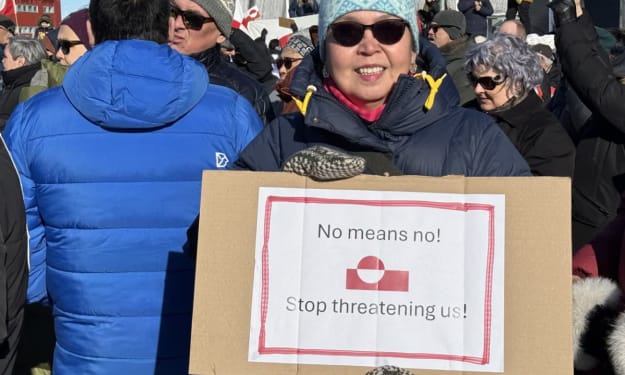
Greenlanders Say “We Don’t Want to Be Americans” as Trump’s Threats Rekindle Arctic Tensions
When former U.S. President Donald Trump once again raised the idea of asserting American control over Greenland, the response from the Arctic island was swift, united, and unequivocal. Greenlanders, through their political leaders, made one message clear to the world: they do not want to be Americans. The renewed rhetoric from Trump has not only revived an old controversy but also exposed deeper questions about sovereignty, identity, and the rights of small nations in an era of aggressive geopolitics. Greenland, the world’s largest island, may be sparsely populated, but its strategic importance has grown dramatically in recent years. Melting ice due to climate change has opened new shipping routes and access to vast reserves of rare-earth minerals, oil, and gas. These developments have turned the Arctic into a focal point of global power competition, drawing interest from the United States, China, and Russia alike. Yet for Greenlanders themselves, the conversation is not about global dominance — it is about dignity, autonomy, and the right to decide their own future. A United Political Front in Greenland One of the most striking aspects of the current moment is the rare unity displayed by Greenland’s political leadership. All major parties in the Inatsisartut, Greenland’s parliament, issued a joint statement rejecting any suggestion that Greenland could or should become part of the United States. Their words were firm and symbolic: “We don’t want to be Americans. We don’t want to be Danish. We want to be Greenlanders.” This statement was more than a reaction to Trump’s remarks; it was a declaration of identity. Greenland has spent decades gradually moving away from colonial dependence on Denmark. Since gaining home rule in 1979 and expanded self-government in 2009, the island has taken control of most domestic affairs, while Denmark still manages defense and foreign policy. Many Greenlanders view eventual independence as a long-term goal, but one that must come through democratic choice — not external pressure. Public opinion strongly supports this stance. Surveys consistently show that the overwhelming majority of Greenland’s population opposes becoming part of the United States. The idea of being “bought” or absorbed by another country is widely seen as outdated, disrespectful, and incompatible with modern principles of self-determination. Trump’s Renewed Interest and Strategic Arguments Donald Trump’s fascination with Greenland is not new. During his presidency, he openly floated the idea of purchasing the island, reportedly seeing it as a strategic asset that could strengthen U.S. military positioning in the Arctic and counter rival powers. His latest comments, which hinted that America might take Greenland “one way or another,” reignited fears about coercive diplomacy. From Washington’s perspective, Greenland’s location makes it invaluable. The U.S. already maintains a military presence at Pituffik Space Base (formerly Thule Air Base), a key component of missile defense and space surveillance. Trump and his allies argue that greater U.S. control would enhance security, prevent Chinese investment, and limit Russian influence in the Arctic. However, Greenlandic leaders strongly dispute the notion that their island is vulnerable or incapable of managing foreign partnerships responsibly. They argue that security concerns should be addressed through cooperation with Denmark and NATO, not through threats or unilateral ambitions. To many in Greenland, Trump’s rhetoric feels less like a security strategy and more like a return to 19th-century power politics. Identity, Culture, and the Fear of Losing Control Beyond geopolitics, Greenlanders’ resistance is deeply rooted in cultural and social concerns. Greenland’s population, predominantly Inuit, has a distinct language, traditions, and worldview shaped by Arctic life. The island’s social model prioritizes community welfare, public healthcare, and local decision-making tailored to its harsh environment. Many fear that becoming part of the United States would fundamentally alter these systems. Questions arise about healthcare access, land rights, environmental protection, and the preservation of Indigenous culture. For a society that has already experienced the long-term impacts of colonial rule, the idea of exchanging one external authority for another is deeply unsettling. Local voices have repeatedly emphasized that Greenland is “not for sale.” This sentiment reflects a broader rejection of being treated as a commodity rather than a community. The frustration is not only with Trump personally but with the mindset that assumes powerful nations can redraw borders without the consent of the people who live there. Denmark, NATO, and International Concerns Denmark has firmly backed Greenland’s position, warning that any attempt to force a change in the island’s status would violate international law and strain alliances. Danish leaders have stressed that Greenland’s future can only be decided by Greenlanders themselves, in accordance with existing self-rule agreements. The controversy has also raised concerns within NATO. If a leading alliance member were to threaten the territorial integrity of another member’s realm, it could undermine trust and cooperation at a time when unity is already under pressure from global crises. Allies worry that such disputes weaken the moral authority of democratic nations that claim to uphold international norms. A Defining Moment for Greenland’s Future Ironically, Trump’s threats may have accelerated conversations within Greenland about full independence. While economic challenges remain — including reliance on Danish subsidies — the current situation has strengthened national consciousness and political solidarity. Many Greenlanders now see greater autonomy not just as an aspiration, but as a safeguard against external interference. This moment is a reminder that in the modern world, power should not override principle. Greenland’s leaders are not denying the island’s strategic importance; they are insisting that strategic value does not cancel human agency. Their message resonates far beyond the Arctic, echoing the struggles of small nations everywhere that find themselves caught between competing global powers. Conclusion: Sovereignty Is Not Negotiable As tensions simmer, one truth stands out: Greenlanders are determined to speak for themselves. They reject the idea of becoming Americans not out of hostility, but out of a profound commitment to self-identity and self-rule. In doing so, they challenge a world order that too often prioritizes strategy over sovereignty. Whether Greenland eventually becomes fully independent or continues its partnership with Denmark, its future will be shaped by the will of its people — not by threats, deals, or geopolitical ambition. And in asserting that right so clearly, Greenland has delivered a powerful message: in the 21st century, nations are not possessions, and people are not bargaining chips.
By Muhammad Hassana day ago in The Swamp



Comments
There are no comments for this story
Be the first to respond and start the conversation.