
5G Technology: Connecting the Future at Lightning Speed
Subtitles for “5G Technology: Connecting the Future at Lightning Speed” 1. Introduction: The Next Step in Digital Evolution 2. What Is 5G Technology? 3. How 5G Is Changing Everyday Life 4. 5G and Business Innovation 5. Challenges and Concerns 6. The Future of 5G Technology 7. Conclusion: Building a Connected Tomorrow


Introduction: The Next Step in Digital Evolution
In a world that moves faster every day, the demand for speed, efficiency, and connectivity has never been higher. From streaming high-definition videos to powering smart cities, 5G technology is the next big leap in digital communication. More than just faster internet, 5G represents a transformation in how people, devices, and industries connect and operate. As the United Kingdom continues to expand its 5G infrastructure, it’s shaping the way we work, communicate, and live.
---
What Is 5G Technology?
5G stands for the fifth generation of mobile network technology. It succeeds 4G LTE and offers dramatically improved performance. While 4G allowed users to stream movies and access social media with ease, 5G takes connectivity to a whole new level. It provides data speeds up to 100 times faster than 4G, with ultra-low latency, meaning minimal delay in communication between devices.
This ultra-fast network is powered by advanced radio frequencies and small cell networks that ensure stronger and more stable connections. In practical terms, it means downloading a full movie in seconds, smoother video calls, and real-time gaming experiences without lag.
---
How 5G Is Changing Everyday Life
The impact of 5G reaches far beyond mobile phones. It’s changing the way entire industries operate and improving everyday experiences for individuals.
Healthcare: Doctors can perform remote surgeries using robotic tools connected through 5G, allowing real-time precision without delays. Telemedicine will become faster and more reliable, making healthcare more accessible.
Transportation: 5G will power autonomous vehicles by enabling instant communication between cars and traffic systems. This reduces the risk of accidents and makes travel safer.
Smart Cities: Governments are adopting 5G to build intelligent cities where sensors monitor air quality, manage energy use, and improve public safety.
Entertainment: 5G enhances virtual reality (VR) and augmented reality (AR), allowing users to attend concerts, sports events, or even classes virtually with seamless experiences.
---
5G and Business Innovation
Businesses in the UK and around the world are already embracing 5G to boost productivity and innovation. The technology allows real-time data processing, which means companies can automate more tasks and make faster decisions.
For example, factories can now use smart robots that communicate instantly with each other to improve efficiency. Farmers are implementing 5G-powered drones to monitor crops, while retailers are using it to create immersive shopping experiences through augmented reality.
Moreover, remote work has become more efficient, with faster connectivity allowing video conferences and cloud-based collaboration without interruption. This flexibility is redefining how companies and employees operate globally.
---
Challenges and Concerns
Despite its advantages, 5G comes with challenges. One major concern is the cost of infrastructure. Building 5G networks requires new antennas, towers, and maintenance systems, which are expensive and time-consuming.
There are also privacy and security concerns. As 5G connects more devices, it increases the risk of cyberattacks and data breaches. Governments and tech companies must prioritize cybersecurity measures to protect sensitive information.
Additionally, there’s an ongoing debate about health concerns linked to 5G radiation. While scientific evidence shows no proven harm, many people still question its long-term effects, leading to hesitation in some communities.
---
The Future of 5G Technology
The future of 5G looks bright and full of promise. Experts predict that by 2030, 5G will be deeply integrated into every major industry — from education and entertainment to manufacturing and agriculture. The arrival of 6G might seem far away, but 5G will lay the foundation for even smarter, faster, and more connected global systems.
In the UK, companies like EE, Vodafone, and O2 are leading the charge, expanding 5G coverage in both urban and rural areas. As this rollout continues, more people will experience the benefits of high-speed, reliable connections that redefine digital communication.
---
Conclusion: Building a Connected Tomorrow
5G technology is more than an upgrade — it’s a revolution. It has the power to connect people and devices in ways never before possible, reshaping industries and improving quality of life worldwide. With the UK’s commitment to technological advancement, 5G is set to drive the nation’s digital future, creating endless opportunities for innovation and growth.
As we stand at the dawn of this new era, one thing is clear: 5G isn’t just about faster internet — it’s about a smarter, more connected world.
About the Creator
Fiaz Ahmed
I am Fiaz Ahmed. I am a passionate writer. I love covering trending topics and breaking news. With a sharp eye for what’s happening around the world, and crafts timely and engaging stories that keep readers informed and updated.
Keep reading
More stories from Fiaz Ahmed and writers in The Chain and other communities.
Blockchain: The Technology Revolutionizing the Digital World
Introduction: Beyond Cryptocurrency When most people hear the word blockchain, they immediately think of Bitcoin and other cryptocurrencies. While blockchain is the technology that powers digital currencies, its impact goes far beyond finance. From securing data to transforming industries, blockchain is reshaping the way we store, share, and trust information. As the technology continues to trend in the United Kingdom, it’s clear that blockchain is not just a buzzword — it’s a digital revolution.
By Fiaz Ahmed 5 months ago in The Chain
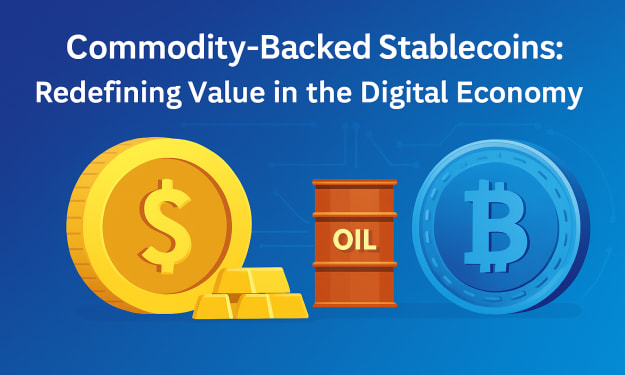
Commodity-Backed Stablecoins: Redefining Value in the Digital Economy
The cryptocurrency market has consistently evolved to address volatility, scalability, and trust. Among the innovations reshaping this ecosystem, commodity-backed stablecoins have emerged as a critical bridge between blockchain technology and traditional asset classes. Unlike purely algorithmic or fiat-backed models, these tokens derive value from tangible commodities such as gold, silver, oil, or even agricultural products. This asset-collateralized approach not only mitigates market instability but also offers institutional-grade trust for investors seeking transparency and sustainability in digital finance.
By Siddarth D6 days ago in The Chain
How Stablecoins Are Created: A Deep Dive Into The Future of Digital Finance
The evolution of digital finance is reshaping how we think about money, and at the heart of this revolution lies a seemingly simple yet incredibly powerful innovation: the stablecoin. Designed to offer the best of both worlds—blockchain’s speed and decentralization with the stability of traditional currencies—stablecoins are quickly becoming integral to both individual transactions and global financial systems. But how are these digital assets actually brought to life? What lies beneath their perceived simplicity? Let’s take a deep dive into how stablecoins are created, and what it takes to build a currency that must remain stable in a volatile digital world.
By Siddarth D6 days ago in The Chain
Staying sane in the insane world.
”It is no measure of health to be well adjusted to a profoundly sick society.” Jiddu Krishnamurti This quote has been one of my favourites since the moment I first laid my eyes on it. To me, it cuts right through the fog of the illusion of normality that permeates our lives. And since I am someone who has never felt (well) adjusted to this society, Krishnamurti’s words gifted me with the realisation that there isn’t anything inherently wrong with me.
By Eva Smitte2 days ago in Humans



Comments
There are no comments for this story
Be the first to respond and start the conversation.