
Curly Half Wigs: The Secret to Perfect Blending with Black Hair
Comfortable, Cool, And Chic
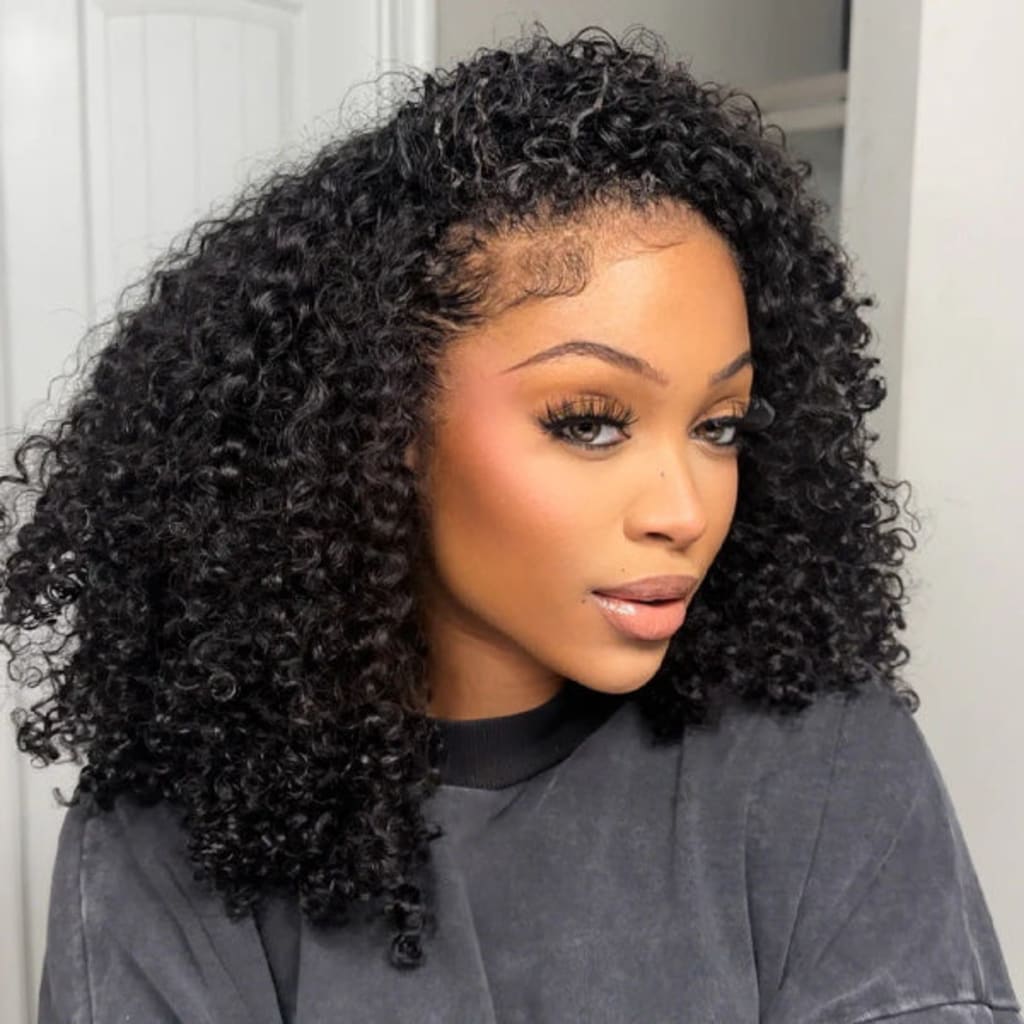
For Black women seeking diverse looks while retaining their natural texture, a curly half wig offers a convenient and aesthetically pleasing option. More than a simple "wig," a curly half wig seamlessly blends with natural hair through precisely engineered curls, premium materials, and meticulous craftsmanship. The following analyzes several key aspects of its effectiveness in achieving this "invisible blend."
1. Curl Texture: Replicating Natural Hair Growth for a "Genetic Match"
Black women's naturally curly hair comes in a variety of forms—from tight coils to loose kinks to soft curls, each texture carrying a unique memory of their hair's texture. High-quality curly half-wigs are custom-replicated to these natural textures:
Precisely Controlled Curl Density: Tight curls mimic the "clustered growth" of naturally curly hair, with the curl radius and winding angle of each tuft matching those of real hair to avoid the appearance of artificial bulk. Loose curls, on the other hand, emphasize the "randomness" of curls, manually adjusting the tightness and looseness of individual strands to recreate the "imperfect perfection" of natural hair growth.
Durable Texture Design: The high-temperature setting process used in these wigs allows the curls to withstand the pull of daily combing and quickly regain their elasticity after washing, avoiding the "layered" effect caused by loose curls and ensuring consistent volume with your own hair.
2. 100% Virgin Human Hair: The Ultimate Guarantee of Texture and Interactivity
The ability to 'talk' to one's own hair is the core criterion for determining wig integration, and 100% virgin human hair is the key to achieving this:
Texture Homology: Virgin human hair retains the natural cuticles of hair growth, and its glossiness and coarseness closely match the coarse, dense hair texture commonly found on Black women. Under sunlight, the wig and one's own hair will exhibit a consistent matte brown sheen, rather than the plastic-like sheen of synthetic fibers.
Compatibility: Black women often transform their hairstyles through perms, dyes, and braids, and virgin human hair wigs readily accommodate these manipulations. They can be adjusted with a flat iron for curling and can be dyed in trendy colors like dark brown and burgundy. After dyeing, the wig is less likely to dry out or split ends, seamlessly interoperating with one's own hair.
Authenticity: The weight and volume of the hair strands are consistent with real hair, without the greasy feel of synthetic fibers. Even in the wind, the wig sways and flows in perfect sync with your own hair.
3. Invisible Weft Track Design: Detailed Craftsmanship that Makes the Weft "Disappear"
The edge treatment of a half-wig is the final mile of fusion. The invisible weft track technology eliminates any visible wefts through three key design features:
Ultra-Thin Mesh Track: The edge where the wig meets your own hair is made of a 0.1mm thick, breathable mesh with a mesh density that closely matches the pore distribution of your scalp, making it virtually invisible against the skin. Silicone anti-slip strips on the inside of the track secure the wig in place without causing pressure or redness.
Gradual Hair Distribution: The hair strands at the edge of the track follow a gradient, gradually transitioning from denser strands in the center to thinner strands at the edges, naturally blending with the density of your own hair. Some high-end styles even feature "baby hair" trims to simulate the fine hairline.
Glue-free Installation Design: No glue or tape is required; the half wig in glueless wigs series secures to your hair with hidden clips, ensuring no tugging during removal. The clips are ergonomically positioned to fit the curves of your head, ensuring no visible hairline traces even when tied into a high ponytail.
4. Length and Layers: A Visual Balance to Break the "Wig" Appearance
The integration of a curly half-wig also depends on its length coordination and layering with your natural hair.
Longevity Range: To meet the common "short hair + extensions" needs of Black women, wigs are typically designed between 10 and 20 inches (approximately 25 to 50 cm) in length, with a 3 to 5 cm "transition zone"—the hair is slightly shorter where the wig overlaps with your natural hair to avoid a harsh, one-size-fits-all distinction.
Three-Dimensional Layered Cut: The inner layer uses a "fishbone" cut to create an airy look, while the outer layer retains the fullness of the natural curl, creating an overall "thin at the top" and "thick at the bottom" curve, consistent with the growth pattern of naturally curly hair on Black women, which is "fluffy at the top and tapered at the ends."
5. Color Matching: From "Single Black" to "Multi-Dimensional Fusion"
Modern curly half-length wigs have moved beyond the limitations of "pure black," enhancing integration through color details:
Subtle Variations of Natural Black: Different shades such as "blue-toned black" and "brown-toned black" are available to match the natural black hair tones of different ethnic groups. For example, West African women's hair often has a "blue-black undertone," while Caribbean women's hair often has a "reddish-brown undertone." Precise color matching ensures that the wig and natural hair appear consistent under light.
Gradual Highlight Design: Light brown or honey-colored highlights similar to your natural hair color are added to the ends or inner layers of the hair to simulate the natural color changes in hair under sunlight, distracting from the focus and adding a more realistic look.
For Black women, the "perfect fusion" of a curly half-wig is, at its core, a respect for and reproduction of natural hair texture. From the genetically matched curl to the invisible hair rail design, every detail eliminates any trace of artificiality, ultimately achieving the ideal state of "feeling like a wig, yet looking natural"—this represents not only an advancement in styling tools, but also a recognition of the aesthetics of diverse hair textures.
About the Creator
How To Dye A Wig?
Hey Sis! So you saw that fire honey-blonde balayage on TikTok, or maybe you’re feeling that midnight blue fantasy, but the thought of bleaching your own curls colored wigs has you saying, “Absolutely not.” I get it—our hair is our crown, and sometimes you don’t want to risk the throne.
By manman zhai7 days ago in Styled


Comments
There are no comments for this story
Be the first to respond and start the conversation.