
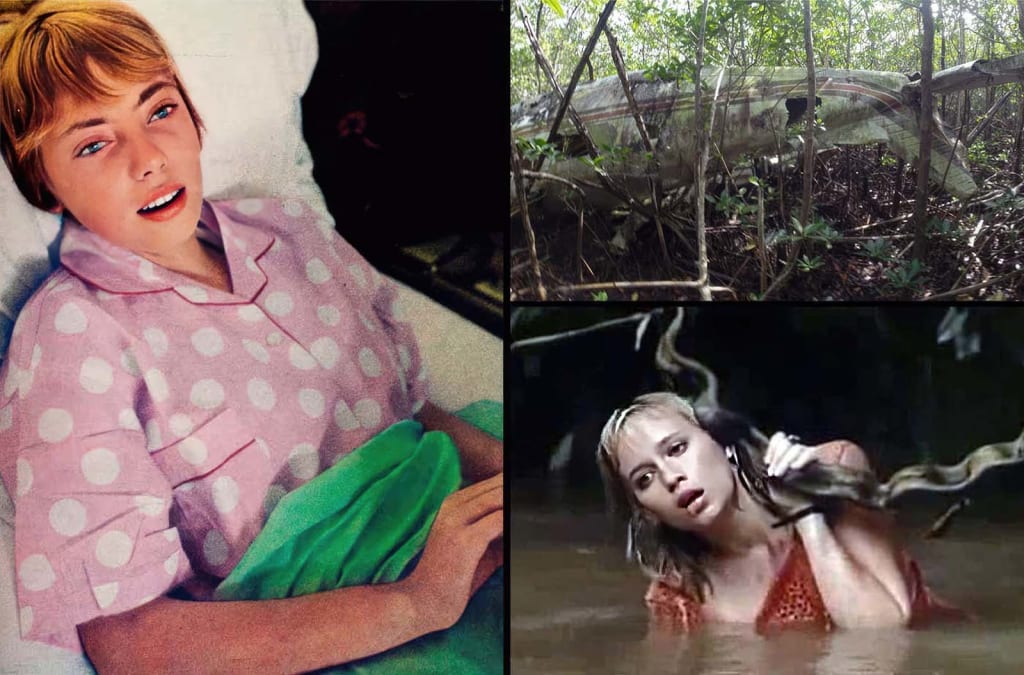
On December 24, 1971, 17-year-old Juliane Koepcke boarded LANSA Flight 508 with her mother in Lima, Peru. The two were traveling to Pucallpa, where Juliane’s father, a biologist, was working at a research station deep in the Amazon. For Juliane, who had grown up between Germany and Peru, flying felt routine. She was looking forward to Christmas with both of her parents.
But less than an hour after takeoff, the world shattered.
The plane entered a massive thunderstorm, and violent turbulence shook the cabin. Passengers clutched their seats as lightning lit up the sky. Suddenly, a blinding flash struck the aircraft. The fuselage broke apart at 10,000 feet. In seconds, Juliane found herself ripped from the plane, still strapped to her row of seats, hurtling toward the jungle below.
She lost consciousness.
When she awoke, she was lying under the dense canopy of the Amazon rainforest. Her collarbone was broken, her right eye was swollen shut, and her body was bruised and cut. The wreckage was nowhere in sight. She had fallen nearly two miles from the sky—and somehow, miraculously, she was alive.
Juliane’s survival instincts quickly took over. From childhood, her parents had taught her about the jungle. She knew its dangers: poisonous snakes, disease-carrying insects, and predators hidden in the shadows. But she also knew its secrets. Streams, her father had once said, always lead to rivers. Rivers, eventually, lead to people.
With that thought, she began to move.
The first days were the hardest. She had almost nothing with her, only a small bag of candy salvaged from the wreckage. She drank river water to stay alive, though she knew it carried parasites. Every step was agony; her wounds grew infected, and flies laid eggs inside them, leaving her flesh crawling with maggots. At night, she lay on the jungle floor, surrounded by the cries of howler monkeys and the rustle of unseen creatures.
On the fourth day, Juliane stumbled upon part of the wreckage. Bodies lay scattered among the trees. With a sinking heart, she searched for her mother but found no sign of her. Grief weighed heavily, but she pressed on, repeating her father’s words about rivers like a mantra.
Day after day, she followed the flow of water. Her shoes were lost to the mud, leaving her feet raw and bloodied. Her strength dwindled, and her vision blurred from exhaustion. Yet she refused to give up. She told herself she had to survive—for her father, for the memory of her mother, and for herself.
On the eleventh day, when her body could barely go on, she spotted a wooden canoe along the riverbank. Nearby stood a small hut, built by local loggers. Summoning the last of her strength, Juliane waited until the men returned. When they found her, barely alive, they treated her wounds with gasoline to kill the maggots, gave her food, and carried her to safety.
Out of 91 passengers and crew aboard Flight 508, Juliane Koepcke was the only survivor.
The world called it a miracle. Newspapers across the globe told the story of the “girl who fell from the sky.” Yet Juliane herself often rejected the idea of divine intervention. She credited her survival to knowledge, resilience, and determination. Without the lessons her parents taught her, she believed she would have perished like the others.
Her life after the crash was not easy. She struggled with survivor’s guilt and the loss of her mother. But Juliane turned her pain into purpose. She studied biology, following in her parents’ footsteps, and became a respected zoologist. She later returned to the Amazon many times—not as a victim, but as a scientist determined to understand the rainforest that had nearly claimed her.
In interviews, Juliane often explained that she did not see herself as a hero. “I was just a girl who never gave up,” she said. Her story has since inspired documentaries, books, and even Werner Herzog’s film Wings of Hope, in which he retraced her steps through the jungle.
Juliane Koepcke’s survival is one of the most extraordinary in history. She fell from the sky, endured eleven days in one of the most dangerous environments on Earth, and emerged alive. Her story reminds us that the human spirit is stronger than we imagine. Even when the odds are impossible, there is always a chance—as long as we keep moving forward.
About the Creator
Keep reading
More stories from shop a ora and writers in Serve and other communities.
The Science of Taste
[written by shopaora] There’s something magical about biting into a warm, flaky croissant in a little Parisian café or sipping spicy pho at a street stall in Hanoi. Many travelers share the same sentiment: food just tastes better when you’re abroad. But is it simply wanderlust playing tricks on us, or is there actual science behind this phenomenon? The answer is both fascinating and complex.
By shop a ora6 months ago in Feast
War Between Pakistan And Afghanistan
Tension Escalates Sharply at the Pakistan-Afghanistan Border What’s happening now? Tensions between Pakistan and Afghanistan have suddenly escalated into heavy fighting along their shared border, known as the Durand Line. Both sides are accusing each other of attacks, and military clashes have intensified in recent days. 
By shaoor afridia day ago in Serve
Israel Attacking On Iran
Israel has carried out major air and missile strikes on Iranian targets. Explosions were reported in Tehran and other areas. Israeli leaders say they attacked to stop Iran’s military and missile capabilities before Iran could launch its own large attack.
By shaoor afridiabout 3 hours ago in Serve



Comments
There are no comments for this story
Be the first to respond and start the conversation.