
Hidden Meanings Behind Playing Cards
What Do Playing Cards Symbolize?


Standard Playing Cards
A standard deck of playing cards is pretty much what it seems: It's a deck of cards that can be used to play different games.
Individuals use them to play solo games like Solitaire to help pass the time while kids giggle and laugh while playing Go Fish and Old Maid. Family and friends fun can have a good old time with Crazy Eights and Rummy while adults can sit on the edges of their seats, holding their breath in anticipation while playing games of chance such as poker and blackjack.
So, is this all there is to a deck of playing cards, or could they hold some kind of deeper meaning or symbolism? Let's take a look.
The Origins of Playing Cards
Before delving into the meanings of cards, let's take a look at how playing cards came to be in the first place.
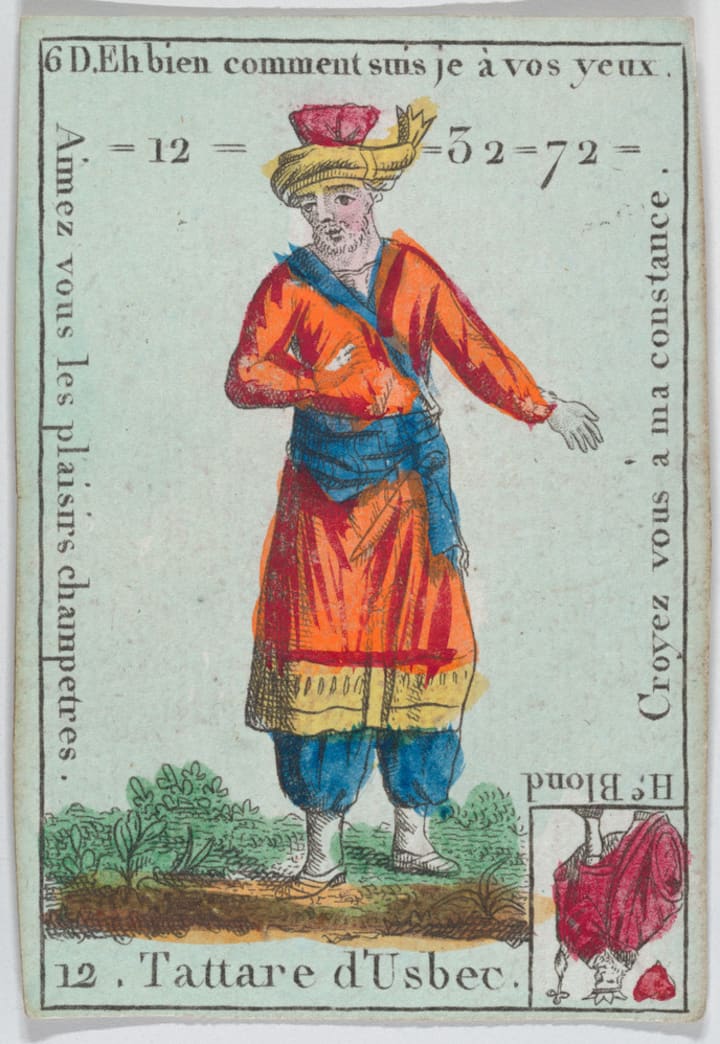
The exact origin of playing cards is unknown, although many historians believe they got their start in China around 1000 AD. While some think the cards started as paper, others believe they evolved from Mahjong tiles.
Following this theory, it is believed that the cards made their way from China to Persia, then to Egypt, before arriving in Europe from both the Italian and Iberian peninsulas. However they arrived, they had become quite popular by 1375.
Another popular theory is that cards actually originated in France in the 15th century, although others believe that Italy was the originator of playing cards due to evidence tracing the cards back to the 14th century. In addition, some credit Germany for their creation, as cards there can also be traced back to the 14th century.
Different Suits Over the Centuries
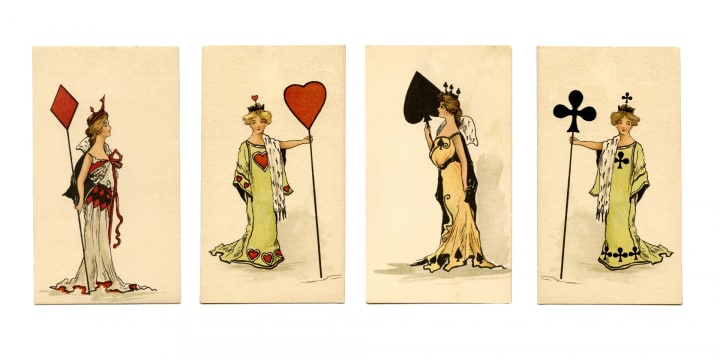
The designs of the cards—also known as the suits—have changed quite a bit over time.
Beginning: goblets and sorcerers
14th Century: swords, cups, coins, and batons
Today: hearts, spades, diamonds, and clubs
How Many Cards Are in a Deck of Cards?
There are 52 cards in a standard deck of playing cards. Now consider there are 52 weeks in a year. Let's look further.
Suits and Seasons: There are four suits in a deck of cards, just as there are four seasons in a year. Each suit consists of 13 cards, while each season of the year is made up of 13 weeks.
Courts and Months: While there are 40 numbered cards, there are 12 court cards, just as there are 12 months in a year.
Cards and Days: Finally, if you add up all of the cards, they total 364. If you add one of the two jokers that come with the deck, the total is 365, which is the number of days in a year. If you add the second joker, the total is 366, which is the exact number of days in a leap year.
The Four Suits of Cards: What Do They Mean?
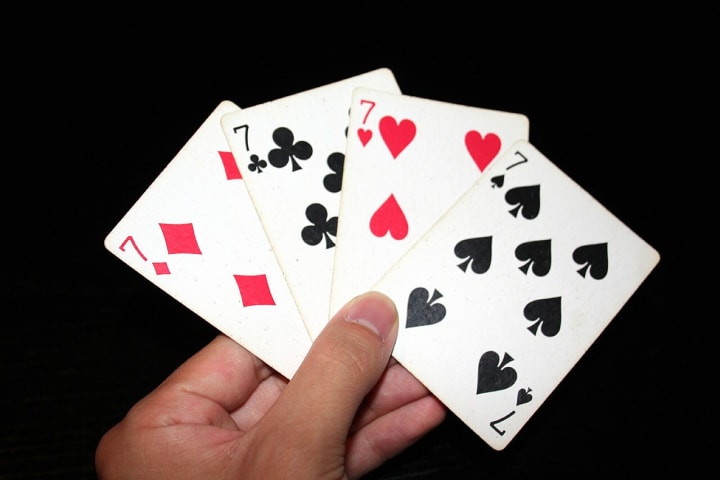
There are different interpretations when it comes to the four suits and what they represent.
Seasons of the Year
Some believe they represent the four seasons of the year, with the red suits being the warmer seasons (in the Northern hemisphere, at least) and the black suits being the colder seasons.
Hearts: spring
Diamonds: summer
Spades: fall
Clubs: winter
Four Elements
Others see the cards as representing the four elements.
Hearts: water
Diamonds: earth
Spades: air
Clubs: fire
Place in Society
Yet another interpretation is that the suits represents one's place in society or social class.
Hearts: the church (clergy)
Diamonds: the working class
Spades: the warrior class
Clubs: agriculture (farmers)
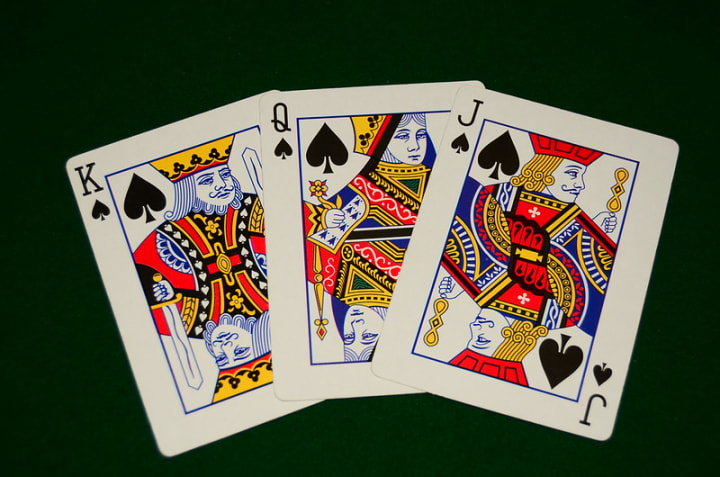
The Meaning of Face Cards
There are three types of face cards: kings, queens, and jacks, which are thought to represent either knaves or knights. These face cards have been inspired by important people in history and were created in France in the 15th century.
King Cards
King of hearts for Charles, the first king of the Franks.
King of spades for David of David and Goliath, a Bible story where a young shepherd defeats a giant.
King of diamonds for Julius Caesar, a Roman dictator who was also Cleopatra's lover.
King of clubs for Alexander the Great, an ancient king and warrior.
Queen Cards
Queen of hearts for Judith of the Old Testament, who saves her town from invasion.
Queen of spades for Pallas Athena, the Greek goddess of wisdom.
Queen of diamonds for the biblical Rachel, the wife of Jacob, who was one of the fathers of the Jewish nation.
Queen of clubs, possibly for Lady Argea, the daughter of King Adrastus of Argos.
Jack Cards
Jack of hearts for La Hire, a French commander during the Hundred Years' War.
Jack of spades for Ogier the Dane, a legendary paladin who appears in many medieval poems.
Jack of diamonds for the Trojan prince Hector, who was a hero during the Trojan War.
Jack of clubs for either Judas Maccabeus, a Jewish priest who led a revolt against the king of Syria, or Lancelot, a knight in King Author's court.

Ace of Spades: The Most Powerful Card in the Deck
The ace of spades is the most powerful card in a deck of cards. In most games, it's considered the highest card. It's thought to be powerful and symbolic of success.
The power of the card dates back to France in the 15th century, where it was referred to as "pike," which represented a spear. Pikes were used as weapons of defense.
Vietnam War and Beyond
During the Vietnam War, the ace of spades was known as the "Death Card." Viet Cong soldiers were quite superstitious and believed the ace of spades predicted death. As a type of psychological warfare, American soldiers would leave ace of spade cards on the bodies of North Koreans they killed in order to instill fear into Viet Cong soldiers.
Today, this card is quite popular among motorcyclists, who often get tattoos of the card as it symbolizes strength and fearlessness.
Card Symbolism
As you can see, there is much more to a deck of cards than just the face value of the cards. While they're a fun way to amuse people, they also have historical significance and lots of interesting meanings.
Sources and Further Reading
https://shuffledink.com/
https://www.technology.org/2018/10/26/why-ace-of-spades-is-so-ornate-and-other-aces-are-not/
https://www.wopc.co.uk/the-history-of-playing-cards/early-history-of-playing-cards
https://www.warhistoryonline.com/vietnam-war/ace-of-spades-origins.html
https://inkspiredmagazine.com/ace-of-spades-tattoo-meaning/
https://fastercapital.com/content/Exploring-the-Meaning-and-Origins-of-Card-Suits-in-Series-52.html#:~:text=The%20four%20card%20suits%20have,spades%20represent%20death%20and%20rebirth.
https://www.encyclopedia.com/reference/encyclopedias-almanacs-transcripts-and-maps/la-hire
https://www.encyclopedia.com/women/encyclopedias-almanacs-transcripts-and-maps/rachel-and-leah
https://www.encyclopedia.com/people/literature-and-arts/french-literature-biographies/ogier-dane
https://www.encyclopedia.com/people/philosophy-and-religion/biblical-proper-names-biographies/judas-maccabeus
https://theplayingcardfactory.com/facts
About the Creator
Janis Masyk-Jackson
I published my first article when I was 10 years old and I've been writing ever since. I'm a mom to 4 grown kids and I love traveling, animals, the paranormal and I'm a huge Disney fan.
Keep reading
More stories from Janis Masyk-Jackson and writers in FYI and other communities.
Why Aerospace Hardware Demands Extreme Precision
In aerospace engineering, hardware is never “just hardware.” Every fastener, fitting, bracket, washer, and mounting component plays a direct role in structural stability and mechanical integrity. Unlike conventional industrial applications, aircraft operate in extreme conditions where even the smallest dimensional error can lead to serious consequences.
By Beckett Dowhan7 days ago in FYI


Comments
There are no comments for this story
Be the first to respond and start the conversation.