disorder
The spectrum of Mental Health disorders is incredibly vast; we showcase the multitude of conditions that affect mood, thinking and behavior.
Hormones vs. Me
I’m so happy to be in a new world now where mental health conditions are becoming increasingly accepted. I see so many positive blogs, articles, Facebook shares about how we should be kind. It’s great that those who are speaking out are encouraging the people surrounding us to then come forward and share their own battles.We are all facing our demons in one way or another.
By Lucy Stride5 years ago in Psyche
THE THING WHICH IS MORE DANGEROUS THAN DRUG ADDICTION
There are many things in this world whose presence causes a possible threat to the livelihood of many other people. Some of those things can be avoided whereas some can be discarded but there are some which can neither be avoided nor discarded rather these create obstacles in the development of some persons.
By Blake Hunt5 years ago in Psyche
A Grapheme Rainbow
For as long as I can remember, I’ve always automatically seen specific colors as numbers. For instance, the number one is black. Always. Three is red, four is olive green, and so on (see above). The number 842 looks like purple, olive green, pale yellow. If I stare at a painting it’s an exercise in paint-by-numbers, but mixed colors don’t have the same effect. Maroon, for instance, means nothing but maroon.
By Scott D. Williams5 years ago in Psyche
Psychology Of The Victim Complex
Back in clinical psychology, a “victim complex” or “victim mentality” refers to a character trait of persons who think they’re always the victims of others’ damaging activities, even if made aware of proof to the contrary. Many men and women undergo regular periods of easy self-pity — within their grieving process, for instance.
By Fahim Chughtai5 years ago in Psyche
...But It Has A Face On It
Ever since I was young, I would give inanimate objects with faces a soul that did not exist. It was extremely difficult to get rid of old stuffed animals for this reason. If they would fall apart, I would try to fix them myself (usually badly), because I couldn't stand the thought of them being "hurt." Even though logically, I knew they weren't alive, it FELT like they were.
By Amanda Cermeno5 years ago in Psyche
A Wonderful Fantasy to My Intrusive Reality
I always had an "overactive imagination" growing up. I loved playing pretend, I loved daydreaming land being someone else, being someplace else; life just seemed more fun that way. Except I never really grew out of playing "pretend". It took over my life up until was I was twenty-two, for fourteen years.
By Billie-Jules5 years ago in Psyche
Autism
As each year passes more and more children are being diagnosed with Autism. With all the different types of disorders out there, Autism has been creeping its way to the top of the list. Autism Spectrum Disorder known as ASD is a complicated condition that includes problems with communication and behavior. It is a serious developmental disorder that impairs the ability to communicate and interact. As recently as 200,000 U.S. cases per year are just diagnosed with Autism. Broken down the term, “spectrum” refers to the wide range of symptoms and severity. A wide range of behaviors can result in a diagnosis of Autism such as: minor problem or a disability that needs full-time care in a special facility, trouble with communication, trouble understanding what other people think and feel, problems with learning, skills might develop unevenly, and it is hard for them to express themselves, either with words, gestures, facial expressions and touch. Autism isn’t easy to diagnose and is hard to define. There are many different types such as: Asperger’s syndrome, childhood disintegrative disorder, or pervasive developmental disorder (atypical autism). Not a disorder that anyone wants to be faced with but with shared information on the disorder it can become manageable. With that said I want other families who suffer from Autism to know they are not alone and to be able to learn more about it what it is and how they can cope.
By MICHELLE SMITH5 years ago in Psyche
Oppositional Defiant Disorder (ODD)
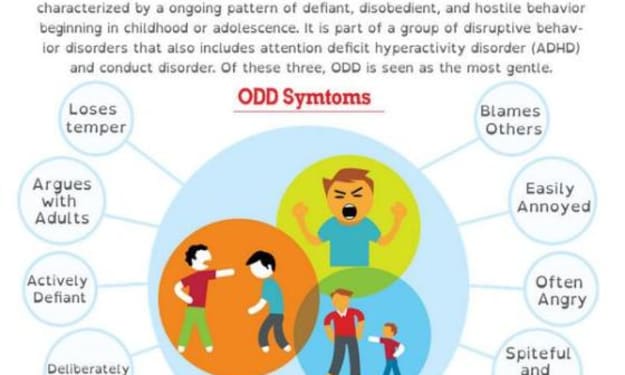
What is Oppositional Disorder? Any child could be considered normal right? No one wants to know that there is something wrong with their child? Well neither did I until I actually investigated the diagnosis. Oppositional Defiant Disorder took me by surprise when I realized that the meaning described my child perfectly. Definition of this disorder says that some kids act angry, defiant and aggressive in sprite of the consequences they will receive and if the behavior continues for six months or more it can be a sign of disruptive behavior disorder. After carefully researching I noticed that it also shares common affects with ADHD such as trouble keeping emotions in check and doing risky and impulsive things. Oppositional Defiant Disorder usually cause problems at school and home. Symptoms generally begin before a child is 8-years-old and most kids have angry outbursts and sometimes us aggression to solve problems. Even though it is a part of growing up and learning to be independent; it is crucial to remember that extreme outburst aren’t normal. Unlike a two-year-old testing limits for the word, “no”, most children with ODD will test further and not expect the consequences to be severe. Common phrases used are, “out of control” or “wild”, which shows the similarity to ADHD but keep in mind that ODD and ADHD are not the same thing but do coexist. The cause is unknown but likely involves a combination of genetic and environmental factors and there are more than 200,000 U.S. cases per year. Even though there is no cause for the disorder, it is broken into two main types: Conduct Disorder (CD) and Oppositional Defiant Disorder, each different from each other but children with Conduct Disorder may develop Oppositional Defiant Disorder.
By MICHELLE SMITH5 years ago in Psyche
Living On The Borderline.
Borderline Personality Disorder (BPD) is a disorder that has a long series of long-term patterns, unstable emotions and bad feelings. It involves inner experiences that cause impulsiveness. Relationships will suffer. It is often confused with Bipolar Disorder or Intermittent Explosive Disorder. A personality pattern is shown over time, and it goes through three stages; these stages may take months or years to cycle through—the personality swings from one stage to the next. An identity crisis may also be present.
By M.O. LeClair5 years ago in Psyche
Bell Let's Talk - About The “Pluses” of Tourette
This article was originally posted on www.tourette.ca and is re-published here by the original author. This article was published on January 28th, 2021 for #BellLetsTalk Day and remains the property of Tourette Canada.
By Simon J. Spencer5 years ago in Psyche