
Do You Really Want What You Want?
You might have fallen in a trap


You want something. You get it. That’s what makes you happy.
Today, it’s easier than ever in history to make this formula work. Twenty years ago, I wouldn’t have had a chance to deliver this article to such a broad audience, without the right connections, a prestigious publication, or a formal education. Today, I can hone my skills with just a laptop and an array of free online resources at my fingertips.
These advancements should have made us happier as a society.
But the reality is far from it.
We are now witnessing the highest rates of anxiety and depression in history. The number of adults with mental illnesses in general increased by 30% and reached 1 billion people. According to experts, this number is projected to increase in the near future.
This stark contrast between our increased ability to attain what we want and our collective unhappiness begs the question: Is the secret to happiness merely about getting what we desire?
Or is it more important to desire the right things?
When our aspirations are not truly our own, it seems they can never bring us genuine joy.
What makes us want something?
Imagine you’re in the midst of planning a summer vacation. The world is your oyster, with countless destinations and activities to choose from. Yet, you’ve set your sights on Bali. You’ve even diligently saved for a year to afford the flight and a luxurious villa near a pristine beach with your very own pool.
Now, let’s delve into the reasons behind this specific craving for a Balinese escape.
Perhaps your boss who you emulate once said that Bali is the dream destination. Maybe you’ve been impressed by the stunning images of an influencer you follow on Bali. Moreover, the exclusivity and cost of such a trip can be seen as a status symbol in modern society. All these factors have aligned, and you’re now eagerly anticipating your dream vacation.
The French thinker René Girard labeled this mimetic desire.
Mimetic desire
Mimetic desire concept suggests that we subconsciously mimic someone else’s desires and actions. Particularly those we perceive as authoritative or influential. Essentially, we yearn for things because someone else did it first and deemed it desirable.
You see, the value of things is not objective or universal.
You may be obsessed with the idea of going to Bali and bring to the table one thousand arguments why it’s the best idea ever. Meanwhile, your partner might be convinced that the perfect getaway is a secluded mountain cabin in the woods.
So, who is right, and who is wrong?
Neither of you. The value you assign to things is simply different.
There are two primary ways to determine the value of things. The first method is to trust in models and follow mimetic desires. The second is to establish value independently.
The most common type is the first one. And here is the proof: people usually choose something that everybody else in their circle wants or already has. When my mother decided to adopt a pet during the pandemic, she chose a cat. Why? Because her friends have cats, and share the cute stories and photos of them on neighborhood chat. But aren’t they adorable too? And what about the countless other animal species, like birds, for example?
On the other hand, when we get something rare or unconventional, we often question our decision. What if you don’t go on a Bali getaway, but instead opt for village vacation complete with gardening? You might feel hesitant to share your experiences with colleagues. This reluctance usually persists even if it was the most enjoyable vacation of your life.
We seek validation in our wishes. We seek social proof.
But these are not just about things. Far more important are the deeper mimetic desires to be a certain way — the desire for moral positions, recognition, spouses, schools, job titles and dreams.
In this pursuit, we often lose sight of our genuine preferences. Aside from that, we do not know if achieving these goals really makes us happy. Instead, we dedicate our lives to satisfying the dreams of others.
Can you form your own desires?
Our wishes inevitably need to come from somewhere.
René Girard believed that our desires function like a bicuspid, requiring attachment to a substrate, such as a rock or another surface. Once detached from one object, it promptly latches onto something else: another model.
The challenge lies in the fact that we often select models to emulate unconsciously. Initially, our parents serve as these models, given their authoritative role in our lives. As we grow older, our idols shift to television personalities and admired peers at school. Eventually, our professional lives introduce new role models, and the cycle continues.
Social media only made things worse. The people we follow or encounter on our screens frequently become our models, leading us to adopt their desires and aspirations without conscious awareness.
The first step toward freedom and conscious desires is identifying the models that have shaped us. The next step involves consciously choosing the models we wish to follow. While it’s unnecessary (and impractical) to reinvent the wheel and embark on a vacation to the North Pole.
The key is to select role models whose lifestyles, values, and cultures resonate with us most profoundly.
How do you determine what you truly want?
Entrepreneur and thinker Luke Burgis wrote a whole book about determining true wishes and freeing ourselves from unfulfilling desires “Wanting: The Power of Mimetic Desire in Everyday Life.” The writer explains that everyone has “thin” desires and “thick” ones.
Thin desires are everyday whims and small details, such as thoughts about a new dress and the desire to visit a new Chinese restaurant in the city. Thin desires are highly mimetic, transient, and superficial, but it’s not worth worrying, as Luke Burgis labels them “a layer of sand over a solid slab of rock.”
In contrast, thick desires have become more of a part of our core identity — desires that endure beyond the ebb and flow of modern life.
Unraveling thick desires might seem challenging, but it’s not as complicated as it appears. The process begins by posing questions to yourself and others:
Can you tell me a story about a time in your life when you put effort into doing something that gave you a deep sense of satisfaction? Something in which you found a deep sense of meaning? Something that brings you joy even to recall?
Aim to unearth at least 4–5 of these stories from your life. Document them, and then reflect on the following questions: What specifically motivated me in each of these instances? What was the goal I sought to achieve? And why is that so significant to me?
According to Burgis, a pattern will start to emerge after several attempts. This pattern is the key to understanding your “thick” desires. As you will know them well, from deep desires there will start to sprout up genuine and righteous thin desires.
That’s, I guess, when the formula for happiness starts to work out.
About the Creator
Keep reading
More stories from Ivanna Kanafotska and writers in Psyche and other communities.
Is the Robot Able to Heal the Soul?
That evening, I lost a friend. He asked me if I ever felt the desire to kiss him and “upgrade” our relationship. The question was so direct that it was impossible to ignore. My platonic love for him was obvious, so no response was needed.
By Ivanna Kanafotskaabout a year ago in Psyche
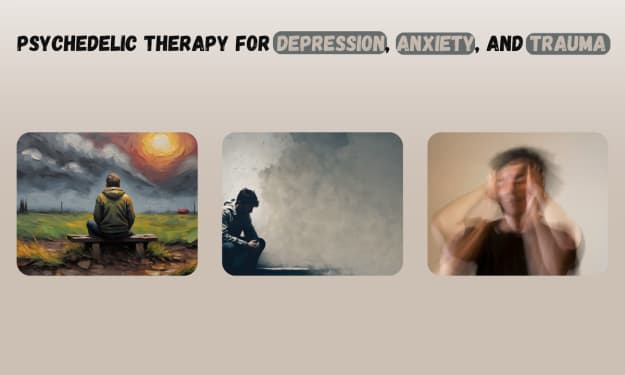
Psychedelic Therapy for Depression, Anxiety, and Trauma
For people who have tried talk therapy, medication, journaling, meditation and still feel stuck psychedelic-assisted approaches can feel like an unexpected opening. Not a shortcut, not a miracle, but a different way of working with the mind when conventional paths fall short. Interest continues to grow because these therapies don’t aim to suppress symptoms; they invite people to understand them.
By Adrienne D. Mullinsa day ago in Psyche
📢 Raise Your Voice Thread: 01/22/2026
Our “Raise Your Voice Threads” are hosted most alternating Thursdays at 12PM ET to offer creators more avenues to uncover exceptional stories on Vocal. As we are continuously searching for fresh creators and inspiring stories, this thread provides an opportunity to exchange and discuss the stories that have moved and motivated us on Vocal.
By Raise Your Voice by Vocal7 days ago in Resources


Comments
There are no comments for this story
Be the first to respond and start the conversation.