
BPD: When the Nervous System Lives at the Edge
A human-centered reflection on emotional intensity, fear of abandonment, and the aching need to feel safe inside one’s own life.

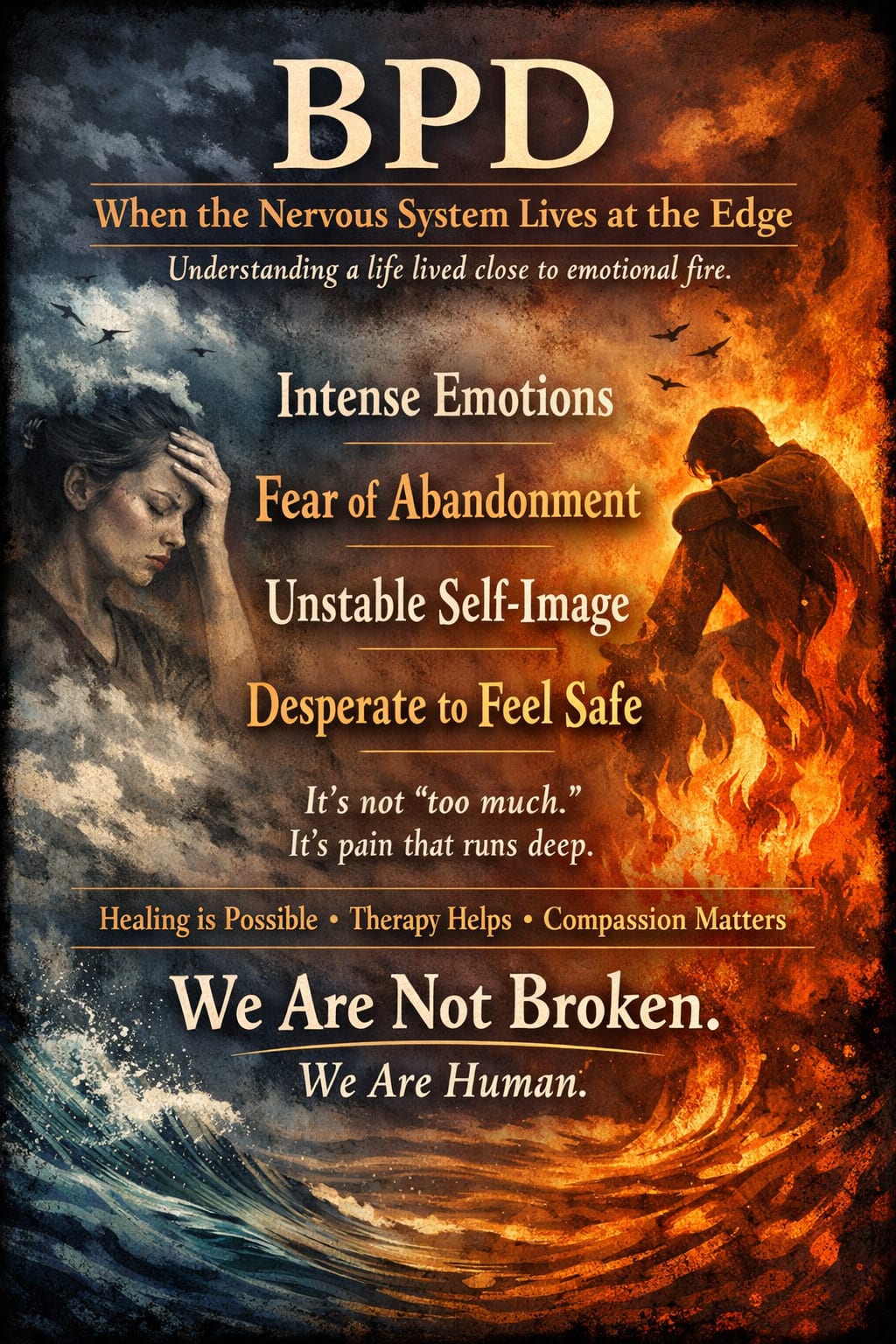
A compassionate reflection on Borderline Personality Disorder that explores emotional intensity, unstable self-image, fear of abandonment, and the possibility of healing through understanding, support, and treatment.
BPD is often spoken about in language that is too cold, too clinical, or too cruel.
People throw the term around as shorthand for “too much.”
Too emotional.
Too reactive.
Too unstable.
Too hard to love.
But that is not the truth of it.
Borderline Personality Disorder is a serious mental health condition that affects how a person experiences emotions, relationships, self-image, and distress tolerance. It is commonly associated with intense emotional pain, fear of abandonment, impulsivity, unstable relationships, and a fluctuating sense of identity. Psychotherapy is considered the main treatment, and many people improve significantly with care and support.
Behind the label is often a person who does not feel “dramatic” on the inside.
They feel terrified.
Overwhelmed.
Flooded.
Ashamed.
Misunderstood.
For many people living with BPD, emotions do not arrive as gentle signals.
They arrive like weather systems.
Fast.
Huge.
All-consuming.
A small shift in tone can feel like rejection.
A delayed reply can feel like abandonment.
A misunderstanding can feel like proof that love is about to disappear.
This does not mean the person is manipulative.
It often means their nervous system is sounding an alarm so loudly that everything else becomes hard to hear.
Clinical descriptions of BPD commonly include emotional instability, impulsive behavior, disturbed patterns of thinking or perception, and intense but unstable relationships. Fear of abandonment and difficulty maintaining a stable self-image are also central features.
And that is the part many people miss:
beneath the behavior is often an unbearable vulnerability.
What the outside world may call “overreacting” may actually be a person trying to survive the intensity of what they feel.
What gets judged as “attention-seeking” may at times be a desperate attempt to not disappear emotionally.
What looks like anger may be pain with nowhere safe to go.
This does not mean harmful behavior should be excused.
It means it should be understood accurately.
Because healing rarely begins with condemnation.
Healing begins when reality is named with enough compassion that the person no longer has to fight both the pain and the shame of having pain.
BPD is also frequently misunderstood because it can overlap with or co-occur alongside other conditions such as depression, anxiety disorders, PTSD, bipolar disorder, substance use disorders, and eating disorders, which can make diagnosis more complicated. A licensed mental health professional typically diagnoses it through a thorough clinical assessment rather than a single test.
There is also hope here.
Real hope.
Not decorative hope.
People with BPD are not doomed.
They are not broken beyond repair.
And they are not sentenced to remain the most wounded version of themselves forever.
Evidence-based treatment can help people experience fewer and less severe symptoms, build more stable relationships, improve daily functioning, and create a life that feels more livable. Psychotherapy is the primary treatment, and dialectical behavior therapy, or DBT, is one of the most recognized approaches used for BPD. Medicines may sometimes be added for specific symptoms or co-occurring conditions, but therapy remains central.
That matters.
It matters because too many people hear the term BPD and think it means hopeless.
It does not.
It means a person may need skills for emotional regulation.
It means they may need consistency.
It means they may need help learning how to survive a feeling without becoming the feeling.
It means they may need relationships built on steadiness, boundaries, honesty, and repair.
And maybe more than anything, it means they need to stop being reduced to a stereotype.
A diagnosis should never become a cage.
It should become a doorway toward understanding.
The human being is always larger than the label.
Some people with BPD may spend years feeling like they are “too much” for the world.
But maybe the deeper truth is that they have been carrying too much without enough safety, enough tools, enough support, or enough language for what was happening inside them.
When seen through that lens, BPD is not a moral failure.
It is not a character flaw.
It is not proof that someone is unlovable.
It is suffering.
It is dysregulation.
It is a life lived too close to emotional fire.
And like other forms of suffering, it deserves treatment, dignity, and care.
To write about BPD responsibly is to remember this:
we are not talking about a trend word, an insult, or a punchline.
We are talking about people.
People trying to hold themselves together.
People trying not to be abandoned.
People trying to trust love without bracing for loss.
People trying to come home to themselves while their inner world keeps shaking.
And that effort deserves more reverence than ridicule.
Author note:
This piece is written in a human-centered spirit. Mental health language should never be used to flatten people into labels. Healing begins where compassion, accountability, and proper support are finally allowed to meet.
—Flower InBloom
About the Creator
Flower InBloom
I write from lived truth, where healing meets awareness and spirituality stays grounded in real life. These words are an offering, not instruction — a mirror for those returning to themselves.
— Flower InBloom
Keep reading
More stories from Flower InBloom and writers in Psyche and other communities.
As a Neuroscientist, I Quit These 5 Morning Habits That Secretly Destroy Your Brain
The First Hour Controls Everything : During a neuroscience workshop I attended hosted by researchers affiliated with Harvard University, one sentence completely changed my perspective on daily life: “The first hour after waking up determines your brain’s chemistry for the rest of the day.” At first, I thought that sounded dramatic. But the deeper I studied brain science, the more I realized something uncomfortable: Most of us are unknowingly damaging our brain every single morning. Not through drugs. Not through trauma. Not through disease. But through small, repeated habits. And because these habits feel “normal,” we never question them. Over time, I decided to experiment on myself. I removed five common morning behaviors — and the cognitive changes were undeniable. Here are the five morning habits I quit — and why neuroscience suggests you should reconsider them too.
By Shahid Zaman7 days ago in Psyche


Comments (1)
🌺❤️❤️❤️❤️❤️ Thank you ❤️❤️❤️❤️❤️❤️❤️❤️❤️❤️❤️❤️❤️❤️❤️❤️❤️❤️❤️❤️❤️❤️❤️❤️❤️❤️❤️🔥🔥🔥🔥🔥🔥🥀 ✨🔥🥀 ✨🔥🥀 ✨🔥