Latest Stories
Most recently published stories in Proof.
15 Psychological Facts That Will Blow Your Mind
**Brainy Dose Presents:** **Psychological Facts That Will Blow Your Mind!** The field of psychology looks at the science of the mind and behavior. Studies trying to understand why we are the way we are have been going on for decades and will continue into the future. We're learning more and more each day, but there's still so much we don't know.
By humphrey patsonabout a year ago in Proof
The Forgotten Truth
**The Forgotten Truth: The Secret of the Lost Colony** In the late 16th century, a group of English settlers set sail for the New World, determined to establish a colony on Roanoke Island, off the coast of present-day North Carolina. Led by John White, the group arrived in 1587 with hopes of creating a new life in the untamed land. But when White returned to England for supplies and then came back to the island in 1590, he found the settlement deserted, with no trace of the 115 men, women, and children he had left behind. The only clue was the word "CROATOAN" carved into a post, and "CRO" carved into a nearby tree. The fate of the "Lost Colony" has puzzled historians for centuries, sparking theories ranging from assimilation with local tribes to being massacred by hostile forces.
By Kingsley Egekeabout a year ago in Proof
Did you know . Content Warning.
Time travel is not just science fiction; it's a scientifically backed possibility. Albert Einstein’s theories of special and general relativity laid the groundwork, proving that time travel, especially to the future, is within the realm of scientific possibility. One intriguing case is a 400-year-old tomb discovered in China containing a ring shaped like a Swiss wristwatch. While this suggests the possibility of time travel, it could also just as likely be a mistake or a modern artifact that somehow found its way into the tomb. Ferdinand Waldmuller’s 1860 painting has often been cited as evidence of time travel, as it shows what appears to be a girl texting on a smartphone. However, a closer look reveals that she is actually holding a prayer book. Similarly, Umberto Romano painted a Native American seemingly using an iPhone, but upon further inspection, it is more likely that he was holding a hand mirror.
By Taylor Blackabout a year ago in Proof
What's Your Hidden Power?
Discover Your Hidden Power with This Simple Test Hidden within each of us is a secret power that we might spend our entire lives without discovering. Fortunately, this test is designed to reveal what yours might be. You will have 15 seconds to answer each question, and you can track your points to find out what your hidden power is. At the end of the test, add up your points to see what you uncover. Remember to subscribe and ring the notification bell for more fun tests and quizzes like this one!
By humphrey patsonabout a year ago in Proof
What is the Basic Structure of a Roof?
The roof is one of the most essential parts of a building, providing protection from weather and environmental elements. While roofs come in various shapes and styles, the basic structure remains relatively consistent. Understanding this structure can help homeowners and builders alike make informed decisions about maintenance and construction. Let's break down the essential components of a Roofing Installation & Repair Services In Dallas:
By surgecelectricabout a year ago in Proof
Humans can talk to whales
Intro - What it's like to be a whale - You are seeing something almost no human has ever witnessed - a whale's eye view of life in the ocean. Footage like this is only possible thanks to cutting edge technology that's changing how we study these species. But to truly understand what it's like to be a whale, what you see isn't the important thing. It's what you hear. Whales exist in a world of sound. Many have wondered if their songs and clicks might even be a form of language. This video is about how new technology, like artificial intelligence is being used to decode this sonic world. Scientists are now using whale songs to train AI language models like ChatGPT for nature. Their hope is that these tools will help us better understand what it's like to be a whale. New technology is completely revolutionizing how we study and protect nature. I recently saw this firsthand as part of an ocean mission with Planet Wild, where we used drones to deploy these camera robots onto the largest animal that's ever lived. Blue whales. - Whoa. Did you get - That? Stick around to the end of the video to learn more about the episode I hosted on their channel. But first, join me on one of the most fascinating and perspective changing explorations we've ever researched, into a whale's world of sound, as we meet whale scientists, animal communication experts, and artificial intelligence innovators, on a quest to answer one question: can we use AI to talk to whales? Ch. 1 - The record that saved Earth's whales from extinction Hey, smart people, Joe here. You're listening to a record called "Songs of the Humpback Whale." In the 1950s, a navy engineer named Frank Watlington was using top secret underwater microphones to listen for Soviet submarines when he recorded these eerie alien like sounds. In the 1960s, these recordings made their way to biologist Roger Payne. When Roger, and his wife Katy, analyzed the sounds, they found complex rhythmically repeating collections of notes. These whale sounds were songs, and those songs were in danger of disappearing. See, in the second half of the 20th century, whales were on the brink of extinction, thanks to unrestricted slaughtering for use in soap lubricants, pet food, even margarine. We killed around 3 million whales in the 20th century alone. Some populations shrunk by more than 90%. When you look at the sheer biomass that humans removed from ocean ecosystems, scientists think this was the biggest annihilation of any animal in human history. Well, Roger Payne had a crazy idea to try and save whales from extinction. - You know, how do you describe somebody like Roger Payne? - Iain's the CEO of Ocean Alliance, a whale conservation group Roger Payne founded in the 1970s. - He was probably the father of modern whale research. But what's more important than that, I think, is Roger understood scientific papers or science alone won't save the wild - World. In 1970, Roger produced an album of these humpback whale songs and it changed the world. Songs of the Humpback Whale went multi-platinum. Those whale songs even made it onto the Voyager golden records that are now flying off somewhere outside our solar system. This version here was included in an issue of National Geographic Magazine. It is the largest record pressing of all time. Michael Jackson, Beyonce, Whitney Houston... No, it's whales. It's honestly hard to imagine today how big a deal this album was. Not just for people, but for whales too. Songs of the Humpback Whale helps spark a revolution in ocean conservation. The Save the Whales movement was born in 1972. The United States passed the Marine Mammal Protection Act. There were protests and actions against whaling ships. By the 1980s, the International Whaling Commission had banned commercial whaling worldwide. Fast forward to today, most of the species that we used to hunt are recovering. No joke, this album might be the reason we still have whales today. - You know, I think it really did change how people thought about wild animals. Wait a minute, these aren't cat food and dog food and lubricants. These are singer poets, you know, musicians in our oceans with their haunting, haunting voices. - Sadly, Roger Payne passed away in 2023. Ch. 2 - Can AI help figure out what whale songs mean? But all of this happened because humans realized -- whale songs mean something. In the decades since, scientists have learned whale songs have dialects. They carry family connections, name-like identifying calls. Unique songs are composed and passed across whole oceans like culture. - We nearly all love music. Who can't appreciate a great composer? A great singer? And these are clearly nature's greatest composers. - The songs that whales compose are rich and complex. But if a song doesn't have words, how can you begin to understand what it means? Especially if the composer can't talk back? Well, this is where technology might be able to help some scientists think. AI's ability to comb through enormous volumes of data in search of meaning might make it possible to figure out what whales are saying when they sing. When I first heard about this, I was really confused, honestly. I mean, like a lot of you, I'm pretty impressed by what AI can do, but I'm also a little bit skeptical. Like, it's one thing to ask Chad GPT to help me come up with a title for this video or something. But how do you ask a thing that's not alive, what a totally different species, is trying to communicate? This is my quest to answer that. We're about to talk to whale scientists, animal communication experts, AI innovators to get some answers. And let me tell you what I learned in the end completely changed how I looked at this entire question. Okay, so I'm about to interview an animal communication Ch. 3 - Living in a world of sound (umwelt) expert so we can get an idea of how you even figure out this question of what an animal is trying to convey when it makes a sound. And that question centers around this word called UMWELT. - It's my favorite word! - This is Caroline Casey. She researches animal behavior and communication. - Oh my gosh, yeah. So umwelt refers, well, it was, it was developed by this researcher named Jakob Von Uexküll. I'm probably butchering that. But it, it basically refers to the the the self-perceived world of an animal and how it interacts with the world around them. And so if you think about our sensory lenses, they're very biased towards vision and hearing. That's what we are most attuned to. But other animals have completely different sensory lenses through which they perceive the world around them. So the sensory systems that they are reliant on, we cannot assume that they're similar to our own. - Okay, so you're saying, I have to imagine what it's like to be a whale. To imagine what it's like to be a whale, first, close your eyes. Because underwater, a mammal's vision might reach 10, maybe 15 meters, but sound travels faster and farther underwater than it does in air. Down here, your primary sense is going to be sound. I mean, take blue whales. They aren't just the largest thing that's ever lived. They make the loudest call of any animal ever. They can make sounds that can be heard over a thousand kilometers away. That would be like me having a conversation across the entire state of Texas. The umwelt of a whale is about sound on scales of distance and time that we can't even fathom. Fathoms... an underwater joke. Boo. Ch. 4 - How do whales make sounds, anyway? But just because whales are all about sound doesn't mean we can't turn it into something visual to help us understand it better. This is a spectrogram, basically. A spectrogram is a way to represent sound on a graph. When it comes to whales, knowing what vocalizations look like can teach us a ton. For instance, this is a blue whale vocalization, Baleen whales, like blues, they make sound with a larynx kind of like we do. Toothed whales, on the other hand, (or other fins?) like orcas, they make sound through their noses. Basically these balloon like lips that can be opened and closed to make sounds like clicks and whistles. I'm a dolphin. Tooth whales also have this thing called a melon, a chunk of special fat on their forehead, which they can use to aim and focus sound. Sperm whales string their sounds together in vocalizations called codas. They're almost like Morse code. Sperm whale codas are incredibly complex, probably because they have the biggest brain of any animal. And that's the thing. If we are looking for meaning in whale sounds, it's not just about making sure that whales have the right hardware. They need the right software too. Well, how do you figure out what makes a whale brain tick? It's not like we can send whales through an MRI machine. But scientists have looked at brains from beached whales and learned a lot about how they work. For example, the part of a whale's brain that's associated with intelligence - it's bigger than a human's is relative to our body mass. Whales also have special neurons in their brains that we only find in animals that are highly social and intelligent and chatty. So that means whales have the right hardware and software to communicate in really complex ways. And now we're at the point where we can't avoid it any longer. We've gotta talk about the L word -- language. What would it take for whale sounds to count as language? Ch. 5 - We need to talk about the L word This is a kind of controversial question. Language researchers have this loose set of rules. For something to be a language, it has to have individual words with specific meanings. The ability to create new words when you need them, and the capacity to describe things that have happened in the past and may happen in the future. So baby talk -- -- not a language. Klingon? "SuDwI' HutlhwI' je" Language. - Language is this really complex thing. So we can't look at one whale song and just slap the L word on it. We've gotta look for patterns in tons of songs over a long period of time. It sounds like we're gonna need a bigger boat. And that boat is called AI. - There are now tools that allow pattern recognition to be much more quantitative. - Ari Friedlaender is one of the leading whale behavior researchers on Earth. - But the D call of a blue whale looks like this and has this shape. Once you know sort of what that is, you can look through volumes of data and pull out all of those cases of finding that individual call. The volume is so high at this point. If you've got 10,000 or a 100,000 images, having something that can go through and process and look for that similar pattern in in real time almost is gonna change everything about how that type of data is collected. Ch. 6 - How AI is already changing whale research - Well, it turns out AI has already changed the way that we study whales. I'm talking whale tails. Whale tails are flukes, they're like human fingerprints. No two are alike and we can use them to identify and track individual whales. And luckily researchers and whale watchers on vacation have taken thousands of whale tail photos. Now, it used to be if you wanted to identify the whale you just saw, you had to flip through literal binders of pictures and match the photos by hand. This worked, but it took thousands of hours. So scientists decided to take a bunch of these fluke photos, feed them into a computer and let it learn. They created a neural network that studied whale tales over and over until it could correctly ID them. And now AI can ID whale 90% of the time. That's better than humans can do. And it can even ID whales from fuzzy or bad photos. What this proved is that AI isn't just some gimmick, it can help people do real science. - This is an opportunity if there are people that are interested in the animals that I work on -- to help us process the data that we have or facilitate more data collection that'll help us learn about these animals in a new way. I'm all for that. Ch. 7 - Training computers to listen to animals - I guess I need to talk to somebody who actually works on this AI stuff. - Hi, I am Katie Zacarian. I am a co-founder and CEO of the Earth Species Project. There's this thing called artificial intelligence that you may have heard of and there's been some breakthroughs in the last decade, which give rise to a whole new way of approaching this problem. - The biggest breakthrough came in 2017 when researchers from Google published this paper called "Attention Is all You Need." Now, before this, computers had trouble understanding sentences because they had to read them one word after another, like how we normally read. But this new idea was like having a magic spotlight that shines on all the words in the sentence at the same time to figure out how they fit together, like puzzle pieces. - For the first time you didn't really need to to label the data and it can detect meaning. - This made computers much faster at understanding language. And because they can understand language better, they can do all sorts of cool things like translating languages, summarizing articles. And answering questions like this is what made ChatGPT possible. But also what was really cool is when applied to things like audio, sound, music, human speech, it also worked well. Why not for animal communication? There's some things that human beings are really great at. Like if I were to play you the sound of a bark and play you the sound of a meow, I'd be like, what animal is the bark? And you'd be like, - Oh, it's a dog. Okay, yeah, - Yeah. And yeah, I was like, cat. We human beings are really good at being able to do that from a very few examples. But what if I were to play you 10 million barks? How much time would that take you to go through hours and hours and hours, tens of thousands, maybe hundreds of thousands of hours of audio and be able to accurately assess a bark from a meow? - AI is really good at these kind of things. Taking scales of data that exceed our tiny and significant finite human lifetimes and finding meaning in it -- sometimes meaning that we can't even see or hear. - There may be things that are just kind of escaping us because of our, you know, our humanness, our anthropo-ness. If we could accelerate that with machine learning and AI, that would be incredible. - Earth species project and other groups are out there right now trying to train computers to comb through immense data sets of animal sounds, turn them into math that computers can understand and look for patterns. Ch. 8 - How can we decode what a whale song means? But just because we can find patterns in these sounds isn't the same as knowing what they mean. These sound patterns sort of don't mean anything unless we know what the animal is doing. - It's a really complicated question, I think far more complicated than most people might think. So my name is Michelle Fournet. I am a marine acoustic ecologist. Do I think that AI can help? Sure, if it's used the right way. Do I think that AI is ready? No, it requires an enormous amount of data -- thousands, millions of data points in order to paint an accurate picture of what's occurring in nature. And we don't have that yet. - So what would it take to sort of paint that picture? - So step one is -- what is the whale doing when it produces the sound? Step two is -- who is the whale with? And then step three is -- how does the whale respond when it hears the sound? And if you could put all of those things together, then you could begin to ascertain what the sound is for. We are just barely, you know, scraping the surface of the amount of data that we would need for AI to build a model that would help us to to decode something. When you think about how long it is, we've been studying medicine or chemistry or natural science, you know, we have several hundreds of years of of thinking about natural science, and we've only been studying whale song really since the sixties. It's only been 60, 65 years that anyone's been listening to these vocalizations. Ch. 9 - Making WhaleGPT is so much harder than we realize - And that is when it hit me. All of these amazing things that humans are training AI to do, they are so easy in comparison to decoding whale language because you remember that word umwelt. - It's like the things that we would even say to a whale, we have to remember that is that is within our umwelt, even the greeting, "hi, how are you?" - asking another animal how they feel internally -- that is a very human way of communicating and we don't know, and we can't assume that whales communicate in that same way. I mean, - Think about that. We might share the planet with whales, but they live in a completely different world. - Whales in general have been on earth for 150 million years. They've been communicating for 150 million years. We have been here for a hundred thousand years. In our current form, when we think about language, it's arrogant to think that the language of an animal that evolved in the ocean over millions and millions of years is going to be analogous to our own. And so until we can come up with a version of AI that is capable of ingesting 115 million years worth of data, I don't think it's going to answer the questions. - But it just can't let go of this idea. I mean, let's face it, what you and I really want to know is what if AI does get there? I've seen headlines saying that we're gonna have Google translate for humpbacks. I've watched YouTube videos saying we're gonna have chat GPT for whales. Serious people are genuinely trying to make these things right now. How do we know that AI won't get there soon? The power of AI just continues to grow and grow. Every few months we see it do some new thing that we thought was impossible. What if whale GPT becomes real one day? - The desire to learn how to talk to a whale and have it talk back to you -- that's very enticing. I think there are times where the ability to communicate with a whale is really important. If it is in danger. Like, I wanna go to the ocean and drop a speaker in the water and I wanna have a conversation with the whale. AI might help me do that. But does that benefit the whale? And if it doesn't, why do it? - At the beginning of all of this, I wanted to figure out how technology might let us understand whales and talk back to them. I mean, that would be so cool. What I realized along the way is technology is absolutely changing the way we study and protect these and other species. And AI will absolutely be a part of that. I mean, it allows scientists to do things they could never do before. Study more than they ever could in a lifetime. Ch. 10 - Should we really be doing this? But when we think about how far we take that technology, what I've realized is the question isn't, can we talk to whales? It's should we? Like, so much of this time we spend trying to figure out nature, we make it about us when more of the time, we should be making it about them. Okay, I've been asking everybody this question. Let's say hypothetically, technology advances and AI allows us to decode and communicate back to whales. What would you say? - If I could talk to a whale, I'd probably say, "what pisses you off?" - I don't have a need to talk to no whale. I would prefer to leave it alone. It's a wild animal. Let it live in - Peace. Everything that I would think to say is a very human construct, like "I'm Sorry." - To be able to understand would be profound. I don't know about communicate. It's a very big question that deserves a lot of thought from many, many people. And maybe also animals need to be part of that - Deliberation. As someone who's had the privilege of sitting in a small boat with a hydrophone in the water listening to whales, it's one of the most amazing experiences I've ever had. I do not necessarily think that that experience is made better by making a sound myself. My hope is that we can, as a species, that we can learn to be better listeners. And I think I have great hope that being better listeners will bring us an enormous amount of joy. - When you think about it, listening is what started all of this. And maybe being better listeners, whether it's with our ears or AI, is what we need to keep fixing our ocean ecosystems from the smallest plankton, to the largest species that have ever lived. As for me, what would I say to a whale? Curious"
By Jariatu Kallonabout a year ago in Proof
Real Voice of Historical Feature
In the heart of a bustling city, where the clamor of ambition and dreams intertwines with the rhythm of everyday life, martial arts practitioners find a unique sanctuary. Martial arts, with its diverse disciplines like karate, judo, and Chinese kung fu, offers not just a way to defend oneself but a path to self-discovery and transformation. Each practice, from the precise strikes of karate to the graceful movements of kung fu, carries with it a rich tapestry of history and technique, blending the ancient with the contemporary.
By Rapelang Malebelleabout a year ago in Proof
Can Video Games Actually Make You Smart?
Video games are a fun way to escape from reality, but other people think they're violent, pointless, and a waste of time. There has been a long-running discussion on whether there are any advantages. Do video games genuinely improve cognitive abilities?
By Mariam Fathalrahmanabout a year ago in Proof
Exploring NASA's Discovery
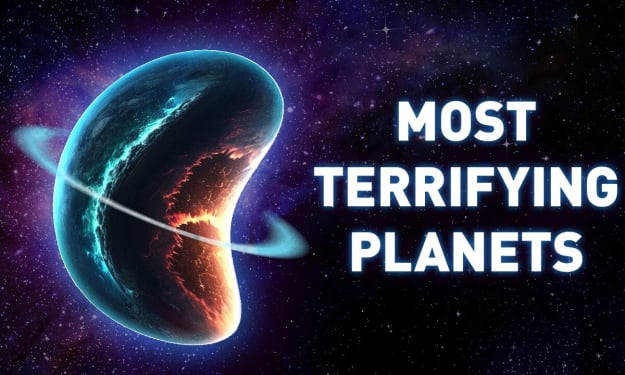
In the ever-expanding realm of astronomy, NASA’s recent discovery of an extraordinarily unusual planet has captured the imagination of scientists and the public alike. This newly discovered celestial body, TOI-3757b, has earned a reputation as one of the most horrific planets ever identified, and its unique characteristics are driving a flurry of excitement and intrigue within the scientific community.
By Horace Waslandabout a year ago in Proof
Astonishing Discoveries
Did you know there are an estimated 40 billion planets in the Milky Way galaxy that could support alien life? That means for every one in five stars, there is an Earth-like planet currently in orbit, with the nearest being only 12 light years away from us. In space terms, that's essentially around the corner. Therefore, it's possible that far closer than you'd think, on another world very similar to ours, is another life form very similar to you, watching a video very similar to this one.
By Horace Waslandabout a year ago in Proof