
Echoes of Awakening: The Timeless Poetry of Allama Iqbal
Exploring the Vision, Wisdom, and Spiritual Power Behind the Voice That Stirred a Nation
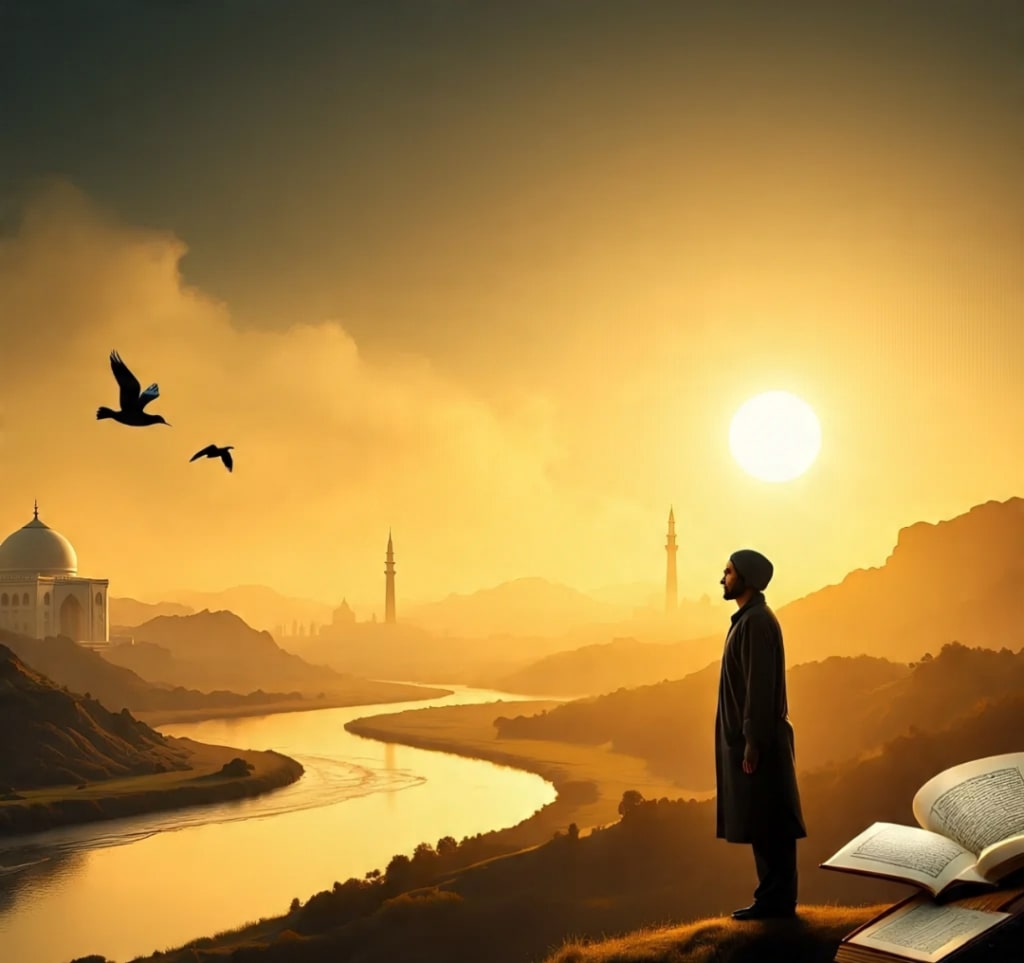
In the quiet corners of history, there are voices that never fade. Their words cross centuries, carrying light for those who seek meaning, purpose, and identity. One such voice is that of Allama Muhammad Iqbal — the poet, philosopher, and dreamer whose verses lit the path for millions and redefined the soul of a nation.
Iqbal was not just a poet; he was a visionary with a pen that wrote in fire and spirit. His poetry wasn’t merely a collection of rhymes—it was a call to action, a spiritual awakening wrapped in beauty, rhythm, and intellect. Through Persian elegance and Urdu power, he spoke of selfhood, divine love, freedom, and the greatness of the human soul.
The Power of a Dream
Born in 1877 in Sialkot, Iqbal witnessed a time when the Muslim world was fragmented, colonized, and in deep spiritual slumber. But where others saw decline, Iqbal saw potential. He believed that Muslims had forgotten the essence of their identity—what he called Khudi, the self.
Through poems like “Tarana-e-Milli” and “Lab Pe Aati Hai Dua”, he inspired both young and old. His famous lines, “Khudi ko kar buland itna ke har taqdeer se pehle, Khuda bande se khud pooche, bata teri raza kya hai,” urged individuals to elevate their character so profoundly that even destiny would pause to ask their permission.
These weren’t just lofty thoughts—they were seeds of transformation. Iqbal's poetry helped shape the consciousness of an entire generation and later became the ideological foundation for the creation of Pakistan.
A Bridge Between East and West
Iqbal’s greatness lies in his unique ability to blend cultures. Educated in Lahore, Cambridge, and Munich, he had deep knowledge of both Islamic philosophy and Western thought. He admired Rumi, but he also studied Nietzsche and Goethe. This gave him a rare voice — one that connected spiritual tradition with modern intellectual challenges.
Rather than rejecting modernity, Iqbal redefined it. He didn’t ask people to return to the past; instead, he urged them to reawaken the spirit of the past and shape a bold future. His poetry was never about despair. It was about courage, dignity, and belief in oneself.
Words That Still Breathe
Today, in classrooms and homes, Iqbal’s verses are still recited. His ideas remain alive in debates about freedom, identity, and justice. His poem “Shikwa” (The Complaint) and its answer, “Jawab-e-Shikwa,” show a powerful conversation between man and God, questioning fate and reminding readers of their own responsibilities.
Iqbal never allowed his readers to feel helpless. Instead, he gave them wings through words. He reminded them that real change comes from within, and that true belief isn’t passive—it acts, it builds, it soars.
A Legacy of Light
The greatest strength of Iqbal’s poetry is that it never ages. His call for Khudi isn’t limited to any nation or era. Whether you're a student in Karachi, a thinker in Istanbul, or a dreamer in New York, Iqbal’s words find their way to your soul. His poetry doesn’t just speak — it resonates.
It’s no surprise that he is known as Mufakkir-e-Pakistan (The Thinker of Pakistan) and Shair-e-Mashriq (The Poet of the East). But more than titles, it is the hearts he touched that keep his memory alive.
Iqbal for the New Generation
In today’s fast-moving world, where screens dominate minds and noise often drowns out thought, Iqbal’s poetry is more relevant than ever. It offers calm in chaos, clarity in confusion, and strength in struggle. It teaches that we are not just consumers of life but creators of our destiny.
Young readers discovering Iqbal today are often surprised at how modern he feels. His vision of selfhood, empowerment, and unity speaks directly to the challenges of today’s youth. He doesn’t offer escape—he offers purpose.
---
Final Thought
Allama Iqbal once wrote, “Sitaron se aage jahan aur bhi hain.” (“There are other worlds beyond the stars.”) He believed in aiming higher than what seems possible. Through his poetry, he gave us a ladder to those stars—a ladder built with words, wisdom, and unwavering faith in human potential.
His legacy is not just in books or monuments. It lives in every soul that dares to dream, question, and rise. Iqbal's poetry is not just to be read — it is to be lived.
About the Creator
Keep reading
More stories from Muhammad Saad and writers in Poets and other communities.
Echoes of the Human Heart
Echoes of the Human Heart In a quiet, dusty corner of the Grand Archive, where scrolls outnumbered stars and the air hummed with the murmur of centuries, a girl named Lira discovered a door that wasn’t there before. She had come as usual—barefoot, ink-stained fingers, carrying a notebook full of half-formed poems. But today, among the shelves of forgotten verses and crumbling parchment, a wooden door stood between “Epic of Gilgamesh” and “Collected Works of Tagore.” Its handle was etched with ancient runes, glowing faintly, as though it breathed. Lira hesitated, but poetry had taught her that wonder begins where certainty ends. She turned the handle. The world blinked. She found herself standing in an open field of moonlight. Before her, a campfire crackled, surrounded by figures dressed in the garments of ages long past. A tall man with a laurel crown played a lyre. A veiled woman in silk held a folded fan. A child whispered verses in Arabic to the wind. They turned and looked at her, their expressions kind, curious, knowing. A voice behind her said, “Welcome, poet. You’ve entered the Heart-Echo.” Lira turned. A woman stood there, her cloak woven from script—lines of poetry in every known language. Her eyes held the depth of libraries, and her voice rang like stanzas made flesh. “The Heart-Echo?” Lira echoed. “It is the space between time, where the true poets gather. Here, the pulse of humanity is recorded—not in history books, but in verse. Each era brings its poets, and each poet carries the song of their people. You are one of them.” Lira blinked. “I’m not… important. I write because I feel too much. That’s all.” The woman smiled. “And that is why you belong here.” She raised her hand. The sky above rippled, revealing windows into other times. A griot in 13th-century Mali singing under starlight. A monk in China brushing characters with trembling devotion. A girl in war-torn Europe scribbling rhymes into the margins of a ration book. “Poetry,” the woman said, “is the human heart transcribed. It lives in every tongue, across every divide. It is protest and prayer. It is lullaby and revolution. It is the only thing we pass on unchanged.” A man stepped forward from the circle. His beard was white, his robe plain, but his voice rumbled like thunder. “I am Rumi,” he said. “I once wrote, ‘The wound is the place where the Light enters you.’ That line has traveled centuries. It has healed people I will never meet.” Then came a woman in a sari, a red bindi on her forehead. “I am Sarojini Naidu. My words fought empires.” And a young man in jeans and a snapback: “Javier. Mexico City. I write spoken word for kids in the barrio. Thought I was alone till I woke up here.” Lira’s eyes widened. “You mean… this place holds poets from everywhere?” “From everywhen,” Rumi corrected, smiling. “We are not separated by time. Only by silence.” The woman in the script-cloak placed a hand on Lira’s shoulder. “You wrote something yesterday. Would you read it?” Lira flushed. “It’s not finished.” “No poem is,” she said gently. “It only echoes.” Lira opened her notebook with trembling fingers. She read, voice quivering: > “We are the ache we cannot name, A thousand drums in one small flame. We are the letters that outlive war, Carved in whispers, needing more.” The poets nodded. A warmth pulsed in the air, as if the world itself had exhaled. Sarojini stepped forward. “You speak with the ache of a world still healing. That makes you a messenger.” Lira looked at the gathering. “What happens now?” “You return,” said the cloaked woman. “And write. And listen. And remember: the purpose of poetry is not perfection. It is connection.” The fire dimmed. The field dissolved. The door swung shut behind her, vanishing into the shelves. Back in the Grand Archive, Lira stared at her notebook. The lines she’d written still glowed faintly, as if lit from within. She smiled. Outside, the world still hurried and stumbled, still fought and loved, still broke and rebuilt. But Lira walked into it differently now. She walked with the echoes of the human heart.
By Muhammad Saad 6 months ago in Poets



Comments
There are no comments for this story
Be the first to respond and start the conversation.