
Echoes of the Human Heart
Exploring the Timeless Power and Purpose of Human Poetry Across Cultures and Eras

Echoes of the Human Heart
In a quiet, dusty corner of the Grand Archive, where scrolls outnumbered stars and the air hummed with the murmur of centuries, a girl named Lira discovered a door that wasn’t there before.
She had come as usual—barefoot, ink-stained fingers, carrying a notebook full of half-formed poems. But today, among the shelves of forgotten verses and crumbling parchment, a wooden door stood between “Epic of Gilgamesh” and “Collected Works of Tagore.” Its handle was etched with ancient runes, glowing faintly, as though it breathed.
Lira hesitated, but poetry had taught her that wonder begins where certainty ends. She turned the handle.
The world blinked.
She found herself standing in an open field of moonlight. Before her, a campfire crackled, surrounded by figures dressed in the garments of ages long past. A tall man with a laurel crown played a lyre. A veiled woman in silk held a folded fan. A child whispered verses in Arabic to the wind. They turned and looked at her, their expressions kind, curious, knowing.
A voice behind her said, “Welcome, poet. You’ve entered the Heart-Echo.”
Lira turned. A woman stood there, her cloak woven from script—lines of poetry in every known language. Her eyes held the depth of libraries, and her voice rang like stanzas made flesh.
“The Heart-Echo?” Lira echoed.
“It is the space between time, where the true poets gather. Here, the pulse of humanity is recorded—not in history books, but in verse. Each era brings its poets, and each poet carries the song of their people. You are one of them.”
Lira blinked. “I’m not… important. I write because I feel too much. That’s all.”
The woman smiled. “And that is why you belong here.”
She raised her hand. The sky above rippled, revealing windows into other times. A griot in 13th-century Mali singing under starlight. A monk in China brushing characters with trembling devotion. A girl in war-torn Europe scribbling rhymes into the margins of a ration book.
“Poetry,” the woman said, “is the human heart transcribed. It lives in every tongue, across every divide. It is protest and prayer. It is lullaby and revolution. It is the only thing we pass on unchanged.”
A man stepped forward from the circle. His beard was white, his robe plain, but his voice rumbled like thunder.
“I am Rumi,” he said. “I once wrote, ‘The wound is the place where the Light enters you.’ That line has traveled centuries. It has healed people I will never meet.”
Then came a woman in a sari, a red bindi on her forehead. “I am Sarojini Naidu. My words fought empires.”
And a young man in jeans and a snapback: “Javier. Mexico City. I write spoken word for kids in the barrio. Thought I was alone till I woke up here.”
Lira’s eyes widened. “You mean… this place holds poets from everywhere?”
“From everywhen,” Rumi corrected, smiling. “We are not separated by time. Only by silence.”
The woman in the script-cloak placed a hand on Lira’s shoulder. “You wrote something yesterday. Would you read it?”
Lira flushed. “It’s not finished.”
“No poem is,” she said gently. “It only echoes.”
Lira opened her notebook with trembling fingers. She read, voice quivering:
> “We are the ache we cannot name,
A thousand drums in one small flame.
We are the letters that outlive war,
Carved in whispers, needing more.”
The poets nodded. A warmth pulsed in the air, as if the world itself had exhaled.
Sarojini stepped forward. “You speak with the ache of a world still healing. That makes you a messenger.”
Lira looked at the gathering. “What happens now?”
“You return,” said the cloaked woman. “And write. And listen. And remember: the purpose of poetry is not perfection. It is connection.”
The fire dimmed. The field dissolved. The door swung shut behind her, vanishing into the shelves.
Back in the Grand Archive, Lira stared at her notebook. The lines she’d written still glowed faintly, as if lit from within.
She smiled.
Outside, the world still hurried and stumbled, still fought and loved, still broke and rebuilt. But Lira walked into it differently now.
She walked with the echoes of the human heart.
About the Creator
Keep reading
More stories from Muhammad Saad and writers in Poets and other communities.
Verses of a Mortal Soul
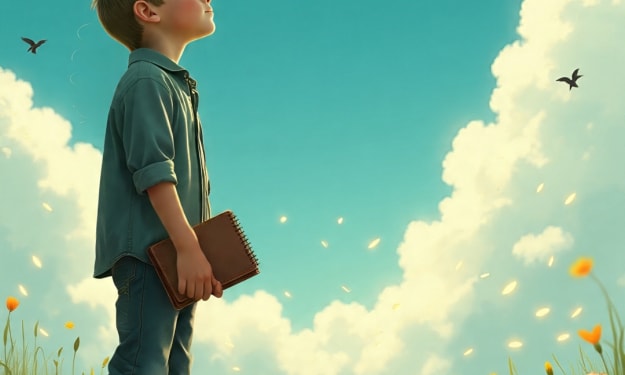
Elio was a quiet child, born in a small village nestled between golden hills and winding rivers. While others ran through fields or built forts from fallen branches, Elio would sit beneath a tall sycamore tree with a notebook in his lap, writing down everything he saw — the way the sun filtered through the leaves, the sound of the water tumbling over rocks, the stories he imagined the clouds were telling. His parents, farmers with hands always covered in earth, didn’t quite understand why their son chose words over wheat, but they smiled at his joy nonetheless. His mother would sometimes read his poems aloud by the fire in the evenings, her voice soft and curious, and Elio would listen with wonder — not just at the sound of his own words, but at the warmth they brought to those around him. As he grew, so did his verses. He wrote about friendship, the changing seasons, the mystery of stars. At school, his teachers noticed his talent and encouraged him to enter local competitions. He didn’t always win, but every poem he shared felt like a seed planted — not for praise, but for connection. One spring, when he was seventeen, Elio was invited to a youth poetry festival in the city. It was his first time leaving the village, and he felt like a small bird suddenly among the towering trees of unfamiliar skies. The city pulsed with voices, lights, and movement — but even here, poetry found him. He listened to spoken-word artists deliver lines with fire and rhythm, watched others paint stories with metaphors and emotion. He realized that poetry wasn’t only about quiet reflections — it could be a celebration, a dance, a song of resilience. He returned home with a heart full of new rhythms and a desire to help others discover what he had found. So Elio began teaching poetry workshops at the village school and organizing outdoor readings beneath the same sycamore tree that had once cradled his childhood musings. Soon, others started writing. Children scribbled verses about their dreams and games. Elders wrote about memories and old songs. The village, once quiet in the afternoons, buzzed with creativity. Poetry was no longer something hidden in notebooks — it was painted on walls, sung at festivals, even exchanged in love letters. Elio found joy not just in his own writing, but in the spark that poetry lit in others. His words had become part of a greater voice — a community of hearts speaking out loud. Years passed, and Elio’s poems were published in books and journals. He traveled to places he had only written about — standing at the edge of oceans, watching the Northern Lights from a quiet hill in Norway, sharing poems with strangers who soon felt like old friends. But no matter where he went, he always returned home to the sycamore, to the laughter of young poets, to the village that had taught him that the most beautiful verses come from living life fully. One summer evening, as the golden hour bathed the hills, Elio sat beneath the tree again, older now, silver in his hair but brightness still in his eyes. Around him sat a group of new poets — children, teenagers, even a few travelers who had heard of the village that loved words. "Why do you still write?" one young girl asked him, her voice curious. Elio smiled, tapping his pen gently against his notebook. "Because life keeps whispering stories," he said. "And every poem is a way of saying thank you." The group grew quiet, letting his words settle like sunlight on skin. Then someone began to read, and another followed, their voices weaving a tapestry of hope, wonder, and joy. Elio leaned back, closed his eyes, and listened — not just to the poems, but to the world itself. It was alive, singing in metaphors, blooming in rhyme, and echoing with laughter. And he, just one poet among many, had helped give it a voice.
By Muhammad Saad 8 months ago in Poets

Comments
There are no comments for this story
Be the first to respond and start the conversation.