
The Animals Who Watch Us Sleep:
What Dogs and Cats Know About Us That We Don’t Notice

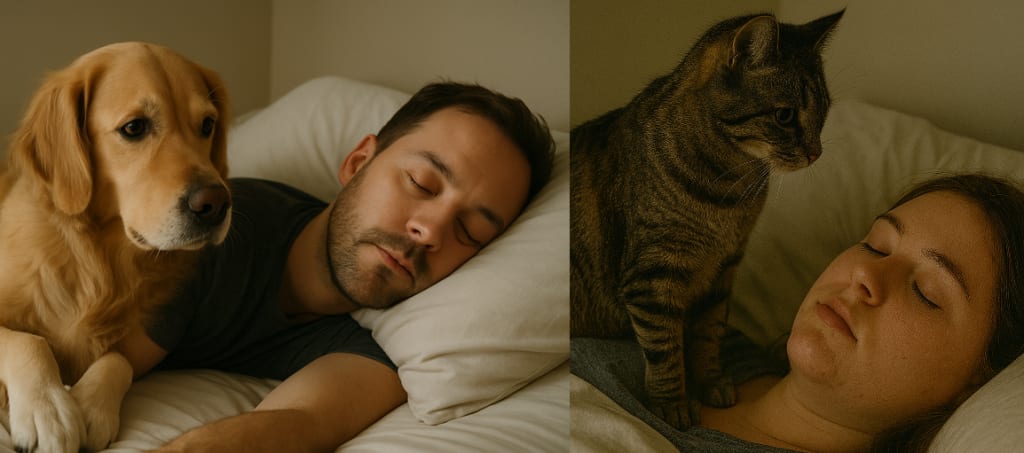
Most people think it’s cute when their dog wanders into the bedroom at night and silently stares at them. Most people laugh when a cat sits inches from their face and watches them breathe. It feels quirky, maybe a little weird, and usually harmless.
But these moments are not random.
They are deeply wired behaviors with roots in survival, attachment, and how animals regulate themselves through the humans they have chosen.
A dog walking into your room at 2 a.m. is not “just checking things out.” He’s checking you. When you fall asleep, your heartbeat slows, your breathing shifts, your scent changes at a molecular level. A dog’s brain—designed over thousands of years to detect subtle physiological states—registers these changes immediately. His instinct doesn’t go to fear. It goes to duty.
Dogs are pack animals. Traditionally, the leader sleeps last. The leader scans the environment while the others rest. But in a household, the hierarchy is inverted. You are the center of his attachment system, yet he still feels responsible for the gap created when you drop into unconsciousness. So he keeps partial watch.
- He listens for changes in breath tempo.
- He tracks movement.
- He positions himself between the door and your most vulnerable state without thinking.
These patterns aren’t sentimental. They’re instinctive, learned across generations of selective pressure.
When he noses the blanket, settles at the foot of the bed, or places his chin near your chest, he is checking whether your breathing stays consistent. He’s not evaluating the room. He’s evaluating the most important organism in it. Your presence regulates his nervous system; your stillness triggers his monitoring. A dog will only do this for the person he identifies as “his.” Not the entire household. Not guests. Not casual companions. Only the individual who forms the core of his internal map of safety.
Cats complicate the story in the best way.
People often mistake feline vigilance for aloofness or accidental weirdness. A cat sitting two inches from your face at dawn looks comical, even unsettling. But their motives are not random either. Cats are solitary predators, but they are socially selective in a way that makes their attachment sharper, not weaker.
A cat watching you sleep is not protecting you the same way a dog does. The instinct is different. Cats check on the organisms they trust because your physiological state affects their environment. Your breathing, your heat, your movement, your micro-expressions—cats read all of this with the accuracy of a small, stealth-based hunter.
- They track rhythm.
- They track silence.
- They track breath patterns that fall outside your norm.
And yes, if a cat thinks something’s “off,” they will try to correct it.
- A tap on the face,
- a paw on the nose,
- sometimes a light smack.
It looks rude, but it is an attempt to restart your movement so they can recalibrate the situation. Cats are not pack-watchers like dogs, they are environment-shapers. If their human is unresponsive, they treat it as a problem to solve, not a threat to guard.
If a cat wakes you at night, bumps your face, or stares at you until you blink awake, it is not random pestering. It is a response to your stillness, your quiet, or your breathing pattern dropping into a range that triggers their internal alert system. Cats will also only do this to their bonded person. Not the household. Not strangers. The one individual who anchors their sense of stability.
- Dogs stand guard to keep the world out.
- Cats monitor to keep the environment predictable.
Both are responding to you.
These moments look adorable from the outside, but the behavioral science behind them is more interesting than the sentimental explanation. Animals are reading us constantly—our nervous systems, our habits, our scent shifts, our breath tempo, our sleeping posture. They detect the smallest deviations without any conscious thought. What we perceive as a pet “checking in” is actually a cross-species attachment behavior that evolved through survival, safety, and selective trust.
So the next time you wake up to a dog curled at the threshold or a cat staring directly into your soul from an uncomfortably close angle, you’re not witnessing a cute quirk. You’re watching an ancient instinct running in the modern world. And you’re watching an animal who chose you do exactly what evolution trained them to do: monitor what matters most.
Sources That Don’t Suck:
National Institutes of Health
Journal of Veterinary Behavior
American College of Veterinary Behaviorists
Animal Cognition (Journal)
Yale Canine Cognition Center
UC Davis School of Veterinary Medicine
About the Creator
Dr. Mozelle Martin
Behavioral analyst and investigative writer examining how people, institutions, and narratives behave under pressure—and what remains when systems fail.
Keep reading
More stories from Dr. Mozelle Martin and writers in Petlife and other communities.
Cat Sanctuary vs. Cat Shelter
Many people assume a cat sanctuary and a cat shelter are the same—but they serve very different purposes. Understanding the difference between a cat sanctuary and a cat shelter can help you decide where to adopt, volunteer, or donate.
By Special Little Whiskers Kitten Sanctuary5 days ago in Petlife



Comments
There are no comments for this story
Be the first to respond and start the conversation.