
My Senior Dog Who Came Back
Zeus' Story of Recovery

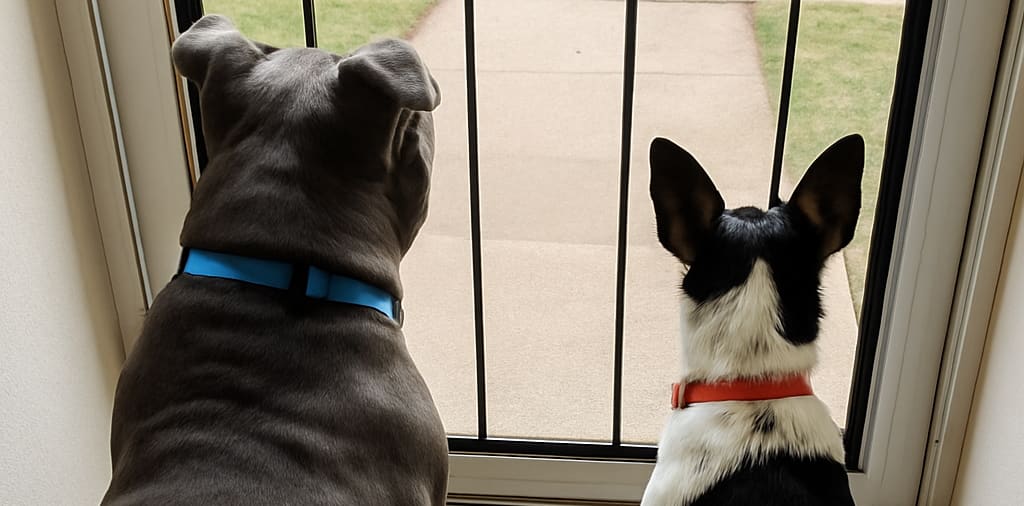
Zeus will be 12 years old in two weeks, a large American Pitbull Staffordshire Terrier ("pit mix") with the kind of gentle loyalty that caused me to underestimate his pain for far too long. For 9 months, he was quietly falling apart. The changes crept in so slowly that each one looked like simple aging, and the pattern only started to make sense when viewed in hindsight.
- The wobbling gait.
- The wide stance.
- The back feet sliding like he was on ice.
- The chronic gagging cough that produced foam at times.
- The slow rise from lying down.
- The way he avoided barking, play, excitement, and movement.
- The dullness in his eyes.
- The withdrawal.
Nine months is a long time to watch a dog fade.
I've written before about how Zeus was a rescue and has always been a velcro dog. That's why the first thing I noticed was that he stopped following me around.
- He no longer went to the door when someone knocked or a neighbors pet walked by.
- He stopped patrolling the yard.
- Stopped exploring.
- Stopped playing with Juno, his 3-year-old, 15-pound “sister.”
- Stopped “talking” to the neighbor dogs.
One by one, the behaviors that defined his personality faded away. The final shift—the one that concerned me most—was the look in his eyes. In human terms, it resembled a flat affect. In canine terms, it showed up as quiet withdrawal, the kind of disengagement that suggests a dog is no longer interested in participating in his own life.

I thought it was age-related arthritis, so I tried every high-rated joint supplement on Amazon. Sadly, none helped. Although I never let it show, I was losing hope and that's what led me to write this article.
The turning point arrived by accident. A pharmacy error converted my Requip prescription into Gabapentin. It had never helped my RLS, but something told me to keep the bottle “just in case.” Weeks later, when Zeus began declining, I called his longtime vet in another state—the one who had treated him for nearly 10 of his 12 years. I sent videos, photos, and a diary-style report of the symptoms I’d been documenting. After reviewing everything, he said, “I’d like to prescribe him Gabapentin. This doesn’t look like arthritis. This looks like nerve pain.”
I told him, “You’re not going to believe this, but I already have Gabapentin—300 mg. The pharmacy gave it to me by mistake.” I read him the label over the phone. He told me to give Zeus half a pill in the morning and the other half at night. For the increasingly rough cough, he added one Benadryl at the same times.
After 9 months of watching symptoms stack, shift, and progress, I tried to protect myself by not hoping too far into the future.
I was absolutely shocked!
By the end of the first day, his back legs aligned under him instead of splaying. He walked with a bit more confidence yet it was noticeable enough because I hadn’t seen him walk that way for months.
I called the vet. He explained that neural pain is its own category. When Gabapentin works, it exposes how much of a dog’s “old age” is actually untreated nerve-driven discomfort.
- The back feet that used to slip out from under him stayed underneath him.
- His spine held its shape instead of sagging.
- His breathing pattern shifted into something quieter and less strained.
- The gliding, guarded movement he had adopted over the past months broke apart into something closer to a natural gait.
By the end of the second day, he rose from lying down without hesitation. That was a big deal because no matter how comfortable I made his bed, or how cushy and thick, he struggled to get up. Now, he was able to more easily get out of his bed.
By the end of the third day, he trotted—actually trotted—to the door when someone knocked. His cough minimized, too. For months it had been a violent, foam-producing cycle linked to airway irritation. The gagging had softened into a dry throat-clear with no foam at all.
- The frequency dropped.
- The force dropped.
The vet said this shift matters because senior dogs often develop overlapping inflammation: joint pain, nerve compression, and airway sensitivity reinforce each other. Once two systems calm, the third begins to follow.
By the end of the fourth day, Zeus behaved like a dog relieved of a weight he had been carrying in silence. He rolled on the carpet on his back for the first time in nearly a year. Not a hesitant lean on the couch, but an actual "happy roll" that required spinal rotation, abdominal engagement, and trust that he could get himself up afterward.
The vet said that rolling is a clinical sign. Dogs in pain avoid it because it torques the hips and activates every stabilizing muscle they have been guarding. Zeus rolled freely, kicked his legs, and rose without struggle. Of course, the smile on his face was impossible to miss!

By the end of the fifth day, he initiated play with Juno. They hadn't played in 7 months. Previous to that, it had slowed down a lot but he kept trying. Seven months ago, he gave up trying to play altogether. But on the fourth day, he moved faster indoors, then outdoors. He wandered the yard in 40-degree weather without coaxing. The vet said if he had arthritis, he would have avoided the cold because his pain would have worsened. Zeus approached the fence and “talked” to the neighbor dogs again, reclaiming rituals he had abandoned when movement became too painful.

The return of instinct is often the clearest sign of recovery.
- Exploration
- Barking
- Social signaling
- Independent decision-making
As these abilities returned one by one, faster than I ever expected, I felt like a giddy mother watching her toddler walk for the first time.
Each reclaimed behavior carried its own meaning:
- The head lift when I said his name.
- The spontaneous bark when Juno alerted to something outside.
- The decision to explore the yard instead of staying curled up in his favorite bed — watching Juno enjoy life because he couldn’t — hit me the hardest.
That was the moment I realized I hadn’t been watching laziness or “senior slowdown.” I had been watching limitation. A dog choosing observation over participation is almost always signaling pain the vet said. I felt an unexpected sting of recognition. I’ve spent my entire career reading behavioral clues in forensic handwriting analysis and trauma therapy with people, so why didn't I notice it with him? The guilt poured on but I had to remind myself that canine decline follows a different set of rules. At nearly 12 years old, changes in a dog’s mobility or energy are easy to attribute to “old age,” especially when the shifts are gradual.
- Human behavior is psychologically driven and patterns emerge through conscious and unconscious expression.
- Senior dogs, by contrast, compensate silently for physiological pain until the body can’t cover the deficit anymore.
Living inside a situation alters perspective, even for someone trained to read patterns.
Regardless, none of this was random. From the pharmacy mistake to the neurological permissions returning, the real ah-hah moment came when I understood that his baseline had never been “old.” It had been discomfort masquerading as aging.
- Pain changes posture.
- Posture changes breathing.
- Breathing changes willingness.
- Willingness changes behavior.
Once the cascade reverses, you don’t get a younger dog; you get the dog who had been buried under months of unmanaged pain.
His new blue collar arrived on the same day his spark did. He wore it — alert, present, and attentive. His breathing was steady. His posture balanced. His expression unmistakably bright. The dog who had been fading had come back as if someone had turned the lights on inside him.
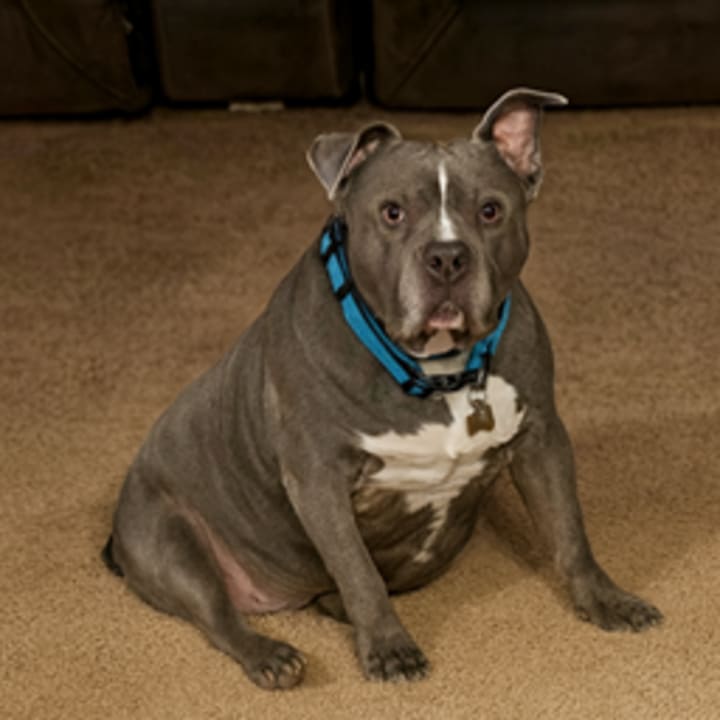
Gabapentin twice a day and Benadryl twice a day. That was the entire protocol. It was the correct pairing for a dog who had been hurting in silence. Knowing that he hurt in silence for so long aches in a way I didn’t expect, but when guilt tries to resurface, I look at the same dog now trotting, exploring, and reclaiming his vibrancy of life on his terms. The revival tells the truth more accurately than my self-blame ever could.
That is why I’m writing this article. If another owner of a senior dog reads this and identifies pain where they once assumed aging, a life may stretch longer — or at the very least, become more comfortable.
Senior dogs do not lose themselves all at once.
They disappear in fragments—mobility first, curiosity next, and finally their social behavior. The spark dims gradually enough that the decline looks like “old age” even when something treatable is underneath it.
Zeus reminded me that “old age” is often a convenient label for a list of treatable problems. He came back when his body finally had the chance. In the quiet shifts — posture changing, bark returning, movement smoothing, and eyes brightening — I witnessed my near-12-year-old senior dog actively reclaim pieces of his life and independence that I — and likely he — thought were gone forever.
Now, a full week later, he’s running around more as he plays with Juno. He’s curious and no longer spends his days lying in his bed as the world passes him by. We are still limited in our time together, I know. But for every day I’m lucky enough to have him in my life, I’ll make sure he can rest the way he deserves—comfortably, peacefully, and without pain.

Sources That Don’t Suck
Veterinary Pain Management Journal
AAHA Senior Dog Guidelines
Veterinary Neurology Clinical Notes
ACVIM Consensus on Airway Inflammation
And special thanks to Dr. Geyer, DVM
DISCLAIMER: I am not a veterinarian, and this article is not medical advice. This is the documented experience of my senior dog, Zeus, and the specific clinical guidance provided by his longtime veterinarian. Every dog presents differently. Any changes to medication, supplements, or treatment plans should be made in consultation with a licensed veterinarian who can assess the individual animal’s health, history, and needs.
About the Creator
Dr. Mozelle Martin
Behavioral analyst and investigative writer examining how people, institutions, and narratives behave under pressure—and what remains when systems fail.
Keep reading
More stories from Dr. Mozelle Martin and writers in Petlife and other communities.
The Animals Who Watch Us Sleep:
Most people think it’s cute when their dog wanders into the bedroom at night and silently stares at them. Most people laugh when a cat sits inches from their face and watches them breathe. It feels quirky, maybe a little weird, and usually harmless.
By Dr. Mozelle Martin3 months ago in Petlife
Cat Sanctuary vs. Cat Shelter
Many people assume a cat sanctuary and a cat shelter are the same—but they serve very different purposes. Understanding the difference between a cat sanctuary and a cat shelter can help you decide where to adopt, volunteer, or donate.
By Special Little Whiskers Kitten Sanctuaryabout 17 hours ago in Petlife
Are Lick Mats Actually Good For Dogs, Cats, and Small Pets?
If you have been to pet shops or online pet groups lately, you have likely seen the pet lick mat. These bright, bumpy rubber mats are a huge hit, and for good reason. Pet owners find that their dogs, cats, and small pets love them.
By Alice Adams7 days ago in Petlife
Review of 'Man on the Run'
My wife and I saw Man on the Run, a nearly 2-hour documentary on Amazon Prime, about Wings, Paul McCartney's group that flew around the world from shortly after The Beatles broke up in early 1970 to shortly after John Lennon was murdered at the end of 1980, making a Beatles reunion forever impossible.
By Paul Levinson6 days ago in Beat



Comments
There are no comments for this story
Be the first to respond and start the conversation.