
When the Rain Forgot to Fall
One boy’s belief reminded a broken village how to hope again.
When the Rain Forgot to Fall
By Tariq Shah
The sky above the village of Darya had been dry for ten long years.
The earth was cracked like shattered glass. The once-rushing stream was now a memory etched in dry stone. Trees that used to dance in the wind stood stiff and bare. The rain, it seemed, had forgotten how to find them.
The villagers adapted. Wells were dug deeper. Water was rationed like gold. Children grew up never having felt a raindrop on their skin. For them, rain was something their grandparents spoke of like a bedtime fairy tale—magical, unbelievable, and lost.
Except for one boy.
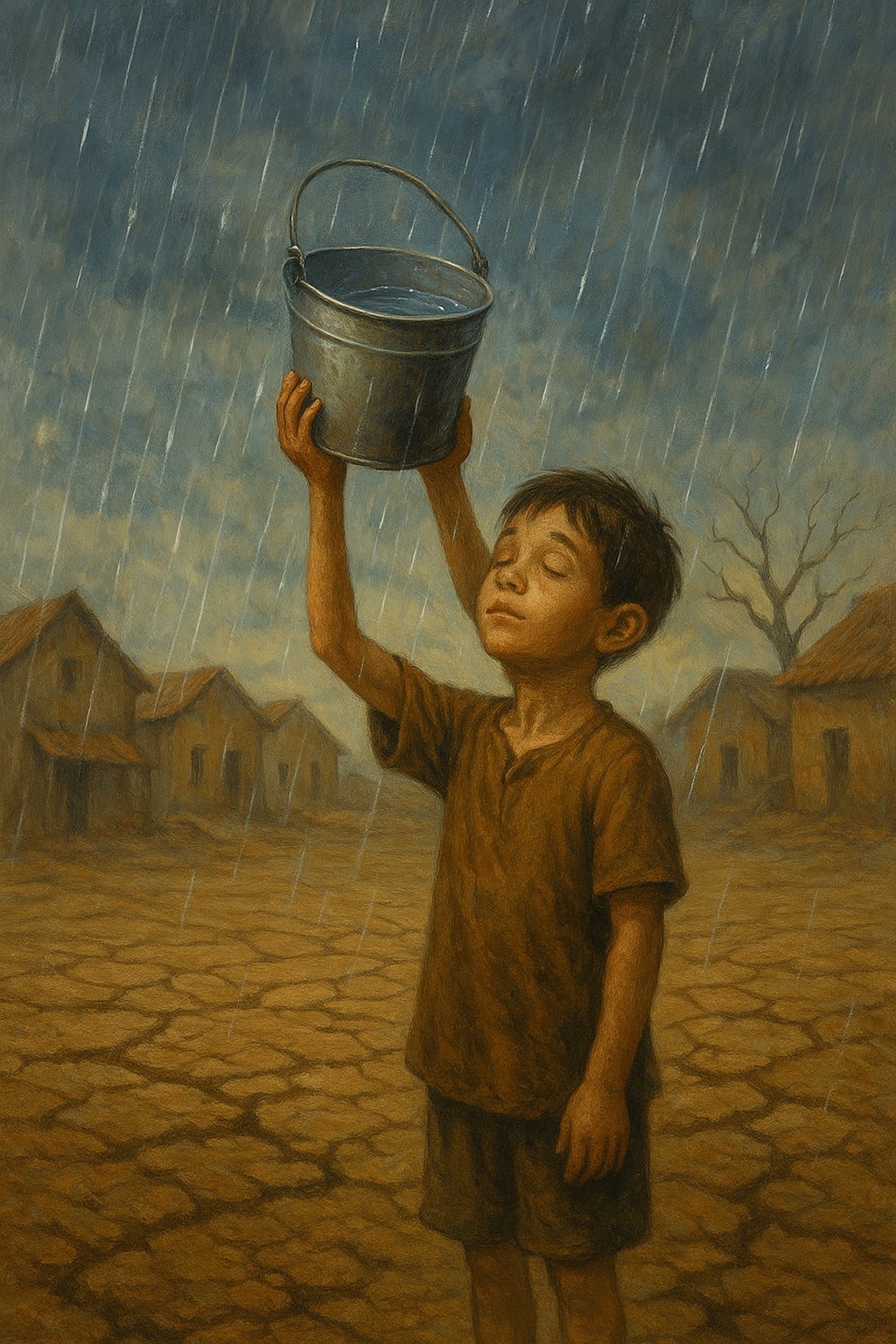
His name was Mikaal. He was ten years old, blind since birth, and known for walking barefoot every morning with an empty metal bucket in his hand.
Every day, without fail, Mikaal would walk to the center of the village square, lift the bucket to the sky, and wait.
“Still no rain, eh?” the baker would chuckle from his dry storefront.
“Poor boy,” others would whisper. “Someone should tell him it’s pointless.”
But Mikaal never stopped. When asked why he did it, he simply smiled and said, “The rain didn’t forget. It’s just shy. It needs someone to believe it’s still welcome.”
The villagers laughed. At first, gently. Then, mockingly.
“Even the clouds have abandoned us,” one old farmer said.
Still, Mikaal returned every morning. His little feet left dusty prints in the square. The bucket always came back empty, but his spirit never did.
His mother begged him to stop. “People think you’re foolish, son.”
“I don’t care what they think,” he replied. “One day, the sky will remember.”
Then came the summer that nearly broke Darya for good.
The last well dried up. Crops turned to ash in the wind. The elders gathered and quietly began planning to evacuate. There was talk of abandoning the village altogether.
But on the edge of that hopeless season, something changed.
It started with the clouds.
They crept in slowly—gray, unfamiliar, like strangers returning after exile. The sky darkened for the first time in years. The air grew heavy. Still, the villagers didn’t believe.
“Probably just a dust storm,” someone muttered.
But Mikaal stood in the square with his bucket, facing the sky he could not see, and whispered:
> “You’re still up there. I know you are.”
And then—
A drop.
Then another.
And another.
A soft plink against metal, like music returning to an abandoned instrument.
The villagers stood frozen as rain began to fall—lightly at first, then with growing rhythm. It soaked the ground. It rolled down rooftops. Children screamed with joy, dancing barefoot in the mud for the first time in their lives.
The village wept, but Mikaal simply stood there, holding his bucket to the sky as if it were the most natural thing in the world.
Someone asked, “How did you know?”
Mikaal turned toward the voice, his eyes clouded but his smile clear. “Because sometimes, hope needs someone to wait for it. Even when everyone else walks away.”
The rain lasted two full days and nights. Wells refilled. Seeds awakened. Trees opened their arms to the sky again.
Darya was saved.
From that day forward, every year on the anniversary of the rain’s return, the villagers gather in the square with empty buckets. Not to beg for water—but to remember the boy who believed when no one else would.
Mikaal grew older, but his ritual remained. He still walks barefoot every morning, bucket in hand, even when the skies are blue.
And when people ask why, he says:
> “Not everything broken is gone. Sometimes it just needs to be missed loud enough to come back.”
---
Author Note:
This story is a reminder that hope is not foolishness—it’s courage wearing a child’s heart. When the world forgets how to believe, be the one who remembers. Like Mikaal, you might be the reason something broken finds its way back.
About the Creator
Keep reading
More stories from Tariq Shah and writers in Motivation and other communities.
Influential Women Magazine: Where Power, Purpose, and Legacy Align
In a world where visibility is often mistaken for influence, Influential Women Magazine stands apart. It is more than a publication - it is a purpose-driven platform that celebrates women whose leadership is rooted in substance, values, and long-term impact. Rather than focusing on fleeting trends or surface-level recognition, the magazine amplifies stories that matter stories of women shaping industries, communities, and future generations through intentional leadership.
By influentialwomenmagazine2 days ago in Motivation
So You Decided To Become a Nurse Practitioner:
So you decided to become an "Advanced Practice" nurse. Congratulations!... is what I would say if this was a good idea. Grad school? In this economy? What were you thinking? Likely it was something along the lines of either 1) “I've seen these other chucklefucks do it— Why can't I?” or even 2) “I've got a nice career, I should shake it up. I miss feeling like I have no clue what I'm doing.”
By Sandor Szaboabout 24 hours ago in Fiction


Comments
There are no comments for this story
Be the first to respond and start the conversation.