
Wangari Maathai: The Woman Who Planted Hope and Grew a Revolution
They told her she was a "mad woman" for planting trees. She proved that a single seed, when nurtured with courage, can topple dictators and heal a nation

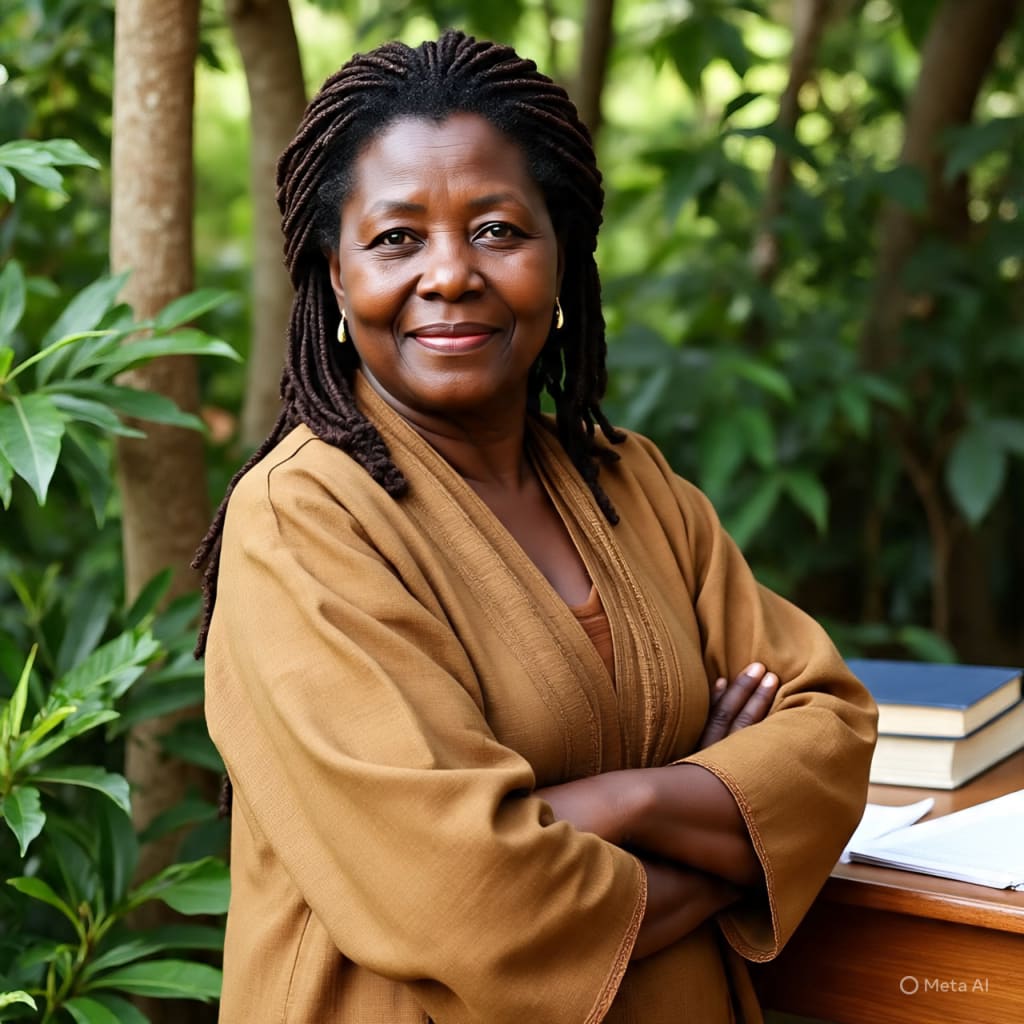
Wangari Maathai did not begin her life expecting to stand on a podium in Oslo, accepting the Nobel Peace Prize. She was not raised with the expectation that she would become a global icon, an environmental revolutionary, or a political disruptor who would stare down a dictatorship.
Her story begins far away from the halls of power. It begins in the central highlands of Kenya, in a village called Ihithe, Nyeri. Here, the soil was red and rich, the streams ran clear and cold from the mountains, and the towering mugumo (fig) trees were considered sacred shrines by her Kikuyu community.
To the outside world, she was just another village girl. But life has a strange, quiet way of molding world-changers in silence. In the shadow of Mount Kenya, a fire was being lit that would eventually warm the entire world.
1 — The Village Girl Who Noticed What Others Ignored
As a child in the 1940s, Wangari’s life was defined by the rhythm of the land. Each morning, before the mist had lifted from the tea fields, she would walk the narrow dirt paths to fetch water for her mother.
She knew the land not through maps, but through touch. She knew the coolness of the soil under her bare feet, the specific smell of the rain before it arrived, and the hum of biodiversity that thrived in the forests. Her mother, a woman of traditional wisdom, instilled a lesson in her that would become the foundation of her entire philosophy:
> "This land is your home. If you take care of it, it will take care of you. If you destroy it, you destroy yourself."
>
Wangari listened. But unlike many children who accepted the world as it was, Wangari was possessed by a restless curiosity. She asked the dangerous questions.
Why were the fig trees never to be cut down?
Why did the water levels in the stream change?
Why did the soil turn to dust in the neighboring villages?
The elders answered with folklore and stories of spirits, not science. But these stories planted a seed of reverence in her heart. She learned that nature was not a commodity to be used; it was a living entity to be respected.
Her intelligence was undeniable. In a time and place where educating girls was often considered a waste of resources, Wangari shone. When the "Kennedy Airlift"—a massive scholarship program initiated by Tom Mboya and John F. Kennedy—offered bright East Africans a chance to study in America, Wangari earned her seat.
She packed her bags and left the red earth of Nyeri for the United States. It was the first big fracture between who she was, and who she would become.
2 — The Education That Changed Everything
Landing in the United States in the 1960s was a culture shock, but it was also an awakening. America was in the throes of the Civil Rights Movement and the anti-war protests. The air was thick with the spirit of change.
Wangari studied biology at Mount St. Scholastica College in Kansas and later pursued a master’s degree at the University of Pittsburgh. It was here, looking through microscopes and studying the intricate webs of biology, that she discovered the two pillars that would hold up her life’s work:
* Environmental Science: The scientific proof that nature is an interconnected system.
* Rights and Activism: The realization that silence in the face of injustice is consent.
She saw how the U.S. managed its National Parks and how citizens engaged in conservation. She realized that the environment wasn't just "background scenery"—it was the engine of life.
When she returned to Kenya after her studies, she was no longer just the village girl from Nyeri. She was the first woman in East and Central Africa to earn a doctorate degree. She had become a scientist, a critical thinker, and—though she didn't know it yet—a revolutionary in the making.
3 — The Kenya She Returned To Was Disappearing
The homecoming was bittersweet. The Kenya Wangari carried in her memory—lush, green, and vibrant—was vanishing.
In her absence, colonial and post-colonial land policies had encouraged the clearing of indigenous forests to make way for tea and coffee plantations. The sacred mugumo trees were gone. The streams she had fetched water from as a child were drying up or choked with silt.
But the devastation wasn't just aesthetic; it was humanitarian.
Wangari traveled to the rural areas and saw the toll this environmental degradation was taking on the women. The women, who were responsible for the home, were walking miles longer every day just to find firewood. The soil was eroding, meaning their crops were failing. Their children were suffering from malnutrition, not because they didn't work hard, but because the land was dying.
Something in Wangari snapped.
She realized that the poverty of her people was directly linked to the poverty of the land. You couldn't fix the economy without fixing the ecosystem.
She started asking the politicians and the men in power:
"What if we planted trees? What if we restored the land? What if we gave these women the tools to save themselves?"
The response was dismissive. She was laughed at. She was told she was "unrealistic," a "dreamer," and a woman with "strange, Western ideas."
But dreamers are dangerous people. Because dreamers build movements.
4 — The Birth of the Green Belt Movement
Wangari stopped waiting for permission.
On World Environment Day in 1977, in a simple backyard ceremony, she planted seven trees. It was a tiny act. But from those seven trees grew a forest.
She went to the rural women—the ones who were illiterate, the ones the government ignored—and she gave them a proposition. She didn't speak to them in high-level scientific jargon. She spoke to them as a sister.
"Plant these," she told them, handing out seedlings. "Water them. Protect them. If they survive, I will pay you a small stipend. You are not just planting trees; you are planting your future."
It was a radical concept. She called them "Foresters without Diplomas."
This initiative became the Green Belt Movement.
It spread like wildfire. Women across Kenya began to organize. They established tree nurseries in their backyards. They went into the forests and collected seeds. They taught their children how to nurture the soil.
As the trees grew, so did the women’s confidence. They had their own money now. They had agency. They saw the streams returning and the firewood becoming plentiful. They realized that they had the power to change their own reality.
But in a dictatorship, empowering the people is considered an act of rebellion.
5 — The Government Thought She Was a Threat
Daniel arap Moi’s regime in Kenya was not fond of criticism, and it was certainly not fond of strong women. Wangari Maathai was loud, she was educated, and she was mobilizing the rural population—a combination that terrified the establishment.
The government began a campaign to silence her. She was attacked in the state-run media. Parliament members called her "mad" and "unAfrican." They said she was a divorced woman who couldn't control her own husband, so how could she control a movement?
They tried to shame her into silence. But Wangari possessed a spine of steel.
"The environment is not an academic subject," she retorted. "It is the breath of our children. I will not be silent when our future is being sold."
The conflict came to a head in 1989. The government announced a plan to pave over Uhuru Park—the only major green space left in downtown Nairobi—to build a 60-story media complex and a giant statue of the President.
It was a lucrative deal for the politicians, but a disaster for the city.
Wangari stood up. She wrote letters. She filed lawsuits. And when the courts failed her, she went to the park. She stood alone at first, a small woman against the machinery of the state.
People laughed. Officials insulted her. But then, the public started to pay attention. The international press arrived. Protests grew. Investors got nervous about the bad publicity.
Finally, the investors pulled out. The project collapsed. The tower was never built.
Uhuru Park remains in Nairobi today—a green oasis in a concrete city—because one woman refused to surrender.
6 — The Day They Tried to Break Her
The victory at Uhuru Park painted a target on her back. Her activism evolved from purely environmental to political. She realized you couldn't protect the trees if you didn't protect the people who lived among them. She began fighting for democracy, for the release of political prisoners, and for human rights.
The regime retaliated with brutality.
In one of the most infamous moments of Kenyan history in 1992, Wangari led a hunger strike at a site that came to be known as "Freedom Corner." She was there with the mothers of political prisoners, demanding the release of their sons.
The police arrived with batons and tear gas. They didn't care that these were elderly women. They attacked.
Wangari was struck on the head with a club. She was knocked unconscious. Blood poured down her face. The images of the police beating a defenseless woman shocked the world.
When she woke up in the hospital, doctors and friends begged her to stop. Next time, they warned, they will kill you.
Wangari adjusted her bandages and shook her head.
"You cannot protect the environment unless you empower people," she said. "You cannot have peace without justice."
She went right back to the protests. Her scars didn't scare her; they became her armor.
7 — The Movement That Rebuilt a Nation’s Soul
The 1990s were hard, but the tide was turning. The seeds Wangari had planted were maturing—both the literal trees and the metaphorical seeds of democracy.
By the early 2000s, the Green Belt Movement had planted over 30 million trees across Kenya. The landscape was physically changing. Birds were returning to areas that had been silent for decades. Rivers were flowing again.
And politically, the dictatorship fell. In the 2002 elections, the opposition won in a landslide.
Wangari Maathai ran for parliament and won deeply. She, the woman who had been beaten by the police and thrown in jail cells, was appointed Assistant Minister for Environment and Natural Resources.
It was a poetic justice. She was now in charge of the very forests she had spent her life defending from the outside.
8 — The Nobel Peace Prize
On a quiet morning in 2004, Wangari received a phone call that would change history.
The Norwegian Nobel Committee announced that Wangari Maathai was the recipient of the Nobel Peace Prize. She was the first African woman ever to receive the award.
The world was initially confused. Why give a Peace Prize to a woman who plants trees? Usually, the prize went to people who signed treaties or ended wars.
But the Nobel Committee saw what Wangari had seen thirty years prior: Resource scarcity leads to war.
When the soil degrades and the water dries up, people fight. By restoring the environment, Wangari was preemptively stopping conflict. She was planting peace.
In her acceptance speech in Oslo, dressed in a vibrant kitenge, she spoke to the world:
"I am planting the seeds of peace. You must be the custodians. Although this prize comes to me, it acknowledges the work of countless individuals and groups across the globe. They work quietly and often without recognition to protect the environment, promote democracy, defend human rights and ensure equality between women and men. By so doing, they plant seeds of peace."
9 — Her Final Years: A Legacy Written in Soil
Fame did not change Wangari Maathai. Even as a Nobel Laureate, she could still be found in the mud, hands deep in the soil, teaching a new generation how to hold a seedling.
She traveled the world, telling the story of the Hummingbird—her favorite parable.
In the story, a huge forest fire breaks out. All the animals—the elephants, the leopards, the lions—stand on the edge, terrified and helpless. But a tiny hummingbird flies back and forth, carrying a single drop of water in its beak to drop on the fire. The other animals laugh. "What are you doing?" they ask. "You are too small!"
The hummingbird turns to them and says, "I am doing the best I can."
Wangari was the hummingbird.
In 2011, her health began to fail. She was diagnosed with ovarian cancer. Yet, even from her hospital bed, her thoughts were on the movement. She passed away on September 25, 2011.
The news broke hearts across the globe. But as the tears fell, so did the rain, watering the millions of trees she had helped plant.
10 — Her Legacy: The Woman Who Proved One Seed Is Enough
Wangari Maathai’s life is more than a history lesson. It is a challenge to every single one of us.
She taught us that you do not need to be rich to be powerful. She was a village girl with no money, yet she mobilized a nation.
She taught us that you do not need permission to lead. When the government told her to stop, she moved harder.
She taught us that action, no matter how small, is better than despair.
Her Green Belt Movement continues today, having planted over 50 million trees. But her true legacy isn't the timber or the leaves. It is the mindset she awakened in millions of people.
Wangari Maathai didn't just plant trees.
She planted courage.
She planted democracy.
She planted the belief that a woman's place is wherever she chooses to stand.
In a world that often feels like it is burning, her voice still echoes like the hummingbird, reminding us:
"It is the little things citizens do. That is what will make the difference. My little thing is planting trees."
What is your little thing?
If this story inspired you, please share it. Let’s keep Wangari’s spirit alive by spreading the message that one person, and one seed, can change the world.
About the Creator
Frank Massey
Tech, AI, and social media writer with a passion for storytelling. I turn complex trends into engaging, relatable content. Exploring the future, one story at a time
Keep reading
More stories from Frank Massey and writers in Motivation and other communities.
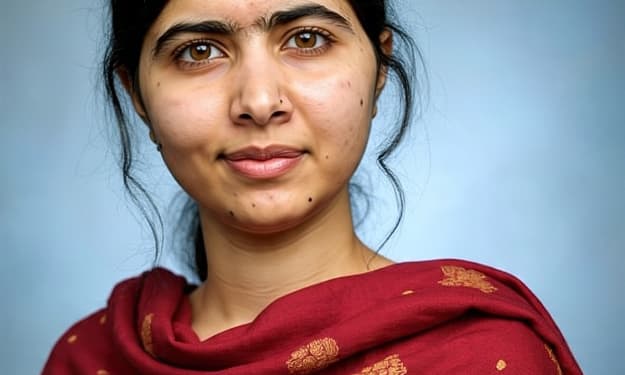
The Girl Who Refused to Sit in Silence
The story of Malala Yousafzai does not begin with the flash of cameras, the thunderous applause of the United Nations, or the weight of a Nobel Peace Prize medal around her neck. It begins much more quietly, in a place where the mountains scraped the sky and the rivers ran clear and cold.
By Frank Massey 2 months ago in Motivation



Comments
There are no comments for this story
Be the first to respond and start the conversation.