
Tie Your Camel: A Lesson in Faith and Responsibility
How one young man learned the hard way that trust in God must walk hand-in-hand with human effort.

The Lesson of Tying the Camel
BY:Khan
Professor Shakeel Siddiqui, the Islamic Studies teacher, entered the classroom with a gentle but authoritative presence. In his hand was a well-worn book, pressed firmly against his chest. He placed it on the desk, adjusted his spectacles carefully on the bridge of his nose, cleared his throat softly, and looked around at the tenth-grade students.
“Today,” he began in a calm, steady tone, “I will tell you a story that may guide you for the rest of your lives.”
The room fell silent. Curiosity lit up the eyes of every student. What could be so important that their teacher spoke with such gravity?
He started narrating:
“Once, a Bedouin came to the Prophet Muhammad ﷺ. He greeted the Prophet respectfully and said, ‘I have traveled from far away. I am hungry and thirsty, and so is my camel.’
The Prophet ﷺ asked him, ‘Where is your camel?’
‘Outside,’ the man replied. ‘I left it there, trusting in Allah.’
The Prophet ﷺ asked him again, ‘Did you tie its legs so it would not run away?’
The Bedouin shook his head. ‘No, I relied on Allah alone.’
The Prophet ﷺ advised him gently, ‘Go, tie your camel first, then place your trust in Allah.’
The Bedouin obeyed. After securing his camel, he returned, and the Prophet ﷺ arranged food and drink for him.”
Professor Siddiqui paused, pacing slowly near the blackboard, letting the lesson settle into their minds.
“From this short story,” he explained, “we learn that trusting Allah is essential, but fulfilling our responsibilities comes first. If someone prays for success in exams but never opens their books, how can they expect to succeed?”
The class nodded in agreement. Most were thoughtful—except Waheed. His mind was elsewhere. Instead of the story’s wisdom, he was lost in excitement about a wedding he had to attend that evening, followed by a cricket match the next morning.
That evening, Waheed asked his mother, “When are we leaving for the wedding?”
She sighed. “My health isn’t good. You and your sister Salma should go with your uncle Shakir. Your father dislikes late nights, so it’s better if you go with family. If it gets too late, stay at your uncle’s place and return tomorrow. It’s Sunday, so there’s no school.”
Waheed nodded. By nine o’clock, he rode his motorcycle to his uncle’s house. The family was ready, and soon they drove to the wedding in Uncle Shakir’s car.
The festivities stretched deep into the night. The bride’s procession arrived at 12:30 a.m., the nikah was performed at 1:00 a.m., and dinner was served by 1:30. By the time everyone returned home, it was nearly 2:30 a.m.
Everyone was exhausted, including Waheed. His eyelids were heavy, but the thought of the morning cricket match kept him restless.
“Stay here tonight,” Uncle Shakir suggested kindly. “It’s too late to travel. The roads are not safe at this hour. Anything could happen.”
But Waheed was stubborn. “It’s fine, uncle. The road is straight. I’ll reach home quickly. Allah will protect me.”
Despite his uncle’s warning, Waheed picked up his helmet, started his motorcycle, and sped off into the night.
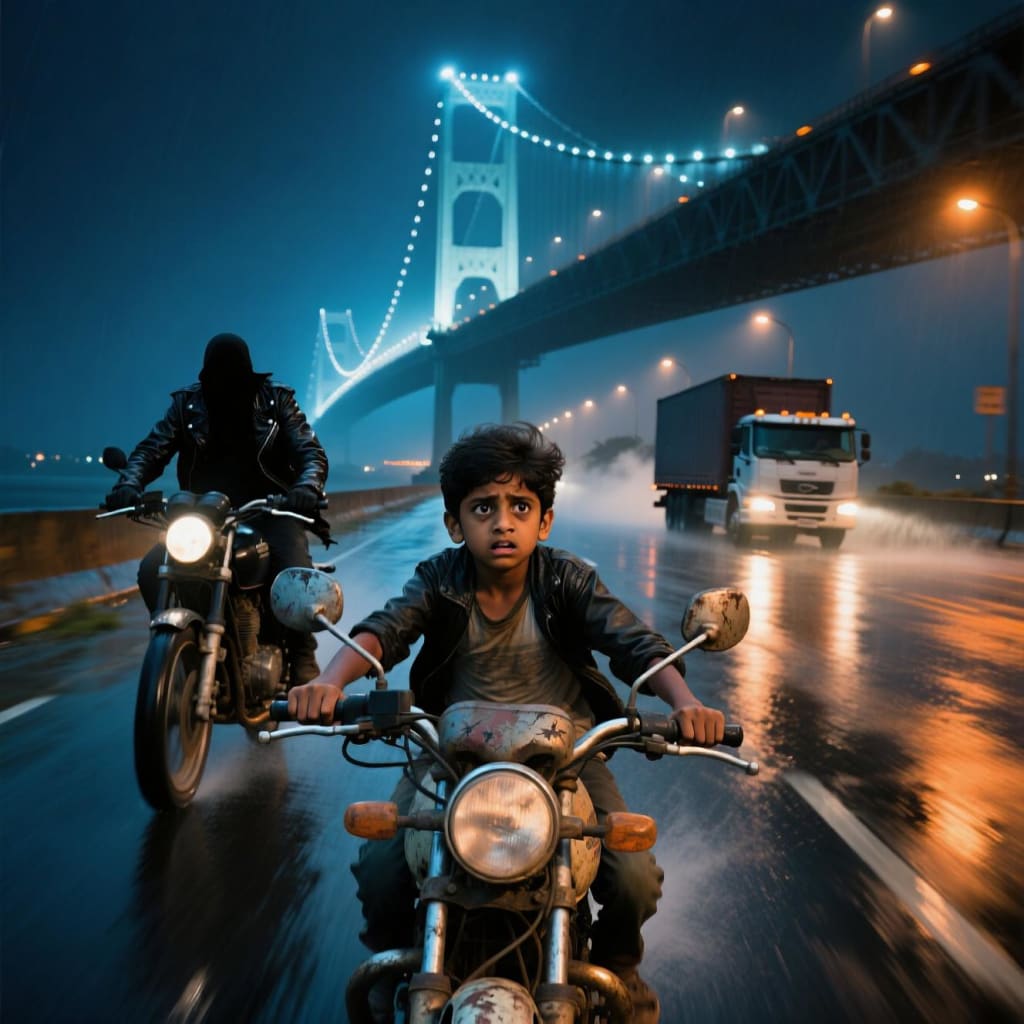
After only half a mile, he noticed another motorcyclist tailing him. The rider looked suspicious—dressed in a leather jacket and pants, barely twenty-two, with the hardened look of someone who lived on the edge of crime. The stranger didn’t speak but tried to overtake him several times, shadowing his every move.
Waheed’s heart pounded. His hands grew slippery with sweat as he tightened his grip on the handlebars.
The road ahead was eerily empty. On the left stood a long bridge. Occasionally, a milk truck passed by this road at night, heading into the city for morning deliveries.
Fear surged through Waheed. Quietly, he began reciting Quranic verses, whispering prayers for protection: “O Allah, save me. You are the Most Merciful.”
Then, out of the darkness, headlights from a truck flashed directly into his eyes. Squinting against the blinding light, Waheed veered sharply left and accelerated onto the bridge.
The suspicious rider was blocked momentarily by the passing truck. That brief interruption gave Waheed his chance. He pushed his motorcycle harder, racing across the long bridge without daring to glance back.
When he finally risked a look over his shoulder, the stranger was gone. Whether he had given up or been delayed, Waheed didn’t care. Relief flooded his chest.
By the time he reached his uncle’s apartment building, his entire body was drenched in sweat. His trembling fingers rang the doorbell. Uncle Shakir opened the door, stunned.
“What happened?” he asked in alarm.
Waheed recounted everything, his voice shaky.
Uncle Shakir shook his head gravely. “Didn’t I tell you to stay here? You ignored me. You didn’t tie your camel, Waheed—you relied on Allah without taking precautions. That was foolish.”
Waheed lowered his head, too ashamed to respond.
Two days later, when Waheed returned to school, he shared the harrowing story with his friends. The news reached Professor Siddiqui, who approached Waheed during break.
“You remember the story I told the class?” he asked, looking directly into Waheed’s eyes. “It seems you did not listen carefully. You forgot to tie your camel before trusting Allah.”
Waheed had no words. He stood in silence, guilt pressing on his heart.
For the first time, he understood the true meaning of the Prophet’s advice.
About the Creator
Keep reading
More stories from Khan and writers in Motivation and other communities.
Richer Than the Rich: Shehzad’s Lesson in Gratitude
Richer Than the Rich: Shehzad’s Lesson in Gratitude BY:Khan The smoky aroma of kebabs lingered in the air, making Shehzad’s empty stomach ache with hunger. Seated in his usual spot outside the restaurant, he watched with longing as platters of seekh kebabs and shami kebabs were served to wealthy customers. Inside a gleaming car parked near the entrance, Seth Fareed, a prominent businessman, savored a plate full of kebabs with hot bread, while his young son—about Shehzad’s age—enjoyed creamy malai boti.
By Khan 4 months ago in Motivation
The Body’s Silent Needs
The morning started like any other. I left my apartment before sunrise, the streets half-empty and lined with the faint scent of damp asphalt. Mist curled along the pavements and around streetlights, softening the edges of the city. I walked slowly, noticing the small details I usually ignored—the sound of shoes on wet pavement, the distant hum of a bus engine, a stray cat moving along a fence.
By Talha khan7 days ago in Motivation


Comments
There are no comments for this story
Be the first to respond and start the conversation.