
THE STORY OF THE WOLVES, THE SHEEP AND WHO WILL I BE IN THIS GAME?
Learn from wolves

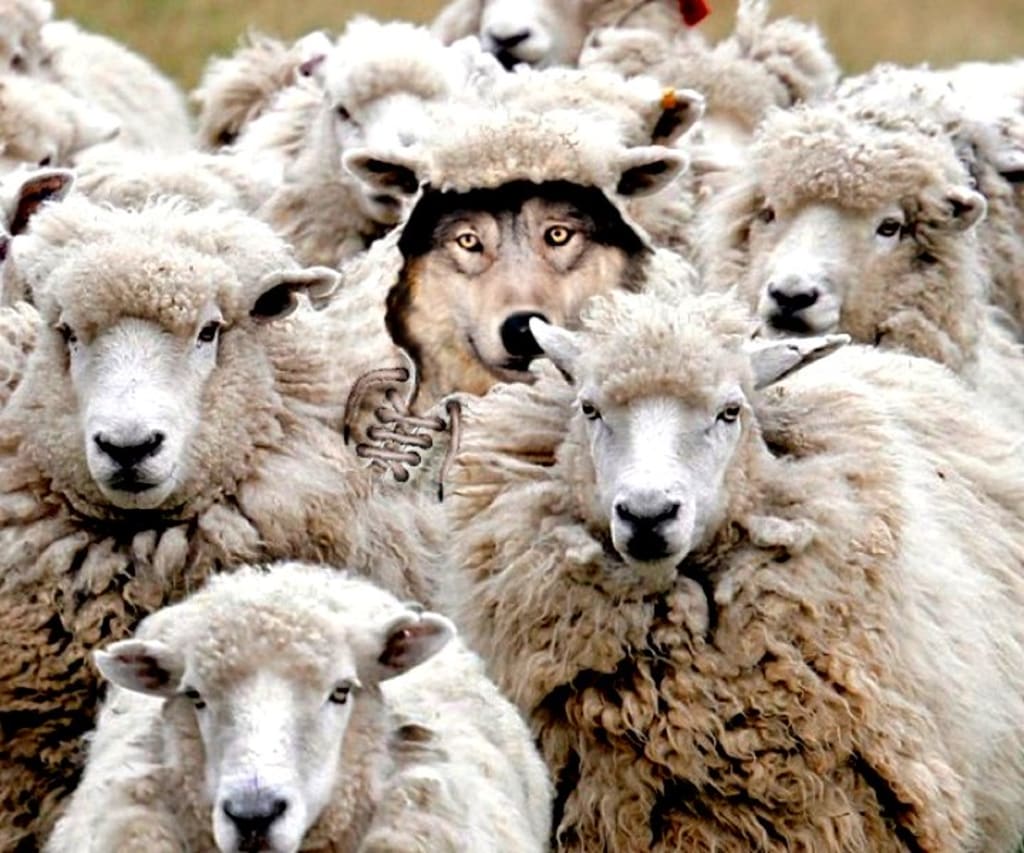
Re-entering a field that seems to be my “home ground”, familiar and understanding the way back, but this re-entry is a difficult challenge, the field of investment - finance. The more I step, the deeper I go into this maze, the more I see its layers, mixed between virtual and real, the more I see my limited understanding. Every game has its “rules”, without “rules” the game will be disorganized and no one can play with each other. But where do “rules” come from and how can we understand them? The question seems easy, that theories, legal regulations… and then from the institutions that have the right to issue laws, the main institutions in the market… will be the answer! But in reality, in this maze, we seem to not find the real “rules” anywhere, and even less know who created these “rules” and it is even more difficult to know who will monitor our compliance with the rules. Struggling with tension, that was the first feeling when I was faced with my first “problems” that needed to be solved. The first tension came from having to always position everything to identify my solutions based on all the “variables”. The problem needs to be solved in a dynamic state with a series of constantly changing variables, and many of those variables are impossible to predict. The next tension comes from the feeling of a Sun Wukong who wants to get out of the Buddha's palm but can't, a feeling of a serious lack of knowledge, not the theoretical knowledge of a technical nature, but the knowledge to understand the hidden layers of that maze, the knowledge to be able to locate oneself. And the final tension is having to always maintain oneself, with steadfastness and an indomitable will of the game.
What does the story have to do with wolves and sheep? We often use the above two images as metaphors for two hidden meanings that, without needing to be repeated, we all understand here. In this field, at first glance, it is not difficult for us to see a clear distinction between “wolves” and “sheep”, but the truth is that few people really know which are real wolves and which are real sheep. There are many wolves in sheep’s clothing and also many sheep in wolf’s clothing. In this field, there is no place for real “love”, nor is there such a thing as “kindness”, there is only “survival”, a battle between the strong and the weak, a battle to see who survives, who is the master of the game, who can really “eat” who. Is it too dramatic? To be able to understand the story and return to the question, which is also the topic, let’s continue the story. In this field, the more I "feel like I can understand", the more I realize the meaning of the so-called "real investment". Only by diving in, can I understand the "inability" of many leaders in directing the economy to invest in which projects, which fields, and when... Have we ever suddenly asked ourselves, why are people with money willing to invest in "really redundant" and "absurd" things when there are many things that need investment and are more meaningful and "more effective" that they do not invest in? The real estate market is the first proof, then the fields of "information technology, digital content industry, e-commerce", and starting with infrastructure. There are thousands of reports, articles, seminars, explaining the reasons for investing, with convincing arguments, eloquent evidence in numbers, with theories from a series of experts, great minds such as in the real estate field for example. But then, like a joke, the story of the climaxes and collapses of bubbles related to real estate keeps happening over and over again, from one country to another, even repeating from one time to another. Are people not qualified enough to understand and learn from experience? Or, is there something hidden behind these stories, like an "addiction" that no one can resist, regardless of the fact that people can see the obvious consequences, aware of what can happen to them?
The story of the wolves and the sheep continues. It is clear that we see that, in reality, the wolves always eat the sheep, and the sheep have no way to effectively resist the attacks of the wolves, if anything, there are only a few temporary "successes", so why do the sheep still exist and develop, only to give themselves to the wolves to eat? The answer will often be "that's how nature created it"! To visualize at a higher level, we will interpret and tell a new story about the wolves and the sheep in this aspect. Obviously, the first thing to see is that the wolves never intend to destroy all the sheep immediately, if they do, after eating all the sheep, where will there be any sheep left to eat. The wolves will need to limit themselves to a certain extent to ensure that the sheep can still “restore” the number of sheep in the flock, but also not let it produce too many, because that will affect the “living conditions” of food, space… Depending on the situation, in each situation, condition and time, the optimal number of sheep will be planned by the wolves. If the number of sheep falls below the allowable level, the wolves must stop attacking, and even some will need to disguise themselves as sheep to lure the sheep into ways to fight against the wolf pack’s attacks to preserve their strength, as well as ways to “earn a living” to develop the flock again. Let’s return to the story of investment – finance!
The real estate sector is just one of many “sheep” of the “wolf pack” of financial investment. However, is there something that makes this field the most attractive, accounting for the highest proportion of the financial world's investment "objects"? Answering this question will also help us begin to find clues for other similar answers, and at the same time find some clues to financial investment games. Humans have three most basic needs, which are food, clothing, and housing. Of these three needs, the need for food is limited by human capacity to receive the most, and so is the need for clothing, but the field of housing is almost unlimited, and can even be said to be endless. People can live without needing anything except the three basic needs above. Commodities can only become real commodities when they are traded, Marx said so, and it is always true. But this transaction can only arise when people really have needs, and here it is not limited to the real meaning, but people can also imagine needs, regardless of whether people really need it or not. Therefore, real estate has been chosen, and it has truly become a great "sheep" of the "wolf pack" of financial investment. People have created all kinds of reasons, all kinds of imaginable things to develop this market. And because everyone needs it, it has truly become meaningful for influencing the psychology of ownership and speculation of everyone. It is also difficult to come up with a standard to determine the value of these real estates. Its value only depends on the relationship between supply and demand, and here the story of "creating demand" is too easy to do. Just stimulate demand, you can multiply it up to hundreds of times. No wonder each square meter of housing in Hanoi is among the most expensive in the world, while our per capita income is still at the world's lowest level. There is nothing so wonderful as to create wonderful virtual "materials" for the financial world to conjure magic like "magicians" conjure magic to turn metal into gold, except here they turn it into real gold. A whole prosperous world is created on "illusionary" foundations, and it becomes the leverage for goods for the financial world to continue creating its flocks of sheep.
The wolves also understand that they are not just a flock, and neither are the sheep. When they nurture their flock to grow, they must also determine that their flock will also be the target of attacks from other wolves. The war is now not just two sides but many sides, the wolves also understand that they cannot directly stand up to protect their flock, because that would be revealing an unspeakable secret to the sheep and the wolves cannot attack each other directly like that. They need another plan. The wolves discovered that grasslands have a decisive meaning for the survival of the sheep, so whoever owns the best grasslands also means that they will have the most influence on the sheep. Owning grasslands does not mean that the wolves are targeting the sheep, it is simply that they are protecting their territory.
Obviously, the real estate sector has a crucial meaning in the financial investment game. They create the material and leverage for financial games, regardless of the time, prosperity or crisis. However, because there will always appear other wolves that also target their sheep, the wolves are forced to have other means of protection. A field that seems far from real estate, but in fact is closely linked and meaningful like pastures to sheep, that is the energy field. Indirectly, major energy sources such as oil and coal play an important and decisive role in creating raw materials and conditions for building and developing real estate. Initially as a purely material input source, the energy field increasingly plays the role of a fundamental lever for the development of the real estate sector under the "magic" hands of financial "alchemists". Energy revenues are reinvested in real estate, we can see quite clearly the large-scale real estate projects in the Gulf region, for example, which is a pretty clear proof. But it must be affirmed that real estate is still the main target of the financial world. Why is that? Because energy does not really exist “in existence”, we cannot “store” it in the sense of “saving”, it only has value when used, that is, it needs to be consumed, but real estate is not like that. You can leave it as it is, regardless of whether it is used or not, it still has value, based on the supply and demand game that is created. Therefore, for money to truly be money and generate money, energy revenues must continue to be invested in real estate. This spiral will continue to accelerate, creating tremendous added value for the financial game. We will continue to delve into this issue in another article. In addition to the pasture, there is another thing that plays an equally important role, not only for the sheep but also for the pasture, which is the water source. Going back in the story, the wolves discovered how magical it is to own a water source. The sheep can go without food for a few days, but they cannot go without water for a few days. The pasture without water cannot grow and survive. Well, then, if they also own a water source, the control of the wolves will be even stronger, and even just owning a water source can have a strong impact on the sheep and the pasture. But unlike the pasture, it can be divided into a zone, the water source often flows through many different zones and in reality, no one can really “block” the water source to control it. The wolf packs need to have cooperation with each other.
The story comes to this point, can you imagine what that water source is? That is the transportation system and transportation infrastructure. Without a smooth transportation system, energy cannot be transported to the places that need it and create value. Real estate is the same, it will not really have value and meaning. The transportation infrastructure system has made everything smooth and not only that, it increases the value of energy and real estate. It is clear to see how valuable a newly opened or expanded road is to the increase in the value of real estate. However, at this point, the story adds a third character, which we will temporarily know and analyze in depth later, that is the State. With the level of importance gradually increasing from real estate, to energy and then to transportation infrastructure, the role of the State is increasingly higher. The State manages real estate to a limited extent, mainly in terms of planning and safety conditions, but the State manages energy issues much more closely, deeply intervening in all activities from licensing exploitation, exploitation, production and business... and in the infrastructure sector, it is often a monopoly through the "communist" forms of infrastructure systems in many different variations in each country. What will the financial world do? Just as wolves need to cooperate with each other to control water resources, so does the financial world. Investing in infrastructure is often very expensive and risky in terms of liquidity. Therefore, it also needs a place to "push" it when this "prey" is not very "delicious". The State here has a great meaning to do that. The financial world has agreed together to control the transport infrastructure system through the role of the State. Do they control the state? Yes, that is essentially true, and depending on each state institution, along with its level of development, the sophistication of this control is expressed in how.
With a flock of sheep abundant to provide food for themselves, the wolves no longer worry about quantity, but if they stop there, it seems that everything starts to become boring. The dish now needs to be more delicious, the story of processing lamb is started to think. And like the processing of all dishes, it essentially starts with and is essentially from spices. The wolves need to think of spices that can make the lamb more delicious and with each spice there will be appropriate ways of processing. Among the spices, salt has the most important meaning, and whoever controls salt can really create a very large added value.
What is the spice of the financial world? It is the information and telecommunications system. Thanks to the information and telecommunications system, everything started to become more special, whoever owned the information and had a good telecommunications system, he could get ahead of others. There is a story about British bonds and because of owning an effective communication system, the Roschild family mastered the game, became the one who held the most British bonds, at the cheapest price and later, thanks to that, until now, is the one who really controls the financial system of England. Through the information and telecommunications system, the story of creating added value based on real estate, energy, transport infrastructure was accelerated rapidly, and not only did it increase in speed, it also led to a tremendous increase in volume, thanks to shortening the time of alchemy and affecting a larger, faster mass of recipients. Media has truly become a pillar of the modern financial world. It is a magical "spice" that allows the financial world to prepare increasingly diverse and faster financial "dishes".
If we continue the story of the wolves and the sheep, it seems like it will lead us to infinity. Yes, with the usual thinking, but basically, the main pillars have been created, and the other things will just be “dishes” to be prepared. So is this the end? No, there is still one last thing, something infinite, but the core of it all, which is the thought. The wolves, when their basic needs are satisfied, will return to the most important thing, their consciousness. And the story now is that whoever controls the thoughts of the wolves, will control everything. We are human beings, and therefore, all the things we do come from our own thoughts. It is the way we think that determines everything. If we do not think that house is necessary, then it will be meaningless to us in any way, and therefore it will have no value. But if we think that it is necessary, then even if in reality it is worthless, we will still consider it valuable and we actually create value for it, a value not from its existing nature, but from our own thoughts. If we say that what creates the greatest added value, it is the thoughts of people. And the future of financial investment will be the game of investing and controlling people's thoughts.
Back to the question which is also the title of the article, there is another side, who will I be in this game? I have positioned myself, I will be the thinker of the "wolf pack". That is also the manifestation of intellectual power.
About the Creator
HieuDinh
- Loves nature, likes to grow ornamental plants such as succulents, lotus (participates in volunteer activities to plant forests, protect forests in the locality)
- Loves dogs and cats (participates in local wildlife rescue activities)
Keep reading
More stories from HieuDinh and writers in Motivation and other communities.
CRYSTAL SUCCULUM
Crystal succulents have an impressive and extremely eye-catching appearance. Therefore, the plant is widely used in decorating living and working spaces. However, to maintain the beauty of this plant, you need to know how to take care of it properly.
By HieuDinh2 months ago in Motivation
The Power Within the Mind
In the quiet town of Riverbend lived a young man named Adam who believed his greatest enemy lived inside his own head. From the outside, his life looked ordinary—he worked at a small printing shop, greeted customers politely, and returned each evening to a modest apartment overlooking the river. But inside Adam’s mind, there was constant noise: worries about the future, regrets about the past, and a steady stream of negative thoughts that told him he was never good enough. Adam’s thoughts controlled his emotions, and his emotions controlled his actions. When he thought he would fail, he avoided trying. When he imagined rejection, he withdrew from people. Slowly, his world became smaller—not because of circumstances, but because of the thoughts he allowed to rule him. One rainy afternoon, while delivering a stack of printed flyers, Adam took shelter in an old bookstore he had passed many times but never entered. The bell above the door chimed softly as he stepped inside. The smell of aged paper and ink filled the air, strangely comforting. Behind the counter sat an elderly man with calm eyes and silver hair, reading as though time itself had paused. “Looking for something?” the man asked gently. “I’m just waiting for the rain to stop,” Adam replied. The old man smiled. “Sometimes we walk into places for reasons we don’t yet understand.” Adam wandered through the narrow aisles until one book caught his attention. Its cover was plain, with a single line written across it: You Are Not Your Thoughts. Curious, Adam brought it to the counter. “That one finds the reader,” the old man said. “Not the other way around.” Adam hesitated. “What does that even mean?” “It means thoughts are like clouds,” the man replied. “They pass through the sky of your mind, but they are not the sky.” Adam bought the book and left as the rain eased. That night, he opened it expecting complex theories, but the writing was simple and clear. It spoke about awareness, about observing thoughts instead of obeying them, and about the hidden power that comes from choosing where to place attention. One line struck him deeply: You cannot always control what appears in your mind, but you can control what you believe and act upon. The next morning, Adam decided to experiment. As he prepared for work, a familiar thought appeared: You’ll mess up today. Normally, he would accept it as truth. This time, he paused. “That’s just a thought,” he said quietly. It felt strange, almost uncomfortable, but also freeing. The thought lost some of its weight. At work, when a customer complained, Adam noticed his mind shouting, You’re useless. Instead of reacting, he took a breath and watched the thought pass. He responded calmly, solved the issue, and realized something remarkable—his day didn’t collapse because he didn’t let his thoughts control his actions. Days turned into weeks, and Adam practiced daily. Not perfectly—some days the old patterns returned strongly—but he was learning. He began to understand that the mind was like a wild horse. If left unchecked, it would run anywhere. But with patience and practice, it could be guided. One evening, Adam returned to the bookstore to thank the old man, but the shop was gone. In its place stood an empty building with a “For Rent” sign. Confused, Adam asked a nearby shopkeeper. “That bookstore?” the shopkeeper said. “Closed years ago.” Adam felt a chill, but instead of fear, he felt clarity. The lesson mattered more than the messenger. As Adam’s control over his thoughts grew, so did his life. He applied for a better position at work—something he would have never dared before. When fear whispered, You’re not ready, he answered, I can learn. When doubt said, You’ll fail, he replied, Maybe—but I’ll try. He didn’t eliminate negative thoughts; he changed his relationship with them. They became signals, not commands. Adam also noticed how his thoughts shaped his relationships. When he assumed others judged him, he acted distant, which pushed people away. When he chose thoughts of openness and curiosity instead, connections formed naturally. His world expanded again. One day, Adam met a young boy sitting alone by the river, staring into the water with heavy eyes. “What are you thinking about?” Adam asked. The boy shrugged. “That I’m not smart. My teacher said I’m slow.” Adam sat beside him. “Thoughts can lie,” he said gently. “Just because a thought shows up doesn’t mean it’s true.” The boy looked up, surprised. “Really?” “Really,” Adam said, smiling. As the sun set, Adam realized how far he had come. The power he once searched for outside—confidence, peace, control—had always been within him. It was hidden behind layers of unchecked thoughts, waiting to be discovered. He understood now that controlling thoughts didn’t mean fighting them or forcing positivity. It meant awareness. Choice. Direction. And in that quiet awareness, Adam found freedom—not from thoughts, but from being ruled by them. From that day on, whenever life felt heavy, Adam returned to one simple truth: I am the thinker, not the thought. And that made all the difference.
By The best writer a day ago in Motivation



Comments
There are no comments for this story
Be the first to respond and start the conversation.