
THE PEOPLE’S PRINCESS – The Life & Legacy of Diana, Princess of Wales
Lady Diana

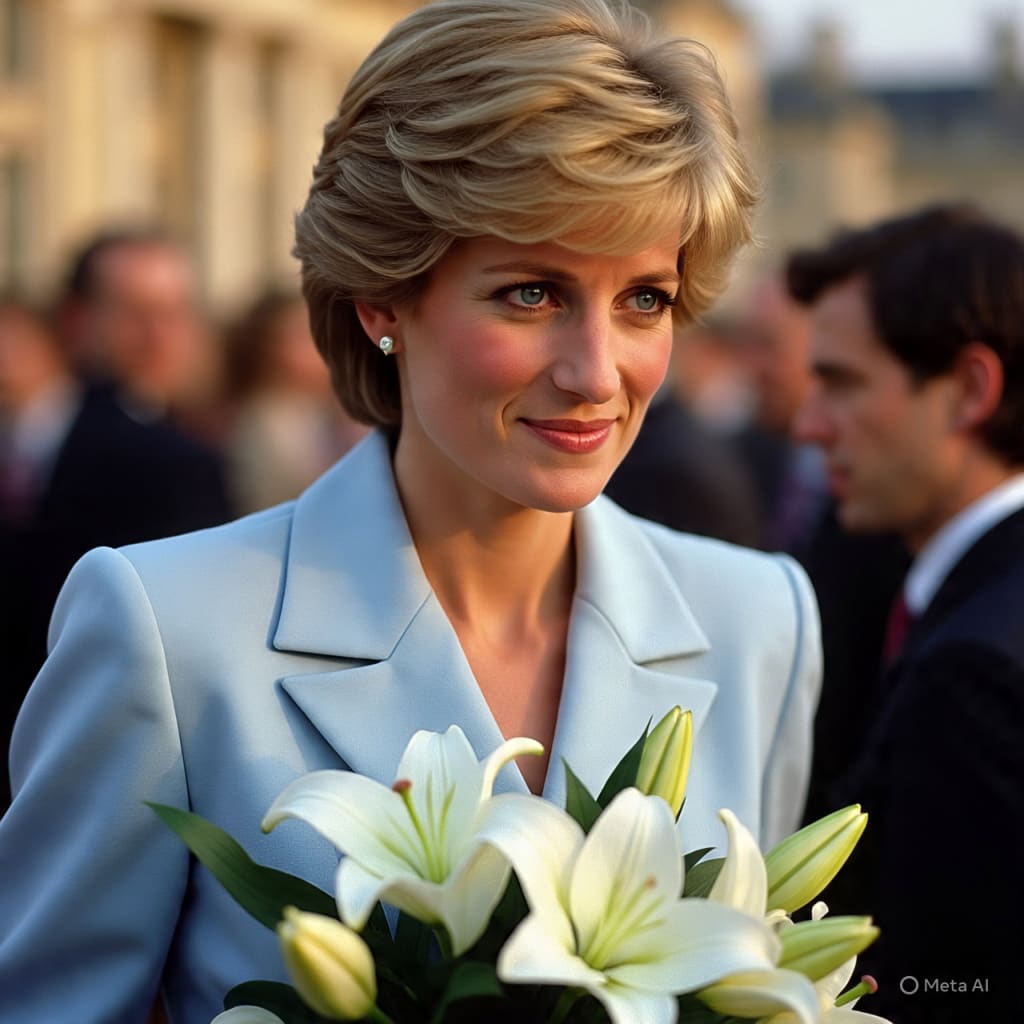
Prologue – Paris, August 31, 1997
The streets of Paris were still warm from the summer day, the night air heavy with the perfume of rain on stone. A black Mercedes glided through the Pont de l'Alma tunnel along the Seine, its engine low, its windows tinted against the intrusive flashes outside. Inside, Diana sat in the back seat, her head tilted slightly toward the man beside her, a faint, private smile curving her lips. Outside, the world was watching, hunting — the motorbikes swarming like shadows in the glow of the city lights.
It should have been just another night.
It should have been safe.
But fate was impatient.
In the space between two heartbeats, headlights flooded the tunnel, an echo of screeching tires, a sickening twist of metal — and the kind of silence that swallows the world whole. Somewhere above, the Eiffel Tower kept shining, indifferent to the tragedy unfolding beneath its watch. And in those final seconds, Diana, the girl who had once been a shy nursery teacher, was no longer just a princess. She was about to become a legend.
Chapter One – A Shy Girl with Big Eyes
Diana Frances Spencer was born on July 1, 1961, in Sandringham, Norfolk — a tiny village whose name whispered of English tradition. She came into the world in Park House, a home leased from Queen Elizabeth II’s estate, just a short walk from the royal family’s residence. It was an ironic twist of geography: even as a child, she was literally growing up in the Queen’s shadow.
Her family was aristocratic but far from the fairy-tale ideal. Her father, John Spencer, Viscount Althorp, was a quiet, reserved man; her mother, Frances Roche, was beautiful, glamorous, and restless. The marriage was troubled, and when Diana was just seven, her mother left, tearing the family apart. Diana stayed with her father but never forgot the ache of that early loss.
She was shy, so shy that when strangers spoke to her, she often lowered her head, her blonde hair acting as a curtain between her and the world. But she had something magnetic about her — a kindness that wasn’t loud, but was deep and real. She loved children, animals, and dancing in her bedroom to pop records.
Her childhood dream? To be a ballerina.
Chapter Two – The Making of a Princess
At sixteen, Diana was sent to a Swiss finishing school — the kind where young women learned French, skiing, and the art of polite conversation. She wasn’t particularly academic, but she had grace, humor, and warmth. After returning to London, she worked as a nanny, a dance instructor, and eventually as a nursery assistant.
This was where life’s script took a sharp turn.
Prince Charles, the heir to the British throne, had been dating her older sister, Sarah. The romance fizzled, but Charles remembered Diana — the shy, fresh-faced girl who had said something that stayed with him after his beloved great-uncle, Lord Mountbatten, was killed: “You must be so lonely. I thought you needed someone to look after you.”
Their courtship was swift, almost surreal. Diana was just nineteen when Charles proposed in February 1981. She accepted, but even then, she confessed to friends she felt like “a lamb to the slaughter.”
Chapter Three – The Wedding of the Century
On July 29, 1981, the world watched as Diana walked down the aisle of St. Paul’s Cathedral in an ivory silk gown with a twenty-five-foot train — a dress that seemed to stretch straight into history. Over 750 million people across the globe tuned in, holding their breath as she said “I will.”
It was a fairy tale — or so it seemed. Behind the scenes, cracks were already forming. The age gap, the different worlds they came from, and, most of all, the looming presence of another woman — Camilla Parker Bowles — cast a shadow over the marriage.
Chapter Four – Motherhood & the People’s Princess
Diana threw herself into her role as Princess of Wales, but she found her true joy in motherhood. When Prince William was born in 1982, she broke royal tradition by taking him on royal tours, refusing to be the kind of mother who saw her children only at bedtime. Prince Harry followed in 1984, and her devotion to them became legendary.
She also began to redefine what it meant to be royal. She shook hands with AIDS patients without gloves when fear and stigma were at their height. She knelt to talk to children, walked through minefields to raise awareness for landmine victims, and used her fame to shine light into society’s darkest corners.
The public loved her for it. The media adored her — and devoured her. Paparazzi chased her relentlessly, and every glance, every tear, every dress became front-page news.
Chapter Five – Cracks in the Crown
By the early 1990s, Diana and Charles were living separate lives. The public fairy tale had crumbled into a painfully public drama. In 1992, Prime Minister John Major announced their separation.
Then came 1995 — and the interview that shook the monarchy. Sitting with journalist Martin Bashir for BBC’s Panorama, Diana’s voice was calm but her words were seismic:
“There were three of us in this marriage, so it was a bit crowded.”
That one sentence became one of the most famous in modern history.
Chapter Six – Freedom & New Love
After her divorce in 1996, Diana was no longer “Her Royal Highness,” but she was more famous than ever. She used her freedom to deepen her humanitarian work — visiting hospitals, orphanages, and minefields in Angola. She became close to heart surgeon Hasnat Khan, whom she called “Mr. Wonderful,” and later began a romance with Dodi Fayed, the son of billionaire Mohamed Al-Fayed.
The summer of 1997 was one of movement and sunlight for her — yachts on the Mediterranean, charity work, and the hopeful glow of a woman who seemed to be carving out a second chapter of life.
Chapter Seven – The Final Night
On August 30, 1997, Diana and Dodi arrived in Paris from the French Riviera. They dined at the Ritz Hotel, but when the press swarmed, they decided to head to Dodi’s apartment. To avoid the photographers, their driver took the Pont de l’Alma tunnel.
At 12:23 a.m., the car crashed. Dodi and the driver, Henri Paul, died instantly. Bodyguard Trevor Rees-Jones was the only survivor. Diana was rushed to Pitié-Salpêtrière Hospital, but despite hours of effort, she was pronounced dead at 4 a.m. She was 36 years old.
Chapter Eight – The World Wept
News spread like wildfire. Crowds gathered outside Kensington Palace with flowers, letters, and candles. In the days that followed, millions lined the streets for her funeral. Elton John sang “Candle in the Wind,” rewritten in her honor, and her brother, Earl Spencer, delivered a eulogy that spoke of her “extraordinary and irreplaceable” spirit.
Chapter Nine – The Legacy Lives On
Diana’s legacy is carved into the heart of modern humanitarianism. She humanized the monarchy, broke down stigmas around AIDS and leprosy, and inspired a new style of royal engagement. Her sons carry her spirit forward — William through his work on mental health and homelessness, Harry through his causes for veterans and his stance on media intrusion.
To this day, her name evokes not just a princess, but a woman who dared to live — and love — on her own terms.
And so, the shy girl from Sandringham, the young woman who once dreamed of being a ballerina, remains forever the People’s Princess.
About the Creator
Frank Massey
Tech, AI, and social media writer with a passion for storytelling. I turn complex trends into engaging, relatable content. Exploring the future, one story at a time
Keep reading
More stories from Frank Massey and writers in Motivation and other communities.
From Shadows of Survival to Global Icon: The Untold Epic of Jackie Chan
Prologue – The Cannonball That Wouldn’t Stop Rolling Hong Kong, April 7th, 1954. The city was a restless symphony — hawkers shouting over the clang of tram bells, the air heavy with the scent of street noodles, incense smoke, and salt from Victoria Harbour. Inside the cramped French Hospital, a young mother gritted her teeth, her knuckles white as she clutched the bedrail. Her husband, Charles Chan, stood beside her, wearing the wrinkled chef’s uniform he’d rushed over in.
By Frank Massey 5 months ago in Motivation
“The Man Who Never Missed a Day”
When I was 17, I met a man who delivered newspapers in the rain. Not in a casual, half-hearted way—but fully committed, every single morning. He would leave his house before sunrise, his coat soaked, shoes falling apart, and the wind cutting through him like a knife. Yet, despite the cold and wet, he smiled at everyone on his route. To a teenager like me, it was both confusing and inspiring. I remember the first time I saw him struggle with a bundle of papers that seemed almost too heavy for him. He slipped on the wet pavement, muttered something under his breath, and kept walking. When he reached the next house, he knocked on the door, handed over the paper, and smiled as the door closed. That smile was strange to me—it wasn’t pride or satisfaction, it was… calm. Almost peaceful. Curious, I approached him one morning. “Why don’t you take a day off when it’s so hard?” I asked, shivering in my hoodie as the rain soaked me through. He laughed, a deep, gravelly sound that didn’t sound annoyed, only knowing. “Son, nobody cares about today,” he said, shaking his head. “What matters is tomorrow. You build your life the same way: one small effort, every day, even when nobody notices.” At the time, I didn’t understand. My life felt urgent, like it had to explode with success immediately. I was chasing big ideas, jumping from project to project, leaving most half-finished. I thought motivation was everything—without the spark of inspiration, nothing mattered. The idea of showing up every single day, even when tired, even when bored, even when invisible, felt almost insane. I watched him for weeks. Rain or shine, he was there. I started noticing small details I hadn’t seen before—the careful folding of the papers, the way he adjusted his wet coat to protect the bundle, the extra minute he took to smile at a child running out to grab the paper. Every morning, the same ritual. Every morning, the same effort. And yet, nobody cheered. Nobody noticed. Years passed. I went to college, chasing my own “big dreams,” my own versions of instant success. I started businesses, abandoned them; learned new skills, stopped halfway; made promises to myself I couldn’t keep. I told myself I was working toward greatness, but mostly, I was chasing the idea of success, not the work itself. Motivation was my fuel, and when it ran out, I stopped moving. Meanwhile, the memory of that man stayed with me. The quiet diligence, the smile in the pouring rain. I didn’t realize it at the time, but he had already taught me the most important lesson: consistency matters more than talent, and persistence matters more than inspiration. Years later, I found myself struggling. A career path crumbled beneath me, a relationship ended badly, and my confidence had hit rock bottom. I remembered the man with the newspapers. I thought about how small, invisible efforts can be the hardest to trust—because results are not immediate, and recognition is not guaranteed. Yet, he had shown me that those small efforts accumulate, slowly but inevitably, into a life that cannot be ignored. I started experimenting with this principle myself. Every morning, I wrote 500 words for my stories—even when tired, even when uninspired. I practiced my skills quietly, without posting or sharing. I did the work not for applause, but because it mattered to the person I wanted to become. Some days, it felt like nothing was happening. Some days, I wanted to give up. But then I remembered the man with the newspapers, and I kept showing up. It didn’t take long before I started noticing changes. The words I wrote flowed better, ideas connected in ways they never had before. People began noticing my work. Small victories became more frequent, and my confidence started to rebuild. What had seemed like meaningless, invisible effort had quietly transformed my life. That man never became famous. He never went viral. He had no thousands of followers, no awards, no recognition. But every paper he delivered, every smile he shared, every step he took in the rain—it all mattered. Each day of consistent effort built a life he owned completely, a life he could be proud of. I realized then that success is not a moment. It is not a sudden flash of recognition or a single lucky opportunity. Success is the sum of the quiet, consistent decisions we make when no one is watching. It’s the choice to wake up when it’s easier to sleep. It’s the decision to work when it’s easier to scroll on your phone. It’s the effort we put in when the world doesn’t applaud. And the truth is simple: showing up every day is more powerful than talent, motivation, or luck. Talent fades. Motivation fluctuates. But showing up—every single day, rain or shine—creates results you cannot imagine. Just like the man in the rain, your efforts may not be recognized immediately. People may overlook them, circumstances may feel unfair, progress may seem invisible. But over time, the cumulative effect of your daily effort will speak for itself. One day, the world will notice. One day, your consistency will transform your life. So, start today. Don’t wait for motivation. Don’t wait for inspiration. Show up. Every day. One small effort. One action. One step at a time. Let your grind be louder than your excuses. Because the man who never missed a day wasn’t special. He was ordinary. But through persistence, he became unstoppable. And so can you.
By Ihtisham Ulhaq5 days ago in Motivation



Comments
There are no comments for this story
Be the first to respond and start the conversation.