
From Shadows of Survival to Global Icon: The Untold Epic of Jackie Chan
The most followed celebrity of China

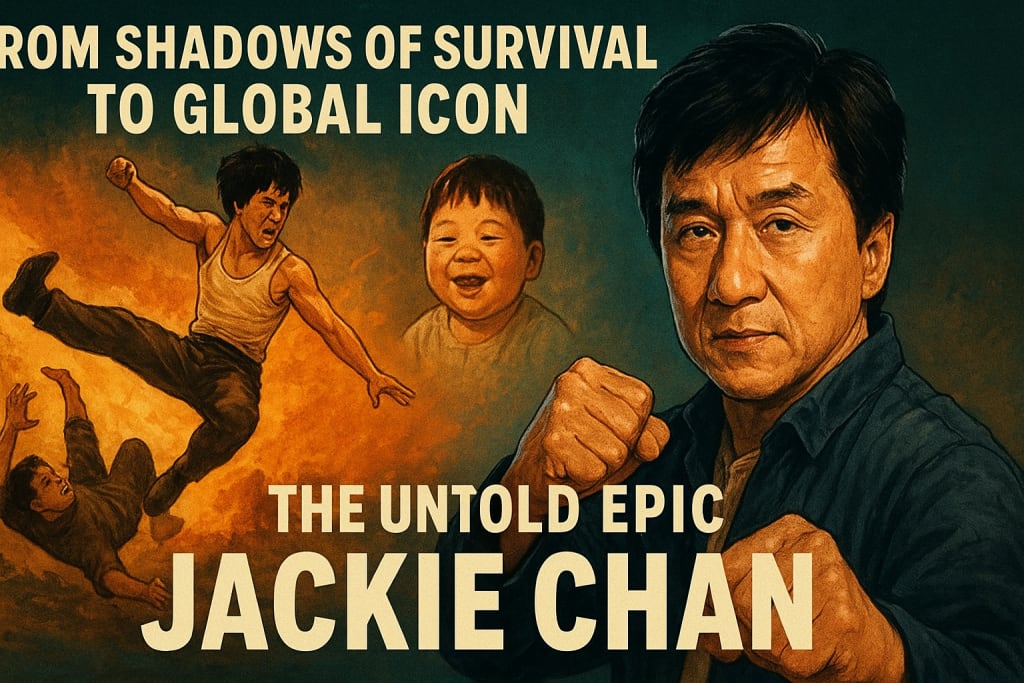
Prologue – The Cannonball That Wouldn’t Stop Rolling
Hong Kong, April 7th, 1954.
The city was a restless symphony — hawkers shouting over the clang of tram bells, the air heavy with the scent of street noodles, incense smoke, and salt from Victoria Harbour. Inside the cramped French Hospital, a young mother gritted her teeth, her knuckles white as she clutched the bedrail. Her husband, Charles Chan, stood beside her, wearing the wrinkled chef’s uniform he’d rushed over in.
A nurse emerged from the delivery room holding a red-faced baby boy — not just big, but huge for a newborn. “Twelve pounds,” she said, wide-eyed. The boy flailed his arms with surprising strength, letting out a cry so loud it startled the orderly at the door.
“He’s like a cannonball,” the midwife laughed, bouncing him gently. In Cantonese, she added, “Pao-Pao.”
Charles looked at his wife, Lee-Lee, and they smiled — exhausted, but full of pride. They named him Chan Kong-sang, meaning “Born in Hong Kong.”
No one in that room could have guessed that this restless cannonball would one day leap off skyscrapers, tumble down mountains, and turn pain into laughter for millions. For now, he was just a child in a poor family, in a city that demanded you fight for every scrap of life.
Chapter 1 – Childhood in the Margins
Jackie’s earliest memories weren’t of toys or birthday cakes — they were of cramped rooms and the constant shuffle of his parents’ work clothes. Charles Chan was the head cook at the French Embassy, a quiet man with an alert gaze that seemed to scan every room. Lee-Lee worked as a housekeeper, quick with a laugh but sharper than she let on.
What Jackie didn’t know then was that his parents carried secrets. Charles had once been a spy for the Chinese Nationalists, skilled in disguise and deception. Lee-Lee, during wartime, had risked her life smuggling opium to survive. In Hong Kong, those dangerous days were behind them — or so they hoped.
But life in the 1950s colony wasn’t easy. Hong Kong’s streets were alive with opportunity and danger in equal measure. Men gambled in back alleys; gangs ruled certain districts. Jackie spent his days chasing rubber balls through crowded markets, ducking between adults who cursed at him to watch where he was going.
By age seven, his boundless energy was becoming a problem. His parents feared he’d fall in with the wrong crowd. Then came the decision that would define his youth: Charles and Lee-Lee enrolled him in the China Drama Academy, a Peking Opera school run by the fearsome Master Yu Jim-yuen.
It wasn’t school as most knew it.
Days began at 5 a.m. with the crack of a bamboo stick on the floor. Breakfast was a simple bun and tea. The rest of the day was a relentless blur — acrobatics, martial arts, weapon drills, singing, acting, tumbling. Mistakes weren’t met with a gentle correction; they were met with the sting of the bamboo cane.
Jackie would later recall, “It was hell… but it was also where I became me.”
He met two boys there who would change his life: Sammo Hung, a stocky powerhouse, and Yuen Biao, wiry and quick. Together, they’d become the “Three Dragons” of Hong Kong cinema — but for now, they were just tired, bruised kids trying to impress their teacher and avoid punishment.
Chapter 2 – From Opera Stage to Film Set
By his early teens, Jackie’s body was a machine — muscles hardened by endless drills, joints loosened by years of stretching. He could do standing backflips, leap through hoops, and land without a sound. But the world outside was changing. Peking Opera was fading from public interest; the film industry was booming.
Master Yu began sending his top students to movie sets as extras and stunt doubles. Jackie was often cast as the anonymous thug who flew backward when the hero’s fist connected. These weren’t fake falls — they were real impacts, onto thin mats or hard floors.
“Again,” the director would say. And Jackie would fly through the air again. And again.
Money was little, but Jackie was learning the camera’s language — how to make a punch look devastating, how to angle a fall so it looked deadly. He idolized Bruce Lee, who moved like lightning and radiated control. But Jackie’s own early leading roles went nowhere.
Then, in 1974, his parents called from Australia. Work in Hong Kong was unpredictable; they wanted him with them. Jackie traded the film sets for construction sites in Canberra, mixing cement and hauling bricks. A co-worker named Jack took him under his wing, calling him “Little Jack.” Soon, everyone did. The name stuck. Jackie Chan was born.
But Australia couldn’t cage him. When an old contact from the Hong Kong film industry reached out, Jackie packed his bag and boarded a plane home.
Chapter 3 – The Bruce Lee Shadow
When Jackie returned, Hong Kong cinema was still reeling from Bruce Lee’s death in 1973. Studios wanted another icon. Jackie was strong, fast, and had the opera school’s precision. Producers tried to mold him into a Bruce Lee clone — same hair, same screams, same dead-serious glare.
It didn’t work. Jackie didn’t have Bruce’s coiled intensity. His first few starring films barely made a ripple. Audiences saw the imitation and turned away.
That’s when Jackie had a revelation:
Why try to be Bruce Lee, when I could be Jackie Chan?
Instead of the flawless warrior, he became the underdog — the guy who got smacked in the head, who slipped, who improvised in a fight with whatever was around: ladders, chairs, even his own clothes. He infused humor into combat, letting the audience wince and laugh in the same breath.
In 1978, Snake in the Eagle’s Shadow hit theatres. Jackie fought with unorthodox moves, comedic beats, and an expressive face. Audiences loved it. Later that year, Drunken Master exploded at the box office. Jackie wasn’t Bruce Lee’s successor — he was something entirely new.
Chapter 4 – The Pain of Glory
Success gave Jackie freedom, and he used it to push limits no one else dared. He took control as director, choreographer, and star. Safety wires? Too slow. CGI? Not yet. Jackie wanted real stunts — real danger.
In Police Story (1985), he leapt onto a pole wrapped in electric lights, sliding down while bulbs shattered around him, skin burning from heat and friction. He landed hard, shattering glass. The crew gasped — Jackie didn’t move for several seconds.
On Armour of God (1986), a routine jump from a wall to a tree went wrong. Jackie fell headfirst onto a rock. He was rushed to the hospital with a fractured skull. Surgeons drilled into his head to remove blood, leaving a permanent hole. He almost died.
His friends begged him to slow down. Jackie refused. “Pain is temporary,” he said. “Film is forever.”
Chapter 5 – Family Secrets
In his forties, while filming in Australia, Jackie’s father sat him down. The truth spilled out:
Their real surname was Fong. Charles had once been an intelligence officer for the Nationalist government. He’d carried coded messages, tracked enemies, and lived under false identities. Lee-Lee had been an opium smuggler before turning to domestic work.
Jackie listened in stunned silence. It dawned on him that survival wasn’t just about stunts — his parents had been living on the edge long before he had. Their quiet life in Hong Kong had been a mask.
Chapter 6 – Hollywood Breakthrough
Breaking into Hollywood was harder than any stunt. Jackie’s early U.S. films in the ’80s flopped. Directors didn’t understand his style. They wanted stunt doubles, quick cuts. Jackie wanted wide shots, full-body choreography, and comedy.
Then came Rumble in the Bronx (1995). Filmed in Vancouver but set in New York, it showcased Jackie’s signature blend of martial arts and slapstick. American audiences took notice.
In 1998, Rush Hour paired Jackie with Chris Tucker. Their chemistry was instant — Jackie’s calm precision against Tucker’s rapid-fire comedy. The film grossed over $200 million, spawning sequels and making Jackie a household name in the West.
Chapter 7 – The Man Beyond the Screen
Jackie’s success brought wealth, but also responsibility. He donated millions to disaster relief, education, and medical care. Through the Jackie Chan Charitable Foundation and Dragon’s Heart Foundation, he built schools in rural China.
Even in his 60s, Jackie still performed most of his stunts. Recovery took longer, but the cannonball refused to stop rolling.
Epilogue – Still in Motion
Today, Jackie Chan has appeared in over 150 films, holds Guinness World Records for most stunts performed, and is one of the few actors beloved in both East and West. He remains a bridge between cultures, a living legend who turned pain into joy for millions.
From a poor boy in Hong Kong to a global icon, his life is proof that falling isn’t failure — it’s just another chance to get back up.
About the Creator
Frank Massey
Tech, AI, and social media writer with a passion for storytelling. I turn complex trends into engaging, relatable content. Exploring the future, one story at a time
Reader insights
Outstanding
Excellent work. Looking forward to reading more!
Top insights
Compelling and original writing
Creative use of language & vocab
Easy to read and follow
Well-structured & engaging content
Excellent storytelling
Original narrative & well developed characters
Expert insights and opinions
Arguments were carefully researched and presented
Eye opening
Niche topic & fresh perspectives
Heartfelt and relatable
The story invoked strong personal emotions
Masterful proofreading
Zero grammar & spelling mistakes
On-point and relevant
Writing reflected the title & theme
Keep reading
More stories from Frank Massey and writers in Motivation and other communities.
THE ROCK A TRUE STORY
1. Prologue: A Pebble in the Crowd In the early 1980s, a young boy sat mesmerized in the audience of a regional wrestling arena. The cheers, the spotlight, the electricity in the air—it all fascinated him. That boy, barely seven or eight, watched as his father, Rocky Johnson, wrestled with grace and power. It wasn’t just wrestling—it was storytelling through strength and charisma. This moment planted a seed deep in the boy’s heart: the desire to step into the ring was both inherited and inevitable.
By Frank Massey 5 months ago in Motivation
You are not a failure
“ You look sad, David, what’s going on?” the old man noticed, as David pulled out a chair when he entered the room. “ When I look at my life, I’m not happy. Nothing is working. I’m forty-three. I have no house, no money, no kids. I make minimum wage at my job to survive. Not to mention the credit card debts and some health issues. I think that I’m a failure,” David said, almost in tears.
By Michel Tetchi 6 days ago in Motivation



Comments
There are no comments for this story
Be the first to respond and start the conversation.