
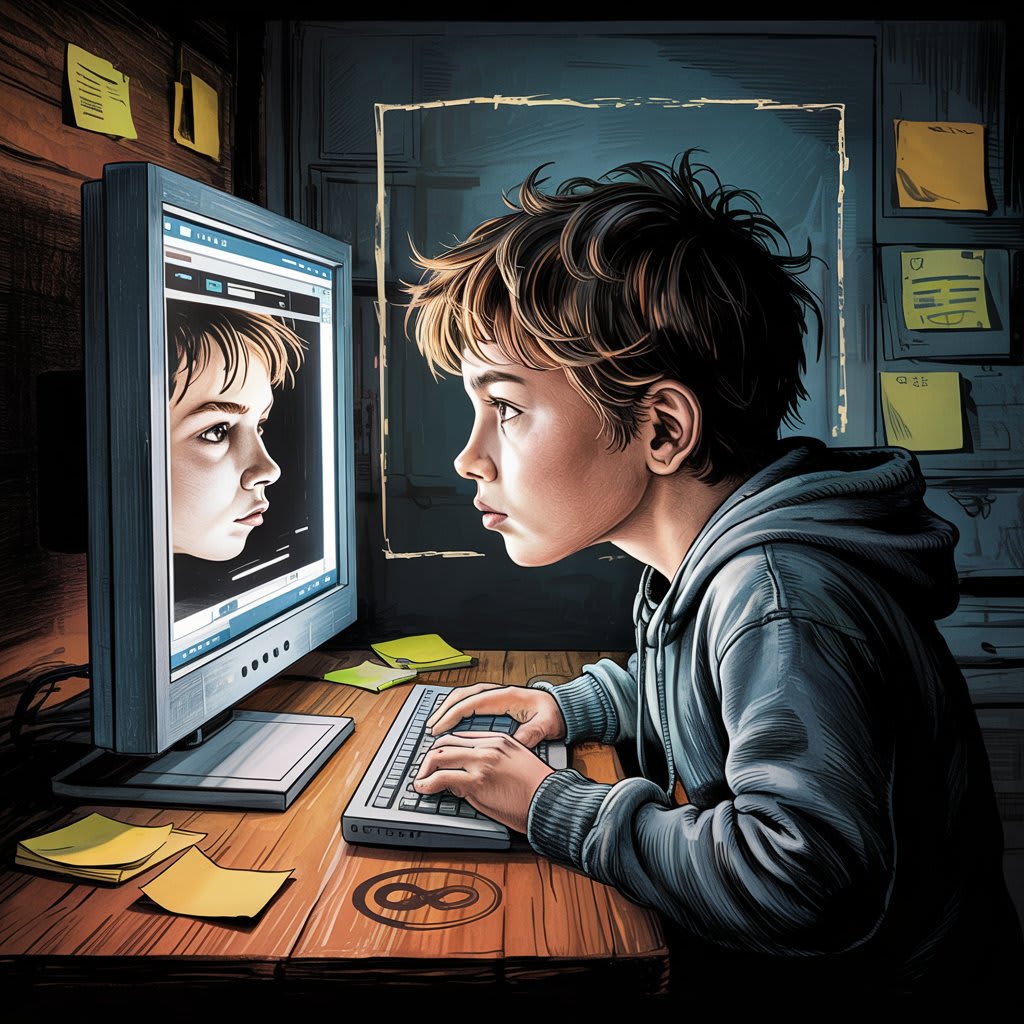
Ayaan was always the one who got things right. The star pupil, the one with a golden future ahead. His parents spoke of him with pride — their son, the future doctor, the future savior. He had always been on track, always the first to finish his homework, the one who would shine in every exam. Everyone expected him to be the perfect student, the perfect child. But there was something no one saw, a subtle shift that began creeping into Ayaan’s life, unnoticed by anyone except for the boy himself.
It started with a game.
At first, it was nothing more than a harmless distraction. Just a few hours after a long week of studying — a break. It wasn’t anything special. The kind of game you could get lost in, but only for a short while. He thought it would be a temporary escape, a way to wind down. Ayaan had been under so much pressure lately — the constant exams, the expectations, the endless push to be better. He thought he deserved it, this small indulgence, this moment of joy.
But then, the game started calling to him.
It wasn’t long before those brief moments of escape began to stretch. What had once been a Saturday night diversion became an everyday routine. Ayaan told himself it was okay, that he could balance it. He could study and game. He could be the same student, the same person who would ace the next exam while still indulging in the pleasure the game gave him. It wasn’t an addiction, not yet. It was just a way to relax, right?
But soon, the balance began to tip. The hours spent playing began to creep into his study time. A few minutes turned into hours, and the hours turned into entire afternoons. His grades didn’t drop at first. He still managed to scrape through with average marks, but something changed. He wasn’t really studying anymore. He was just doing enough to get by, to meet the bare minimum. It wasn’t the same. He could feel the tension in his body, the creeping anxiety that told him he wasn’t living up to his potential. Yet, when he picked up his books, the weight of them was too much. His eyes drifted back to the screen. One more match, just to take the edge off.
And that was where it started — that addiction. The game, in all its colorful glory, became his escape. It was his world, the only place where he could feel the rush of success, the thrill of progress. In the real world, the pressure was too much. His future was a constant weight on his shoulders. But in the game, he could start fresh. Every victory, every achievement, was immediate. It didn’t matter how much time he wasted in the real world; here, he could always win. The dopamine hit was instant, and it became his drug.
Ayaan no longer noticed the change. He was too deep in the game to care. His mind felt clearer, sharper in the game. But outside of it, he was dull. His friends began to notice the distance between them. They tried reaching out, asking him to hang out, to do something other than sit in his room, glued to the screen. But Ayaan always had an excuse. “I have a lot of studying to do,” he would say. “Just finishing this one thing.” But the one thing never finished. The one thing never ended.
He began to slip. The things that once brought him joy — hanging out with friends, reading books, even talking to his parents — lost their appeal. All he wanted was to play. His mind would race with thoughts of the game, even when he wasn’t playing. He would dream of his victories, of the satisfaction of leveling up, of achieving the next milestone. His grades dropped, not dramatically at first, but enough for his teachers to notice. His mother, who had always praised his academic success, became concerned. “Ayaan,” she would call to him, “Why don’t you take a break? Come eat something. You’ve been at this computer all day.”
But he didn’t want to. He couldn’t. The game had a hold on him. The real world felt like a burden, like a place where nothing was guaranteed. But the game, it was predictable. It was a world where everything could be controlled. Every second he spent away from it felt like wasted time. He couldn’t allow himself to lose that sense of control, that sense of achievement. So, the cycle continued.
Days turned into weeks. Ayaan no longer saw the sun rise and set. His room, once filled with the warmth of his family, became his fortress. The dark glow of the screen illuminated his face as he spent hour after hour in the game. He was barely eating. His clothes started to accumulate in piles on the floor. The weight of his responsibilities seemed like a distant memory.
And then came the moment of truth.
It wasn’t an event, a confrontation, or even a drastic failing that broke through Ayaan’s addiction. It was a single, haunting thought that crept into his mind one morning when he could barely keep his eyes open from exhaustion. He hadn’t slept in days. His head felt heavy, his body sluggish. His phone buzzed with a reminder — the biology exam was in two days. The exam he hadn’t prepared for. The one he was supposed to ace. But as Ayaan stared at his phone, all he could think of was the game. He couldn’t summon the energy to open his books. The thought of studying, of facing the mountain of material he had neglected, felt like too much. It would take too long. The game, on the other hand, promised instant rewards.
But something was different. He looked around his room, at the piles of discarded food wrappers, the clutter of empty cans. He thought of his parents, of the pride they had in him. He thought of his friends, who had given up on him. And for the first time, Ayaan felt a wave of guilt wash over him. Not because of his poor grades, not because of the future he was squandering, but because he had let something so trivial, so hollow, take over his life.
He sat there in silence for a long time, the room spinning around him. The game, the screen — they weren’t his salvation. They were his prison. And as the realization hit him, he felt the weight of it more than anything else. The addiction had not just robbed him of his time. It had robbed him of his future.
The next few days were hard. Ayaan was not used to facing life without the constant escape of the game. He felt lost, disoriented. But slowly, he started taking small steps. He pushed himself to study, bit by bit. It wasn’t easy. Every part of him screamed to pick up the controller, to lose himself in the rush again. But he resisted. Little by little, the fog began to lift. The books didn’t seem as heavy as they once did. He could feel his mind clearing, the obsession beginning to break.
It wasn’t a quick fix. There were relapses, moments when Ayaan felt the pull of the game. But each time, he became more aware of the danger it posed. He started seeing the world outside the screen again, and with it, the realization that life wasn’t meant to be lived in an endless loop of instant rewards.
Ayaan didn’t return to his old self overnight. But he learned something that would stick with him forever: that the greatest reward in life wasn’t a level-up, a win, or an achievement. It was the feeling of having control over yourself, of knowing that the real world, with all its demands and challenges, was worth facing head-on. That was the ultimate game. And Ayaan was finally ready to play.
About the Creator
Keep reading
More stories from Haad Khan and writers in Motivation and other communities.
Building a Self-Running System
Managing money doesn’t have to feel overwhelming, exhausting, or emotionally taxing. For most people, financial stress doesn’t come from a lack of self-control- it comes from not having a reliable system in place. When your finances depend on memory, motivation, and constant choices, errors are almost guaranteed.
By Emma Adeabout 21 hours ago in Motivation
Rachel Reviews: The Spiral Archive by Pieter Hendrik
It's difficult for me to know where to start with a review of this book as it was, for me, an entirely unique experience and one that I'll probably never have again. I don't want that to be interpreted as unenjoyable but it has left me scratching my head a little and ruminating on its content, its themes and its characters.
By Rachel Deeming4 days ago in BookClub



Comments
There are no comments for this story
Be the first to respond and start the conversation.